Let’s stop testing household products on animals!

Let’s stop testing household products on animals!

Let’s stop testing household products on animals!
02.05.2018
Europe
Let’s stop testing household products on animals!
Animal testing

For the third time in a year, One Voice calls on the Ministry of Higher Education, Research and Innovation about the issue of household product testing on animals, but they remain silent. The goal of the European Union is to completely replace the procedures involving the use of live animals.

That’s it, since Friday April 27th, Wallonia in Belgium, has put an end to conducting tests on animals for cosmetics, cleaning or hygiene products, etc. It is also committed to the implementation of a global plan for the gradual reduction of the number of animals used in laboratories and the development of alternative methods so that no animal is in the end used. This is part of a set of measures taken in the interest of the animals in the Belgian kingdom. This modernised animal welfare code assumes that the animal is a sensitive and sentient being.

The European Union is moving forward yet France stands still

In France, however, we have sent three letters to the Ministry of Higher Education, Research and Innovation since April 2017. We have requested that the toxicity tests of household products be banned on animals, in our capacity as a French association for the defence of animals, but also as French representatives of the ECEAE, principal European coalition campaigning on the problematic of animal experimentation. However, we still have no sign of life from the current Minister Frédérique Vidal, in fact the same as with Najat Vallaud-Belkacem before him.

The European directive on the protection of animals used for scientific purposes states, however, that the final objective of the European Union is the « complete replacement of the procedures applied to live animals for scientific and educational purposes ». We therefore urge our Minister to adopt a national plan for the effective implementation of the 3R’s (Replacement, Reduction and Refinement) rule so that in the long run, no live animals are used for experimentation.

Good practices that should be the norm

The techniques of experimentation on the animals are today quite obsolete, alternative methods are being developed and are quite effective. There is therefore no fundamental interest in making the animals suffer, the analysis of the ingredients being sufficient to determine the dangerousness of these products.

As proof, brands of cleaning products like Étamine du Lys, La fourmi verte, L’arbre vert, or Pure have already been doing this for a long time. Their product lines have also been awarded the One Voice’s humane label, guaranteeing the absence of animal testing either before or after their design. Effective products can therefore have an almost neutral impact on the planet, and have been designed without cruelty to animals.

We would indeed and definitely like that these good practices became the norm, and that no more household products sold in France come from the result of rabbits, cats, dogs, mice or even monkeys suffering from experiments … Only the political will to act is lacking. Our leaders must take responsibility regarding these sentient beings who, like us, feel pain and fear.

Does Pinder hang up his whip in the locker room?

Does Pinder hang up his whip in the locker room?

Does Pinder hang up his whip in the locker room?
30.04.2018
France
Does Pinder hang up his whip in the locker room?
Exploitation for shows

The Circus Pinder has cancelled several dates of performances (in May in Grenoble, Albertville, Valence …), and currently does not offer any dates for booking after April 2018! Is it – finally – the beginning of the end of circuses with animals?

According to the press, the circus has cancelled several dates of performance, and on its website, no reservation is possible after the month of April. A bystander told us what the circus told her, but from our side, having failed to reach the circus – all calls unanswered- we cannot confirm this information.

However, we can question this cancelled tour at a time when the legitimacy of the presence of the circus is questioned both by animal defenders and the public, who is turning more and more towards live shows without the exploitation of animals.

In any case, we are delighted that lions, lionesses, camels, zebras, donkeys, dogs and all the other animals of this circus are finally freed from the constraint of homelessness, from captivity in cramped cages, and from roadside car parks. When not touring, they live in a park, on the grass, in the Paris region.

$(document).ready(function(){ $(‘.diaporama’).bxSlider(); });

In several photographs of Jo-Anne McArthur, taken during our investigation last year, lionesses and lions show their fangs…

The big cats have visibly had enough of these constraints, the gaze from the crowds, these obligations, this life without freedom… in the constant contact of these humans, the sensitive ears struck by this thunderous music, eyes blinded by multi-coloured spot lights…

We also remember that it is very bad for the lions back to be ridden upon by a human animal like a moped, as does the trainer at every performance. It is not normal for a big cat or any other animal to obey a human primate, or to be stored as a tool in cages on the back of trucks. It is not natural either to be whipped and to obey under duress! No animal has to undergo such treatment.

And even if he were born in captivity, the need and the thirst for freedom remains unchanged!

While waiting to know more, demand circuses without animals!

Photos: One Voice/Jo-Anne McArthur WeAnimals

Tarpan and the ecological balance

Tarpan and the ecological balance

Tarpan and the ecological balance
29.04.2018
France
Tarpan and the ecological balance
Natural habitat

The tarpan is a wild equine, probably the ancestor of our fellow horses. Introduced in our countryside, it provides ecological management of natural territories. Their return is orchestrated by the association ARTHEN that supports One Voice.

The tarpan

Tarpan, wild horses descended from the primitive European horse that populated some parts of Eastern Europe until the 19th century. After their disappearance in the wild, their descendants were found among small horses used by local farmers. It was a Polish scientist, Professor Vetulani who undertook to save the species. Today, they live wild in several countries where they are recognized for their major role in the maintenance of grasslands. In the Netherlands in particular, they are found in herds of dozens or even hundreds living on reserves where they are able to find their original way of life. In France, first imported into Lorraine, they are present in a few small reserves, mainly located in the central-east of the country. (Source: Arthen)

The place of herbivores

No offense to hunters, but the merits of the presence of a species is not limited to a label “fair game » and the primary role of large wild herbivores is not to finish on a plate. Because, know it or not, herbivores are managers of the landscapes which, by their grazing, maintain the open areas like the meadows. Certainly, their populations must be regulated; but as Nature knows best, hers plans don’t include Sunday hunters, but instead natural predators such as wolves, bears and lynx. They don’t just kill the most beautiful specimens so they can hang their heads as trophies on their living room walls. They kill the sick or fragile thus participating in the health of an ecosystem in its entirety. To take full measure of this phenomenon, there is nothing else like the famous video from Yellowstone, illustrating the renewal of an entire environment following the return of wolves…

The usefulness of tarpan

The establishment of the tarpan populations in France has undeniable advantages. In contrast to sheep farming, they do not need sanitary treatments, which, when released back into the wild via excrement are the source of dramatic chemical pollution of the micro fauna. They are also naturally resistant and do not need shelter or food supplements. They are wild animals therefore autonomous, independent of humans and with a high added value for the environment. In other words, they are natural managers of ecosystems; the only ones to be able to maintain or participate in the return of a sustainable balance, beneficial to biodiversity.

To act

One Voice supports the return of large herbivores such as the tarpan in France. It represents a major challenge to our society which only sees a species directly useful to humans if they are beneficial. Unlike extensive farming or pastoralism, which are not as ecologically friendly as we would like to believe (in addition to medical treatments, herds are also destroying vulnerable areas by trampling over them); only naturally regulated wild species are truly respectful of nature.

The Arthen association is raising funds today to build a new park in Bugey to accommodate a new group of tarpan. This natural area is “dry grassland » in the process of becoming brush wood because the land was formerly grazed and has now been abandoned for several decades. Tarpan can contribute to maintaining the ecological interest of this environment, which contains a particular flora and fauna: orchids, butterflies and shrike, etc.

Firstly the area must be fenced off and some adjustments made such as water points and a round up area. One Voice supports this project and hopes that many of you will mobilize to make it possible. To learn more and make a donation, go to Ulule.

Photo credit: © Arthen.

American Mustangs, the last of the free horses

American Mustangs, the last of the free horses

American Mustangs, the last of the free horses
28.04.2018
Etats Unis
American Mustangs, the last of the free horses
Wildlife

Subdued, trained, domesticated horses surround us. In each of them, however, vibrates the deep soul of the last free horses, the wild Mustangs of the American West. These proud beings, returned to the wild, must be protected.

Fear

Fear enlightens his big dark eyes and runs through the surface of his body long nervous shivers that make his shiny flanks shudder. To the east, in the distance the cry of a hunting puma echoes through the night. The wind has not yet carried their smell to the nostrils of the puma, but the wind can turn, it’s only a matter of time.

The oldest among the mare’s snorts. She raises her head, neighs shaking her mane and then gets to work. We must leave the pasture very quickly. All follow her at a trot, because they know that fear gives birth to the right choices. For the Mustangs, life is flight. Fear is wisdom. And this mare carries it in her.

The small herd goes up to a plateau

The wind blows hard, the grass is scarce. Dominated by the snow-capped peaks of the Rockies, Montana’s valleys are scattered far and wide around them, scoured by rivers, canyons and lakes, covered with woods and meadows. Drawing in silhouettes on the setting sun, several males follow the herd at a distance. They are teenagers chased out of their group, who roam the plains in search of mares to seduce and herds to be established.

A beautiful stallion with a white coat and dappled in black, who protects the herd does not hear it that way. Under the passionate eyes of the females, he approaches his first rival, a proud young chestnut and who sizes him up, chest against chest. Side by side, the two males engage in a sort of highly practiced dance, lifting the dust from the ground with great hooves and standing face to face on their hind legs. The tall dappled stallion steers his opponent away without fighting or biting, while the young male gallops off with his companions with an air of misfortune.

A long time ago, these colourful horses arrived from Europe, in the holds of the Conquistadors ships. 

Some escaped and went wild again. The Cheyenne and the Sioux then captured them and gave them great respect. After the massacre of the Indian nations, horses were free again and some of them are still free today. It did not take long for the memories of humans to fade from their minds and their old manners to return to them as from the beginning. During the unions that are freely decided between male and female, their coats have donned all the colours of the rainbow and their bodies have become smaller, strong and fast in harmony with nature. Their hair is thicker, to counter the ferocious winters of the north-western United States.

Head bent over the grass but ears erect, six adult mares graze alongside the stallion who returns and calms down. It’s up to them to think, to take care of the young and to take care of the good management of daily life. The oldest is responsible for deciding departures and moments of rest. On this point, everyone trusts him, the stallion like the others.

Tonight, everyone will sleep standing in the field of wild grasses. The cougar has moved away but the threat remains and we must stay ready. Tomorrow, when the sun rises again, the small herd of Mustangs will set out again to other hills, other water points, other softer and tastier pastures.

This world of extreme vigilance, common to herbivores, is however a happy world. How peaceful are the days when one dreamily grazes the slopes of a green hill, while watchers watch over them! May they be sweet, those moments of love when the foal of the year comes to push his muzzle against the teat to feed from milk so good!

Peaceful beings, without borders, without territory, that of wild horses.

They are constantly going where the seasons lead them. But today, there are few places where they can still live without the saddle, bit, halter, lanyard or reins. Wherever they live, they are hunted, killed, eaten, captured, and trained. Only the mustangs in the United States remain, the brumbies of Australia, which are shot from helicopters, and some semi-wild herds in the Camargue. With Przewalski’s horses and the genetically reconstituted Tarpan, they are the last free horses on our planet. The only ones in which we can still sense the deep soul of our own slave horses…

Two prefectures abandon night shootings of red foxes

Two prefectures abandon night shootings of red foxes

Two prefectures abandon night shootings of red foxes
26.04.2018
France
Two prefectures abandon night shootings of red foxes
Wildlife

Two draft prefectural decrees, in Meurthe-et-Moselle and Aube, to allow night shooting of red foxes has been abandoned. The numerous participations concerning public consultations has paid off and the developed arguments have won the battle! Several hundred foxes and their young have been saved. This is one more step towards the rehabilitation of this animal so intelligent and sensitive, victim of a terrible reputation.

In February, several public consultations were launched by prefectures in eastern France, with a view to adopting orders authorizing night shooting of red foxes. We had asked you to stop such orders of the planned « levy », in other words the stalking and hunting of more than 500 foxes in the departments concerned.

Yet these small canines feel emotions, are sentient beings, and intelligent. They live in families, and have a very rich subjective life, we witness the place they have taken over time in our stories for children and in our imaginations. Their ingenuity and liveliness has been remarkable to be hold in the eyes of humans for centuries.

The false arguments of hunters revealed in the light of day

The Renard Grand Est Collective, of which One Voice is a part of, had raised contradictions and false arguments in the reports of the federations of hunters that prompted the writing of these decrees. A solid and reliable argument had been prepared on the basis of the legitimate criticisms raised by these draft orders.

In Meurthe-et-Moselle, the hunters had convinced the prefecture that the hares were in danger because of the foxes, and required the shooting of 500 of them. Not a contradiction, the same federation of hunters required the « levy » in parallel with 1500 hares in the same order. The figures in their report were very questionable.

In Meurthe-et-Moselle as in the Aube, the fox still crystallized all the irrational fears around illnesses, whereas its presence prevents in particular that the Lyme disease – of which voles are carriers – spreads at high speed, likewise for alveolar echinococcosis …

We are still waiting for the summaries and analyses of the Moselle and Ardennes consultations, but the renouncement of the Aube and Meurthe-et-Moselle prefectures is very encouraging! In Meurthe-et-Moselle, 62% of the opinions filed were against the draft order, they were 96% in Aube!

The red fox indicative of irrational fears

What our contributions to all of this has shown is that the red fox is once again considered as the source of all evils, the scapegoat of humans …

If the partridge and hare populations need to be « restored », it would be much more effective to remove them from the list of huntable animals. Protect their habitat by ceasing to cut back ever more forests to put in place intensive agriculture with the application of pesticides or the building of shopping centres.

Foxes regulate their population in accordance with their habitat and the presence of food available, so it is useless to hunt or trap endlessly! These poor animals are considered during the entire hunting season as game and the rest of the year they are considered as likely to cause damage. This allows for their trapping and even their unearthing, regardless of their age, which means that babies too can be slaughtered!

Opinions matter, let’s keep taking action!

Thank you for your mobilization!

If sometimes the opinions of the public and animal advocates are swept away, this time the two consultations were taken into account as they should. The arguments of the public were based on a scientific, technical and very precise basis, in addition to highlighting the highly sensitsive nature of these wonderful beings.

So, let’s always be vigilant, and let’s get ready to write at the next opportunity, to defend the foxes! To make them disappear from the list of species likely to cause damage, please continue to sign our petition!

Maya kept on the road; it is with impunity that the circus does this

Maya kept on the road; it is with impunity that the circus does this

Maya kept on the road; it is with impunity that the circus does this
19.04.2018
Europe
Maya kept on the road; it is with impunity that the circus does this
Exploitation for shows

Maya is still on the roads of Europe, in the dark truck trailer of the circus that has held her for decades. The lack of response from the administrative tribunal in the form of the rejection of our second appeal, and the silence from the Prefecture do not say anything good about the state of our society vis-à-vis the evident suffering of captive wild animals.

A Prefecture that has become mute

In her letter addressed to the circus at the beginning of March, the Prefect asked that he transmit to her within a fortnight the fixed place in which he intended to allow Maya to live. Knowing now after the veterinary expertise that she had ordered at our request had concluded in particular that « considering her advanced age, Maya requires a stable environment”. Conditions with longer breaks between shorter journeys. Against all odds, while the exchanges were maintained with the Prefecture, and since the deadline for the notice of the Prefecture to the circus has been exceeded, we no longer get answers. On the side of the state services, its radio silence!

An administrative court which considers that the facts are insufficient and that the State has already done enough.

The Administrative Court, for its part, says it has no proof that Maya is worse than in October 2017 according to our first appeal. He even considers that we cannot blame the Prefecture for remaining inactive or not having taken the necessary measures and ordering the expertise we have been asking for months. For him, the state of Maya has even improved, since she was seen by a veterinarian who removed an abscess of the hindquarters, and she spent some time (we do not know how long) in her « winter quarters.

Arielle Moreau, a consultant lawyer for One Voice, comments: « If lawyers began their careers with the defence of captive wild animals, it’s a safe bet that they would quit very quickly as it is so demoralizing! And this, coming from the law where we obtain the least favourable decisions, despite all objective elements that confirm situations of mistreatment and acts of cruelty”. Despite this passing disappointment, we do not intend to leave Maya in this situation.

It would be inconceivable to abandon Maya to this sad fate.

New steps will be taken to end this life of homelessness and suffering that has been imposed on Maya. We will provide real-time news of these actions.

Again more and more dogs are being supplied to the labs … Let’s close down the breeding farm instead of enlarging it!

Again more and more dogs are being supplied to the labs … Let’s close down the breeding farm instead of enlarging it!

Again more and more dogs are being supplied to the labs … Let’s close down the breeding farm instead of enlarging it!
19.04.2018
Mézilles
Again more and more dogs are being supplied to the labs … Let’s close down the breeding farm instead of enlarging it!
Animal testing

A laboratory dog breeding farm that we follow closely is today trying to legalize its expansion. Breeders are waiting for the government to relax the number of dogs allowed. We are asking the Prefect for the closure of this farm. Animal experimentation must diminish, and not increase, as we still see sadly. It is the alternative methods that must be encouraged!

Breeding and experimentation is the cause of suffering upon suffering.

The breeding of dogs in Mézilles in the department of Yonne provides dogs for laboratories. To our knowledge, and according to available figures, it is the largest breeder of this type in France.

In this place, up to 500 Beagle and Golden Retriever females are put through an endless breeding program for many years. Their little ones are torn away from them to undergo experiments. And once these breeding females are sick or too old, they are also sold off alive or slaughtered and then sold in pieces, exploited even in death.

But these are sentient beings that live there! For the overwhelming majority, they are the dogs that see the light of day … the day light that they will see is still after all too short!

Whether in the breeding program or in the laboratories, the place of life for these gentle beings is a place of detention where no consideration of their well-being is spared. Here there is little comfort, no attention is paid or caresses given, crammed into courtyards or in cold boxes.

Several times a week without respite, specially chartered vans take them from the farm to the laboratory benches, and to their « animal house ». These particularly social dogs are then separated from their companions, sisters and brothers. Once there, they are often locked in tiled pens, they will no longer see the sky, and will undergo tests until death takes over some of them.

Some may even be fattened up, made obese to better test bariatric surgery techniques. Others may have broken bones, for the study of prosthetics, females may undergo abortions and forced caesarean to dissect the pancreas of their puppies…

If experimental dogs live the worst of the ordeal, then what of other animals?

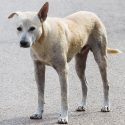
In France, dogs are among the most protected animals of all, thanks to their status as pets. However, laboratories are using them increasingly more to experiment with toxic, irritating, dangerous products, to test new surgical techniques, or to dissect parts of their bodies. European law stipulates that the use of animals for animal experiments must be reduced, refined, and replaced (the 3Rs) by alternative methods, such as computer simulations, cross-referencing the results of other past experiments, or even in vitro stem cell experimentation… However, these methods struggle to impose themselves as they should. Researchers do not invest enough in their development, even as the evidence accumulates on the certain obsolete protocols and health scandals related to drugs tested on animals (as for example, the drug Mediator).

So if the Beagle and Golden Retriever dog, that is so gentle, so cooperating and loving towards humans, are bred and used in increasing numbers to undergo often cruel treatment in the hands of scientists, what then for animals lesser protected by the law, such as monkeys, rabbits, rats, mice, guinea pigs and hamsters…?

Where are they taken? Who are these laboratories that « consume » dogs in such great quantities?

A political will must assert itself!

A request for regularization that questions

Last September, we met the chief of staff of the prefect of Yonne. We had presented our report on the beagles and asked them to consider our request to close the breeding programs. It is not by perpetuating and expanding the fostering capacity that we will see the end of animal testing.

The notice published mentions the size of the facilities, the evacuation of the fluids, in appearance, just the technique. But looking closer…

In Mézilles, the inspection counted more than 1500 dogs including 1300 over 4 months old, while the authorization is only for 500 adult bitches. Breeding, which does not seem to meet the standards, would therefore require a regularization of the previous authorization. Fifteen years ago we had investigated this farm, and then we handed over 350,000 signatures to the Ministry of Research to demand the ban on experiments on dogs and cats.

Will the state still decide in favour of the powerful animal experimentation lobby or will it finally take stock of the issue of animal suffering, and stop maintaining an out-dated system?

Actions taken by One Voice

The notice of inquiry was published on March 23th 2018, for 30 days. On April 18th 6 days before the close, there was still no public comment in the investigation registry. Maybe they hoped to go unnoticed…

We urge you to write before April 24th to enquete-publique-649@registre-dematerialise.fr against the expansion of this breeding program of dogs dedicated to animal experimentation!

We wrote all our technical objections to the investigator on the application for regularization of the breeding program, and write to the Prefect. If the suffering of dogs intended for animal testing does not affect the hearts of the authorities, we hope that they will hear at least our arguments concerning the risks and impact on the environment due to the large concentration of dogs.

We are also calling for a big gathering in front of the Yonne Prefecture in Auxerre on June 9th at 2 pm, and we invite you to sign the petition that we will give to the Prefect. For all the experimental dogs and animals, thank you for your mobilization!

The rabbit, exploited from its hairs to its eyes

The rabbit, exploited from its hairs to its eyes

The rabbit, exploited from its hairs to its eyes
17.04.2018
Monde
The rabbit, exploited from its hairs to its eyes
Animal testing

The exploitation of rabbits is limitless, they are not given any respite … One Voice fights for them, facing hunters, laboratories, furriers and breeders of angora.

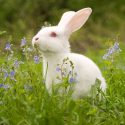
The real life of rabbits is to dig burrows in the side of hills, nibble clover in bloom and make great leaps across the meadows. Their real life is to fight or cooperate with other rabbits, in large warrens, to warn them of danger by thumping the ground or to nurse in the evening a litter of newly born. Simple pleasures of existence, which humans deprive them of.

This fluffy animal, charming with its long ears and pompom tail, our people’s stories for children and of our mythologies. Some even see it drawn on the moon. Everyone loves rabbits. And yet …

We hunt them

The rabbit is « extremely cunning, » according to the hunters. Equipped with a 360 ° field of vision and always on alert, he escapes as soon as he perceives the slightest anomaly in his environment. He will exploit the smallest bush, the most unlikely elevation of terrain, to fadeaway as if by magic, in sight of his pursuers. Sometimes it suddenly pops back up between the hunter’s boots, before spinning back into the cover of the woods. The rabbit has developed tremendous physical and cognitive abilities to escape death.

The pleasure of killing is thus increased in these hunters due to the vivacity of their prey which they track down with their dogs. But not only this: there is also the hunt with packs dogs, where « the ardour of dogs that lead loudly after an elusive animal and the ruses deployed by the rabbit offer an incomparable pleasure » (sic). Then there is snaring, beating, hunting – with basset hounds – and ferret hunting, to the bottom of the burrows. So much so that the species is disappearing in certain places of Europe, depriving the food of its natural predators, like the lynx, and thus unbalancing the whole ecological equilibrium of a region.

One Voice advocates for the protection of wild animals in France and for the abolition of the black list for « pests », on which sometimes appears the rabbit.

We torture him in the laboratory

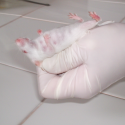
Every year, nearly 1.5 million rabbits die in laboratories, after horrific suffering. Since the rabbit does not secrete tears, making it impossible to expel any irritant, it is frequently used for the painful Draize test. The head held in a yoke, his eyes are kept open by metal clips. A chemical is then deposited into his eye, to observe the irritation of the cornea and other physiological damage that the substance may cause. The toxicity of herbicides, household products or beauty products is thus measured … for weeks! The rabbit is also exploited for its sensitivity to teratogens, which causes them to create monsters.

During one of its investigations into a laboratory, One Voice was able to film rabbits kept in restraining boxes. A product was injected into their ears and fever was thus triggered and measured. They underwent several tests in a row. Their veins were in such a bad way that they screamed in pain when their blood was drawn. With its clothing labels, its surveys and its participation in the development and promotion of alternative experimental methods, as well as the evolution of a legislative framework,

One Voice battles towards the end of animal experimentation

We eat them

Rabbits have long been raised in hutches. Occasionally, they could walk in a corner of the backyard, or even nibble at the lawn whilst in their mobile hutches before having their necks broken in the yard of the farm.

Today, the norm is battery breeding. Thousands of rabbits are enclosed in wire-cage cages the size of a sheet of A4 paper. The ceiling is very low and prevents rabbits from leaping, which induces a deep malaise and stereotypical behaviour. Females are inseminated artificially at a steady pace. Quickly separated from their young, they then have another litter a few days later. When they reach the age of ten weeks, the rabbits are then piled into trucks heading to the slaughterhouses. The unfortunate will be hooked by the hind leg on a slaughter line, more or less stunned with electricity, then slaughtered, skinned, bled and carved up.

One Voice works to develop an evolution in our lifestyles towards a more humane diet

We skin them

The trade in rabbit skin has never been so good. Fashion is fur and rabbits are not expensive. In France, some 70 million rabbits are killed each year and their skin sold. It’s not just a by-product of the meat industry, but rabbits are bred and raised for their soft fur.

One Voice fights the exploitation of animals for their fur in France and around the world

We tear out their hair

The angora rabbit is only raised for the production of its hair, a very sought-after textile fibre.

Angora hair can be compared to cashmere, mohair or alpaca. From the age of two months, the angora rabbits are isolated in individual cages, because the cohabitation with other rabbits would cause a felting of their fleece. At regular intervals they are shaved. Attached to a table, the hairs are brutally torn off by the hand full, until they are almost naked in their cages, trembling with the cold and fear. The survey, conducted by One Voice in several of these farms in France, highlighted the pain of these rabbits who cry out when they are epilated. Often, some skin is also removed with the hair…

One Voice lobbies for the ban on the breeding of angora rabbits and trade in their wool.

Support our campaigns for rabbits, against the cruelty and persecution they suffer in nature, laboratories, and farms for their flesh, their fur or their hair.

Help Elyo, a circus lion covered in wounds

Help Elyo, a circus lion covered in wounds

Help Elyo, a circus lion covered in wounds
13.04.2018
France
Help Elyo, a circus lion covered in wounds
Exploitation for shows

A lion covered with wounds sufferers in his truck. We identify him as Elyo, he is the brother of Chirkane, the rebellious beast who assaulted his trainer in front of an audience during a show last year. We ask for his immediate removal, we are filing a complaint against the circus for acts of cruelty, both for Elyo the lonely and wounded lion and as well for the other animals which are also in very bad condition.

In lions, the brothers always team up together. When they leave their mother behind, it is in a group that they go on an adventure, never alone. And like Cecil, it is between brothers that they found a home and protected it from other males. At the circus, none of this is possible: the cubs are removed very young from their mother, any adventures are made in a truck and when a lion begins to behave like a real lion, it disappears.

Chirkane, like Tilikum among the wild beasts, had also assaulted his trainer on May 7th in Doullens, in front of a crowd of children who were petrified by the horror.

Where is he today? « In a zoo, » says the circus without specifying which one, while at first mentioned “wrongfully » that the lion had been put down. Or nowhere in the eyes of his brother, for whom Chirkane is dead… We intend to shed light on what happened to Chirkane. Without the companionship that he loved and a shoulder to lean against when Elyo fell asleep, his loss has real meaning. He is now all alone in the living hell of the traveling show which is the life of captive circus lions and this is from the cradle to the grave.

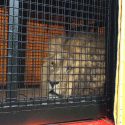
So yes, « this lion has been in very low spirits since he lost his companion, » according to that of a circus girl who was interviewed on video by the activists from « North is for circuses without animals » and « CLAC-Collective of Liberation of Animals in circuses« . During the passage of this circus through a small town in the Hauts de France, they discovered the big beast in very bad condition, at the bottom of his barred cage. His nose was damaged; temple, forehead and his eye brow bore multiple lesions.

The other animals also looked in bad shape. The pictures show us their dull, damaged coats, besieged by parasites. Some of them are extremely thin, while others – the so-called « domestic » herbivores – are attached within reach of hands on the bare lawn of a terrace in the city centre.

One Voice is indignant to the fate of these unfortunate animals and lodges a complaint against the circus, demanding immediate withdrawal of the wounded lion. We also ask the Prefect to make every effort to seize Elyo from the circus and we also propose to take charge of him. Finally, we write to the mayor of the city demanding him to ban circuses with animals in his commune and hoping that the exhibition of such miserable animals will make him fully understand the cruelty of this obsolete attraction. More than ever, One Voice is committed against the exploitation of animals in circuses!

Photos: The North is for circuses without animals