New investigation: Jumbo and his miserable companions still locked up in the Muller Circus

New investigation: Jumbo and his miserable companions still locked up in the Muller Circus

New investigation: Jumbo and his miserable companions still locked up in the Muller Circus
06.04.2022
Bouches-du-Rhône
New investigation: Jumbo and his miserable companions still locked up in the Muller Circus
Exploitation for shows

Since our appeal was delivered last February, our investigators have returned to see how Jumbo is getting on in the Muller Circus in Vitrolles. Since the beginning of March 2022, therefore, we have filmed in him the lorry with the doors half, but never fully, open. As always. And once again, the pool was full of dirty water and thereby inaccessible. Until the last day arrived when he was finally able to get out of the lorry for a few minutes. Our complaints are ongoing. Jumbo remains in the circus.

Our fight to save Jumbo from this hell in prison is a road strewn with pitfalls. Between those who do not want things to change and those who are convinced of the legitimacy of locking animals up for entertainment, captive animals sometimes seem to have few allies. However, for more than twenty years the circus tents have been empty, with many circus artists choosing to stop exploiting animals. We can help them in this process. We are partnered with sanctuaries in France and Europe but also in Africa and India.

In any case, anything is better than settling down or sending animals abroad to better continue exploiting them! Or worse, slaughtering them to sell them to taxidermists in anticipation of the legislative implementation decrees on animal mistreatment that has been voted in but is still pending without these essential laws.

Rare images, the big picture never shown

The monkeys, tigers, and Jumbo are enclosed almost all of the time. The tiger cubs, without their mother, are entrusted to a lioness… The only event that breaks their boredom is the show and its poor and humiliating acts, for just one of the monkeys and the tigers and under the permanent threat of props to coerce them three of four days a week. The rest of the time and for the rest of them, it is bars, chains, looks, noise, whips… How can they stay in good health like this? Animals who require so much exercise. And for the tigers, so much solitude; and for the hippopotamuses, company.

Our images, unpublished, bear witness once again to the fact that the animals are shut in day in, day out. They reveal what we cannot show from the ground because the circus artists stand guard, and it is better not to rub shoulders with the Mullers… Many peaceful activists have paid the price, just as forces of law and order have by trying to enforce a court decision.

Our ongoing procedures

Our appeal, started by the Association in February 2022, will determine whether the Muller consorts can be granted a reimbursement of their lawyer’s fees and will take action in supporting a State brief that on one hand does not exist, just as on the other, will determine whether the Prefect is empowered as an administrative authority to proceed with the withdrawal of the animals placed in conditions likely to cause them suffering. Because if the Prefect is not authorised and the courts close the associations’ complaints, then who is responsible for the protection of the animals?

Since then, the association has submitted a new request to the Prefect and then to the administrative court, in view of the Mullers’ criminal convictions, to request the withdrawal of the opening permits and of the proficiency certifications of these incompetent owners. The proceedings are still underway.

Finally, a new complaint filed for non-conformity of the conditions the hippopotamus is being kept in has led to a criminal mediation to which the Mullers have not deigned to respond. The file went back to the Valence prosecutor’s office for further action.

We will never give up the fight for the animals in this circus and for Jumbo in particular. Sign the petition!

Translated from the French by Joely Justice
Badger digging in Gironde: hunters and the Prefect dismissed

Badger digging in Gironde: hunters and the Prefect dismissed

Badger digging in Gironde: hunters and the Prefect dismissed
05.04.2022
Gironde
Badger digging in Gironde: hunters and the Prefect dismissed
Wildlife

In May 2021, the Gironde Prefect authorised hunters to benefit from a substantial additional period to dig out badgers. We have challenged this decision. The Bordeaux Administrative Tribunal has just cancelled this decision, ruled as illegal and dangerous for the replenishment of the population.

Hunters cannot get enough and keep asking for additional opening periods, mainly to kill the young who are not yet weaned. On 7 May 2021, with flagrant disregard for the Environmental Code, the Gironde Prefect gave them the possibility to go and dig out badgers between 15 May 2021 and 14 September 2021. To avoid this carnage, we had immediately filed an urgent appeal. The tribunal rejected our request, suggesting that the Prefecture had managed this activity sufficiently and that underground hunting with hounds in Gironde had no impact on the badger population. And yet…

A recurring scenario throughout France

In the documents that the hunters submitted to the Tribunal, we read that badgers having no natural predators will cause damage to crops and crashes on the roads. They therefore proposed to eliminate them and thereby ‘do a favour’ for the population who did not actually ask them for anything! We see this hypocritical rhetoric is well-oiled and this terrible scenario is replayed throughout France. Just as in the Morbihan, Saône-et-Loire, and Ain departments, where badgers are in danger of death each time.

For the simple pleasure of the hunters

Both in Gironde and elsewhere, the prefects rely on the data provided by hunters to justify their decision. As well as the method being debatable, this data lacks precision. What is the damage caused? Has it really been done by badgers? If yes, where? How much? What is the real impact? The Prefecture has not correctly justified their decision to arrange this additional hunting period.

And our question is: who is going to control the hunters? How can we know what collateral damage they commit, particularly in protected species? There must be an independent hunting policy and a radical reform on these barbaric practices for this. We are far from it. Our investigation proves it. Underground hunting with hounds is particularly violent, synonymous with a cruel death for, among others, young badgers.

A victory pointing to unlawful procedures

With this victory, we have not been able to prevent the massacre of badgers in Gironde in the summer of 2021. But the Bordeaux Administrative Tribunal’s decision has the merit of highlighting the processes of hunters who constantly want to lengthen the hunting season in all ways possible. Yes, this decision states that the hunters’ kills are in fact illegal, in collusion with the government services. It warms our hearts and provides additional arguments for future fights in favour of badgers.

You can continue to sign our petition for a radical hunting reform, which includes the abolition of underground hunting with hounds!

Translated from the French by Joely Justice

A total crisis for badgers in Morbihan

A total crisis for badgers in Morbihan

A total crisis for badgers in Morbihan
01.04.2022
Morbihan
A total crisis for badgers in Morbihan
Wildlife

In Morbihan, a prefectural decree threatens to increase the period for hunting badgers with hounds from 15 May to 14 September. Together, we can stop this massacre. We are calling on all those who oppose this cruelty to rally together and to respond to the public consultation. We have until 15 April to do so.

At the beginning of May, badgers poke their snouts out of the nest. Aged around eight weeks old, they are still feeding from their mothers and like to play in the fresh grass. Their lives have hardly begun. Will they be stopped dead by the pickaxe blows of the Morbihan hunters? In this department, the government services, once again under the influence of the Federation of Hunters, in effect plan to increase the authorisation on underground hunting with hounds for an additional period from 15 May to 14 September 2022. A public consultation is online, open until 15 April. We are therefore invited to comment on this announced massacre. Let’s do it.

Lethal practices for many animals

This time, the Prefect is not imposing his decision arbitrarily and is submitting it to public consultation. Perhaps because last year he was unsuccessful and was dismissed by the administrative tribunal. To justify five additional months of hunting, hunters are alluding to the damage caused by badgers on agricultural crops. The argument does not hold up. It is absolutely not necessary to kill animals to protect plants: fencing and olfactory barriers are a solution. Especially as these barbaric practices are not only lethal for badgers: wild cats, otters, or bats (equally protected species) also pay the price. Additionally, destroying badgers in the month of May puts the replenishment of their population in danger.

France lagging behind its European neighbours

Particularly violent, underground hunting with hounds involves letting dogs into badgers’ tunnels to drive them out. Brutally seized by their claws, they are shot down. Underground, dogs and badgers engage in real fights, which the dogs also come out of injured. Our undercover investigation bears witness to this.

Europe, the United Kingdom, Spain, Portugal, the Netherlands, Belgium, Luxembourg, and even Switzerland have banned underground hunting with hounds. Why not in France?

Our actions have already allowed great victories for badgers, recently in Saône-et-Loire where we managed to get a similar decree suspended, as well as in Ain where we won the case.

It is now time to lead from the front for the Morbihan badgers. We are inviting the government services in this department not to give in to pressure from a minority of hunters defending their antiquated hobby. We invite you to consult our article on the arguments that can oppose this type of decree and to reformulate them with your own words. Together, let’s take on this public consultation and fight to protect wildlife and for respect for animals.

Translated from the French by Joely Justice

Animals in the Franco-Belge Circus still being exploited…

Animals in the Franco-Belge Circus still being exploited…

Animals in the Franco-Belge Circus still being exploited…
01.04.2022
Ain
Animals in the Franco-Belge Circus still being exploited…
Exploitation for shows

For months, reports have been coming in thick and fast concerning the Franco-Belge Circus that we went to visit just two years ago in Milly-la-Forêt. On 1 March, they were in Villelaure, in mid-February in Digne-les-Bains, and last summer in Villefontaine, Tour du Pin, or even in Meylan. Once again, this time on the outskirts of Bourg-en-Bresse, the public are rising up to see animals behind bars, shut in lorry-cages, and having to perform destitute acts on stage under coercion. We need you to write to the town’s Mayoress!

On Thursday 31 March, the Jackson Muller Circus was reported to have been in Ain, in Péronnas, a small town neighbouring Bourg-en-Bresse. In addition to ‘classic’ domestic animals, ponies, and camels, the Circus also exploits zebras, monkeys, lions, and tigers, including a white tiger (a ‘loss leader’ for circuses, always fond of novelties) coming from a cross-breed which carries a genetic disease often leading to these animals having sight, respiratory, and cardiac issues…

Stressed animals who are intensely bored and a danger for locals

The footage filmed by the whistle-blower shows that the tigers are going round and round in the lorry-cages, a symptom of discontent linked to being kept in captivity. Indeed, in the wild, wild animals can remove themselves from everyone’s sight and keep moving as they see fit.

Additionally, the Circus does not guarantee any surveillance of the animals, even though they represent a danger for anyone who does not respect the barriers or signs.

A law still not in force

The decrees for implementing the law on animal mistreatment in relation to travelling circuses are not always published. Yet the deadlines voted on and written in by law are already long before the ban on reproduction (two years) and on straying (seven years). But they will only take effect once the said decrees are published. It is high time that the mayors, independent from the government in power (contrary to the prefects), forcefully get their point across. They can act and no longer allow it to happen by refusing to welcome these mobile establishments of suffering in their area.

The shows start from this Friday 1 April and will take place until Sunday. Let’s all write en masse to the Mayor of Péronnas so that we can ask her to no longer welcome circuses that exploit animals.

Address and email for the town:

Mairie de Péronnas
Place de la Mairie, BP 20
01960 PERONNAS

Contact form

Example letter/email:

For the attention of Madame Hélène Cedileau, Mayoress of Péronnas

Dear Madame Mayoress,

I am outraged that your local authority welcomes a circus into our area which exploits animals, among which there are wild animals, whose place is not in lorries, submitting day after day to the terror of training, a lack of privacy, and travelling.

The Franco-Belge Circus, currently settled in Péronnas, exploits tigers, which are largely solitary, as well as lions which in the wild rule over areas that are hundreds of square kilometres. Monkeys and zebras also need to live in natural spaces and not behind bars or chained up, being threatened with a whip. The place for circus animals is in sanctuaries, not behind wire fences on display to everyone, nor under spotlights, harassed by cheers from spectators or circus artists’ blaring music.

Not to mention the great danger that these animals represent for locals, knowing that no surveillance is guaranteed by circus staff.

I ask that you accept my warmest wishes, in the hope that in the future you will not renew the authorisation for the Franco-Belge Circus to set up in your town, nor any other circus keeping animals; in the hope that you will also speed up a visit on site from the French Office for Biodiversity (OFB) or, in the absence of this, the DDPP, before they depart.

Signature

Translated from the French by Joely Justice
One Voice’s rescue mission for Ukraine’s cats

One Voice’s rescue mission for Ukraine’s cats

One Voice’s rescue mission for Ukraine’s cats
26.03.2022
One Voice’s rescue mission for Ukraine’s cats
Domestic animals

Since 24 February, our teams have been taking action alongside our Ukrainian partners within European and international coalitions that we are part of. Stunned by the start of the war but aware of the danger for the animals — who would inevitably suffer in shelters in the short-term, to a certain extent, from rationing or even starvation, in addition to the risk of bombing — we have offered our help immediately. And when our Ukrainian friends under attack accepted the help we were offering them, we were there.

In the first weeks, the violence of the combat very much moved those in France as it did everywhere throughout the European Union. The generosity of French people was in abundance. And we can see, as can everyone in the media, the exile of millions of Ukrainians, their animals in rucksacks, refusing to leave them behind, while in France the return of the good old days and the lifting of health restrictions raised fears of the first abandonments…

Drawing by Pascal Vaucher de la Croix and Chatal Teano for One Voice – Noé 103

During exchanges with our Ukrainian colleagues, we learnt that numerous monetary donations and donations in kind have been collected, but that their main problem was not either food or money, but transport from the Polish border to their locality in the middle of the country. We are desperate to be able to help them. The support group has been established: the ‘Animals from Ukraine Task Force’ was born, regrouping NGOs from all European countries including One Voice on behalf of France.

Three weeks after the start of the war, it was finally possible to go there to secure the sixty or so cats from the UAnimals refuge, and to prepare for the unexpected, inherent to these situations. We still need to find a place for these animals to stay. We have asked our refuge partners in France as well as abroad.

One month after the start of the war in Ukraine, the rescue mission can begin

So on Thursday 24 March at 8:30am, a call for help arrived: around sixty cats needed to be evacuated from Ukraine. We therefore chartered two vans with two drivers in each so that they could take over the driving and so that they did not have to stop along the way. All of these people were equipped with pet carriers, rehydrated food, towels, large-sized carriers in case they were needed for dogs… and a van with seven seats for potential refugees and their animals — a cause close to One Voice, built around harmony between human beings, animals, and the planet. By 2pm the team was on their way.

Was there a need to quarantine in each country that they travelled through? What would the legal requirements be? Where would the meeting point be? A large part of the logistics was settled before departing, but even so there were still some uncertainties.

On Friday, after thirty hours on the road, the vans arrived in Poland. Our six team members met up in the vicinity of Krakow, around 270 kilometres from the Ukrainian border leading to Lviv, to finish assessing the situation and to have a rest for a few hours before D-day.

Today, twenty cats have been saved!

So at the crack of dawn on Saturday morning, our team met on the border closest to Lviv, where the checkpoint in Budomierz, French firefighters, and numerous facilities gave them advice.

Particularly, that the donations that we had brought should be properly labelled, with many packages going off due to lack of transport from the Polish border into Ukraine, since the flow is mainly in the other direction. The equipment and food were therefore able to return to Lviv with our Ukrainian friends. On site, we were also informed that the refugees authorised to pass the border should have an official place to stay to be able to cross. The only people present were therefore waiting for their friends. But it was better to be prepared for any eventuality than to have to deny anyone our help.

In the morning, our contact in Germany confirmed that they could pick up a number of cats on the journey back to their delegation, allowing a shorter journey for the animals. The main van then entered Ukraine, heading to Lviv, to fetch around twenty cats from the camp; a human can only legally bring five of them back to Poland at once… At midday, they were in the van, in the safety of the other side of the border, with passports in order.

The first part of the team therefore took care of the cats and, as we publish this article, they are now on their way to Berlin. They should arrive late at night to begin their new life. The other part of the team is waiting until tomorrow when it might be possible to retrieve the other surviving cats to take them far away from the war, under more favourable conditions. We have also kept the transport carriers for the dogs. Anything to be reactive and deliver the most effective aid.

Translated from the French by Joely Justice
Samba — the eternal exploitation of a circus elephant

Samba — the eternal exploitation of a circus elephant

Samba — the eternal exploitation of a circus elephant
25.03.2022
Samba — the eternal exploitation of a circus elephant
Exploitation for shows

We have been following the Cirque d’Europe for more than twenty years, to protect Samba. This autumn, it was reported to us as sometimes being in Salouël, sometimes in Mouroux, or even in Malesherbs… More recently, in mid-February, we noticed it in Marolles-en-Hurepoix, then in Goussainville in the last few days, where one of our investigators visited. He filmed the elephant, when she was not hidden by the circus staff.

On 14 March 2022, the Cirque d’Europe had then parked their lorries and camper vans in Foussainville, as they have done for years, and as another ten or so other circuses do. The town does not seem very vigilant of the misery of the animals subjected to travelling and training, so it is a key stop-off for circus performers…

Samba, always hidden away

As they do every time, the employees of trainer Max Aucante position the lorries in such a way as to hide the maximum amount of the animals, and in particular Samba of course. Animal advocates should not be able to film her.

A fight lasting over twenty years, led for Samba by One Voice teams

In the spring of last year, the appeal hearing of our summons of the prefect of Bouches-du-Rhône took place to obtain the withdrawal of the circus’ opening licence. The Court of Appeal did not rule in our favour… but we have not stopped the fight despite this.

In January, we reached out to the Ministry of the Ecological Transition with a letter explaining for the umpteenth time how appalling Samba’s life is and how she is inevitably suffering in such conditions. We demanded that the Minster intervene for her to finally be put into a sanctuary.

Because it has been more than twenty years that One Voice has been defending this elephant… and we will never stop. She should be at Elephant Haven where, since our participation in this wonderful project back when it started, a place is waiting for her. This sanctuary awaits only her. Samba will be able to live there in semi-freedom, far from the lorries, the stares, sticks, being hit with a cattle prod, and from forced isolation.

Is the Ministry of the Ecological Transition’s policy to let circus performers have all captive animals in French circuses? To let them send them abroad? The legislative decree of the 30 November 2021 law relating to circus animals is still not published (this is not the only one)! This certainly allows the government to claim victory even though their exploitation will continue outside of France until death ensues… (there is no doubt that there would then be no need for a law and for decrees). Out of sight, out of mind… but not for us!

Sign the petition

Translated from the French by Joely Justice

Hunting in Sologne: when birds dying is a good deal

Hunting in Sologne: when birds dying is a good deal

Hunting in Sologne: when birds dying is a good deal
22.03.2022
Hunting in Sologne: when birds dying is a good deal
Wildlife

Last November, our investigators infiltrated a group of hunters in Sologne. At their own risk, they filmed the gunfire, the birds being thrown into a panic with tens of them falling down, then dying while being sneered at. Horrific scenes, paid for in cash. Hunting is a fruitful market. Killing birds off pays big time.

« The birds try to escape, to fly quickly and up high, but they are surrounded. Their only chance of survival is the shooting mistakes made by mediocre killers. Some fall dozens of metres mid-flight, still alive. The impact is violent: their body crashes into the ground, they struggle, their legs broken, lungs punctured. The agony is drawn out… » one of our investigators reported, still very shaken by the scenes that he had just witnessed.

Last November, we also infiltrated a hunt in Sologne. If our images – mainly distributed discretely – reveal the barbaric nature of these practices that certain people still dare to defend in the name of tradition, they also expose what is less well known: the fruitful trafficking of hunting.

Fairground tickets for sentient beings

Our videos prove it: hunting is not a healthy walk in the fresh air, a harmony between humans, nature, and living things. Let’s stop with the clichéd ideas. To fill their knapsacks, the hunters pay the owners of the estates. They negotiate the date of the killing and the number of birds that they can shoot. Death is a trade, a money-making business.
On that day, pheasants and young partridges are released into a sky littered with bullets. They are at the meeting place. Hunters have paid. In a panic, the birds try to escape. Alas, captured in the sights of armed men, they are nothing but fairground tickets, tumbling down to the ground. On the ground, the men gather them and line them up.

Some are still moving, twitching, dying.

« I saw this magnificent revered pheasant struggling, desperately drawing on the last bit of life left in him to calm the pain running through him. Unblinking, the hunters watched him. Finally, one of them grabbed him by the tail and legs, shook him and put him back among the corpses. But the bird was still writhing. “Play dead”, another one ordered. Several long minutes passed still before his wings stopped moving. For good. This is what the agony of a pheasant struck in mid-flight looks like. » our investigator testified again.

Massacres every year

In the evening, after the hunt, the men count their takings. 124 pheasants, young partridges, and green woodpeckers have been shot down. The men applaud. They have earned themselves an aperitif.

Each year, millions of birds are killed in this way, slaughtered in plain flight or after months of being bred in captivity. Our investigators have been infiltrating hunts for three years. They have witnessed the ‘gifts’ which the authorities constantly deluge the hunters with. In this electoral period, the hunting lobbies will put pressure on those elected more than ever. We will not let them do it.

Translated from the French by Joely Justice
One Voice is going to the State Council on 23 March for the wolves

One Voice is going to the State Council on 23 March for the wolves

One Voice is going to the State Council on 23 March for the wolves
18.03.2022
One Voice is going to the State Council on 23 March for the wolves
Wildlife

We will never remain calm when faced with the eradication policy for wolves in France. Still this year, the Ministry for the Ecological Transition and the prefect in charge of the Wolf Plan predict that 118 wolves will be slaughtered, even though the population of this animal that is a protected species has still not stabilised above 500 individuals. We have therefore filed two requests before the State Council for the cancellation of the 23/10/2020 ‘executive’ and ‘maximum’ orders regarding wolves. The hearing is set for 23 March at 2pm.

We have challenged the two orders of 23 October 2020, the first which sets the conditions and limits under which exclusions from the ‘destruction’ bans concerning wolves may be granted by the prefects, and the second, issued on the same day, which sets the maximum number of wolves that can be massacred each year. The second order allows the shooting of 19% of the wolf headcount per year (this threshold can go up to 21% under certain conditions). This percentage corresponds to 118 wolves in 2021 and just as many in 2022.

These orders have been set even though:

  • The French National Council for Nature Conservation (Conseil National de la Protection de la Nature – CNPN) gave an unfavourable opinion on both intentions of the orders (as they did for the preceding orders).
  • Wolves are a protected species that is still classified as ‘vulnerable’ by the IUCN which indicates that they are still at an increased risk of extinction.
  • The percentage of the population authorised to be shot has been set higher without evaluation of the effects on the wolf population and, despite the exponential increase of the caps, at a bare minimum, the last few years have slowed the growth of the species.
  • Many scientific studies highlight that a management policy based on the numbers of wolves is inadequate. We must take into account the social fabric of this population which is not currently being done.

Incidentally, the ‘executive’ order removes the necessity of scaring them before shooting, even though studies have shown it to be effective.

We have highlighted two aspects that are of the utmost importance to us: the insufficiency of devices relating to protection measures used for wolf packs, despite the triple electric fencing, guard dogs, reinforced and efficient security, and the absence of any demonstration of the effectiveness of lethal shootings and even their counter-productive nature (due to the de-structuring of wolf packs in particular).

A reputation to restore and individuals to protect, who all have their place in the ecosystem

We are, as we are every year, nauseated by this unfounded policy based on regulation by shooting instead of being driven by the desire to protect animals of this species. During our activities to raise awareness of this subject throughout France, our activists have explained this to the public. We are therefore asking the State Council for these orders to be annulled.

Condemned by the CNPN, this government policy has no grounds. Let’s be honest: it’s criminal. The French Office for Biodiversity (OFB) clearly points out the deadly effects. The survival rate of grey wolves went from 74% before 2014 to 58% from 2014-2019: alarming figures that are clearly attributable to the management of our leaders.

Incidentally, the study published in February 2019 by the Natural History Museum and the OFB clearly established a lack of correlation between the number of shots and the levels of damage that breeding farms suffer. However, on 2 November 2020, 97 wolves had been slaughtered. A chilling figure.

Excluding poaching, this official figure rose to 100 in 2021. The reality is much worse. Poachers are very active and we do not take their threats lightly. We have therefore filed complaints several times against poaching groups established in the last few years (in August 2020 and the previous year, in 2019), but this year it is the agricultural unions for sure who are making threats and calling for massacres.

On 23 February 2022, according to official figures, five wolves were already dead…

Translated from the French by Joely Justice
Help monkeys who are being trapped in Mauritius now

Help monkeys who are being trapped in Mauritius now

Help monkeys who are being trapped in Mauritius now
17.03.2022
Mauritius
Help monkeys who are being trapped in Mauritius now
Animal testing

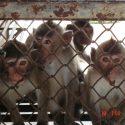
Action for Primates and One Voice have been alerted by concerned residents to the trapping of monkeys taking place now in Vallee Pitot, located in the region of Port Louis in Mauritius. Video footage shows a large gang cage into which unsuspecting monkeys are lured by food and then trapped. Please speak out for these monkeys in Mauritius

These monkeys, in distress to the point that we can hear them howling, are taken out of the cage to be enclosed in small transport carriers, then loaded into the back of a lorry and taken away. We suspect that one of the many primate businesses in Mauritius exporting monkeys for research and toxicity testing (poisoning) is at the root of this.

The capture of wild monkeys is a universally condemned practice due to the cruelty of it, the suffering that it causes to the animals, and the fact that they are torn from their natural habitat as well as their families and social groups. It is likely that the monkeys captured in Mauritius will be sold to laboratories abroad, or used for breeding in farms for the sale of the babies. Mauritius, who exported more than 14,000 long-tailed macaques in 2021, is the main provider of monkeys for laboratories in America and Europe.

The capture look place on public land and Mr Seenath Abedeen, a Port-Louis resident who filmed a series of videos, also reported his concerns to the local police. The monkeys are seeing their natural habitat being invaded more and more by humankind, and yet they are the ones that pay the biggest price for this disruption, almost always with their life.

Act with us to defend these monkeys from the Mauritian authorities.

Send an email to demand an end to these captures and for the protection of these animals everywhere on the island (you can download a template here):

You can also leave a comment on the Port-Louis Municipal Council site: http://www.mccpl.mu/contacts.h…

Non-human primates are our closest existing biological relatives. Mauritian monkeys must be protected and treated with compassion, and not killed or captured to be exploited in laboratories or for any other reason. Action for Primates and One Voice are calling for all Mauritian communities to reflect on the terrible suffering inflicted on these intelligent, social, sensitive animals, and to speak out to help put an end to their barbaric exploitation.

Long-tailed macaques are currently the most used species of primate for toxicity testing, which involves deliberately poisoning the animals in order to determine the amount of chemical product or medication necessary to cause serious injury or death. To do this, they are forcibly held down, after which a test substance is administered by injection, drip, or feeding tube in increasing amounts to measure the effects of the poisoning. The macaques feel intense suffering.

If you live in Mauritius and you are aware of wild captive monkeys that are being taken or used as ‘companion animals’, do not hesitate to contact us at info@one-voice.fr and info@actionforprimates.org

Translated from the French by Joely Justice

A legal victory for badgers in Saône-et-Loire. Our fight continues!

A legal victory for badgers in Saône-et-Loire. Our fight continues!

A legal victory for badgers in Saône-et-Loire. Our fight continues!
17.03.2022
A legal victory for badgers in Saône-et-Loire. Our fight continues!
Wildlife

The Dijon Administrative Court has just, on 15 March, annulled the decree of 11 May 2020 in which the Saône-et-Loire Prefect had decided on opening an additional period for underground badger hunting with hounds from 15 May to 14 September 2020. The digging out of between 600 and 900 badgers who were massacred two years ago was therefore illegal! It is a victory, indisputably on a legal level, but also for the animals; these diggers got their fill of adrenaline and blood… as always when there is no emergency suspension. This decision strengthens our motivation to continue the fight.

The Dijon Administrative Tribunal treated the plea differently to the League for the Protection of Birds [Ligue pour la protection des oiseaux], the Saône-et-Loire Departmental Committee for the Protection of Nature [Comité départemental de protection de la nature] and us for the same decision. The Departmental Federation of Hunters [Fédération départementale des chasseurs] faced us, hand in hand with the department’s prefecture.

A ban on killing young approved!

The stupidity of the decree had been decided on for two reasons: an inadequate cover note and therefore a decree issued under an irregular procedure, but equally — and this is the first time that this has happened to our knowledge — because the tribunal took our argument that the ‘young’ should not be ‘destroyed’ into account. Perhaps because the Prefect himself admitted that the young had been ‘taken’ in previous years… but the judge also took into account scientific studies that we provided which confirm that the young are present in the setts well after 15 May. He also (almost) admitted that the term ‘young’ does not only refer to un-weaned young, but also to dependent minors (weaned but not self-sufficient). A truly great step forward.

Other decrees against badgers are in the hands of several prefects…

Alongside this long-term fight, we continue to defend badgers in other departments. In fact, the decrees increase every year in the spring, and we refuse to leave the hunters to lay down their laws with total impunity. Digging out is absolutely horrific (as we showed suitably in our infiltration investigation), as it destroys forests and massacres totally harmless animals, all which have their place in the ecosystem and representing richness in biodiversity.

In the last few weeks, we have therefore taken part in many public consultations, particularly to oppose the decrees proposed by Loiret (now closed to the public) and by Haute-Vienne (which expires on 27 March), planning to authorise an additional period of underground badger hunting with hounds from 15 May 2022. You too can take part.

And equally for Saône-et-Loire, where the Prefect did not even wait for the outcome of the appeal to submit a new decree proposal absolutely identical to this one, in which it is written that 36% of animals dug out are badgers. The consultation is still underway (until 24 March). We have a list of arguments at your disposition, but be careful to always rephrase them in your own words!

Translated from the French by Joely Justice