Sensitivity and self-awareness in animals

Sensitivity and self-awareness in animals

Sensitivity and self-awareness in animals
07.12.2015
Sensitivity and self-awareness in animals
Domestic animals

Like humans, non-humans are capable of feeling pleasure or aversion. This is scientifically confirmed by the latest studies on ‘sentience’ in animals: A revelation that more than ever raises the question on our relationship with other animals.

There is no fundamental difference between man and the higher mammals in their mental faculty (…) the difference in mind between man and the higher animals, great as it is, certainly is one of degree and not of kind,” declared Charles Darwin, way ahead of his time. We would have to wait until the 21st century for scientists to prove this great man right with the latest studies on ‘sentience’.

Sentience, indicator of animal sensitivity

If the exact definition of ‘sentience’ and knowing whether it is present in every animal always provokes debate, today everyone recognises that animals are sensitive beings, to more or less of a degree. In other words, an animal experiences positive or negative feelings (sensations, perceptions and emotions), from pain and fear to pleasure and joy. Scientific studies have shown that certain animals have high level mental capacities that until now we thought were reserved to humans, like being self-aware, capable of solving new problems, being able to visualise and to understand what other animals know or are capable of. All of these abilities apply whether the animal is wild, a farm animal or a pet.

Scientific certification of high level mental capacities

For some decades now, a number of examples derived from a large quantity of scientific studies confirm this knowledge. Baboons and pigeons assimilate abstract concepts such as similarity and difference. Some animals use techniques to trick their entourage, like pigs who deliberately use techniques to stop a fellow pig from stealing their food. Sheep, for example, are capable of remembering other sheep or humans for at least two years. A sheep also reacts emotionally to a face: he prefers a friendly sheep or human to an angry sheep or human. Chickens understand that a hidden object continues to exist, something that young infants do not yet understand. Great apes and the common bottlenose dolphin show that they are conscious of themselves and recognise themselves when they look in a mirror…

The animal has an “internal world”

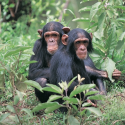
Whilst we are celebrating the 200th birthday of the father of evolutionary biology, science has taken a step forward in confirming that the human being is not the only “animal” capable of long term planning. A scientific study published in March 2009, for example, shows that a 31 year old male chimpanzee, kept at Furuvik zoo in Sweden, plans his future. In the morning, before the zoo opens, the chimpanzee, Santino, collects and makes piles of stones. Later, in the morning, he throws the stones he has prepared in advance at visitors. He stores these munitions on the island slope nearest the spectators, but he doesn’t collect munitions during the closed period of the zoo in winter. For Mathias Osvath, specialist in cognitive science at the University of Lund in Sweden and author of the study, “these observations show in a convincing way that our brothers the big apes genuinely envisage the future in a very complex way (…) I’m personally convinced that they do have this autonoetic consciousness like us where we relive past experiences or when we think about the days to come

Rethink the relationship between man and animal

Since 1997, the European Union has recognised animals as “sentient beings“. Member states are required to “pay full regard to the welfare requirements of animals“. Yet the discoveries made these last few years regarding sentience genuinely pose another essential question: that of the relationship of man with animals. Effectively, if animals are conscious of what they feel, if they know who they are, with whom they are, how can man continue to treat them as an object, use them as a toy or a whipping boy, exploit them, imprison them, torture them and mistreat them? When science repeatedly discovers new information about the ability of an animal to feel, experience, think… it is time that man rethinks how he could be useful to animals instead of how animals could serve him. This is what One Voice is working towards through its campaigns and its invitation to public debate on this subject.

Humanity, a human quality?

Humanity, a human quality?

Humanity, a human quality?
03.12.2015
Humanity, a human quality?
Animal testing

In the game “The Xtreme zone”, humans make the choice to inflict an electric shock on one of the players. But for animals, a similar experience produces a different choice.

On the 17th of March 2010, France 2 viewers watched the first part of a documentary on the subject, “How far can TV go?” On the pretext of a TV game, “the Xtreme zone”, the players, supported by the public, showed that they were capable of putting another human’s life in danger. Directed by an authoritative presenter, they were led to believe that they were administering electric shocks to subjects incapable of responding to questions. The victim was in fact an actor briefed to display increasing levels of pain, but the results were no less worrying.

To resume the statement of Christophe Nick, the author and producer of the documentary, “TV can make people do anything to anybody”.

Humanity in question

This first episode, under scientific supervision, was inspired by an older social psychology experiment undertaken in 1963. This experiment had showed that when under the authority of men in “white jackets”, 60% of humans were prepared to administer an electric shock to another human for the alleged reason that a ‘scientific man’ had instructed them to do so. In France 2’s 2010 documentary, this figure was 81% of participants under the control of “the Xtreme zone” presenter… The transitory executioners were given psychological support following this experience. Electrocuting people is not a trivial act. The results overturn the notion of “humanity”, their supreme quality according to humans – their name being defined by it. But what becomes of it when complying with ‘authority’? Authority, whether this relates to scientists or the media, drives us to ignore our free will, to disregard what our conscience tells us, and our ability to show compassion?

A different point of view for the animals

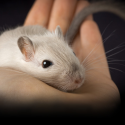
Similar experiments have been carried out with animals but with very different conclusions. Animals prefer not to receive food rather than inflicting an electric shock on someone (in Xtreme Zone, they had nothing to win). In a study conducted in 1964 on rhesus monkeys, 80% of the monkeys stopped operating the chain that delivered food to them when they realised that their companions would be shocked as a result. They preferred to be hungry for several days. The same experiment, conducted on rats, produced identical results: rats preferred to stop feeding themselves rather than making one of their fellow rats suffer.

From empathy to altruism

Frans de Waal reports other cases. In “The age of empathy, Natures Lessons for a Kinder Society“, the ethologist relates his experiences where upon witnessing suffering in one of their fellow animals, they themselves experience suffering…He notably describes the case where the heartrate of a female goose accelerates when her male companion is challenged by another goose. He also talks about an experiment conducted in mice, which shows that when two mice spend time together, a painful stimulus applied to one of them results in the other becoming more sensitive to pain. Or more: when a capuchin monkey has the choice between a token that gives him the right to food, or one that gives both him and his companion the right to food, he systematically chooses the token which allows them both to eat…

Develop compassion in daily life

Whilst the notion of sentient animals creeps in bit by bit, the circulation of part one of Christophe Nick’s documentary, and the publication of the book by Frans de Waal, forces us to question ourselves regarding human nature. What do we become when faced with authority? How do we reclaim this ‘humanity’ that, finally (sic), would appear to be shared with other members of the animal kingdom? To rediscover our free will; should we not learn to listen to our conscience again? Since developing the ability to show compassion in our lives, and learning that the respect for all lives is also the respect for oneself, surely means that humanity will come out of it more ‘grown up’…

Article published by One Voice in 2010

Interview with Albert Lopez

Interview with Albert Lopez

Interview with Albert Lopez
02.12.2015
Interview with Albert Lopez
Exploitation for shows

December 2014. Albert Lopez, the former trainer of orca Ulysses and dolphins of the Barcelona Zoo and the Dolphinarium of Oltremare, reveals to Muriel Arnal the behind the scenes of these detention centres of slavery…

Muriel Arnal: One day, you decided to “look yourself in the mirror” and stop your activity as a trainer. This is particularly courageous and your testimony is essential to support our fight. I deeply thank you for revealing what happens behind the scenes of these centres. What you know about Ulysses is eminently significant in this respect…

Albert Lopez: Yes, I remember, Ulysses stayed alone in the Zoo pool with a dolphin for 12 years. I was alone too. Because I was young and the other employees of the Zoo didn’t like the animals. That’s why we had made connections. The first year Ulysses arrived, he was badly injured by the dolphins. A male dolphin attacked him and bit him very badly and as a result Ulysses was dying. He remained prostrate, without eating, in great suffering. Every day I went into the water, at his side, to treat him. This is how we became friends; we remained friends throughout his detention in Barcelona.

M.A.: Why did this dolphin attack Ulysses? A dolphin does not behave like that in the wild. Is it promiscuity or the stress of captivity?

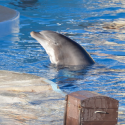
A.L.: These attacks were understandable because when the orca arrived in the pool, the dolphins who were detained there were very scared. The male dolphin beat Ulysses and hurt him very badly. Afterwards Ulysses only stayed with the female dolphins but they were always on their guard with him. One of them had a baby, named Inuk. She became even more aggressive with Ulysses because she was afraid, she was constantly watching Inuk. When Ulysses and Inuk were playing and Inuk was hurt a little, he would go back to see his mother and she would then bite Ulysses. Inuk is the first dolphin born in the Zoo and has survived more than two years; the others did not survive because their mothers did not know how to teach them how to eat. Inuk, he was educated by Ulysses who took care of him and taught him how to eat fish. Ulysses was very small when he arrived, he grew up with the dolphins, he was not aware that he was an orca. He thought he was a dolphin. In the following years, he stayed with a dolphin named Nereida. They bonded, but it was Nereida who decided. Throughout his detention, Ulysses never hurt the dolphins. He was very sweet. Every morning he was waiting for me. I was going to see him directly, talk to him and play with him.

M.A.: Your relationship with Ulysses is established, it seems to me from those crucial moments…

A.L.: Ulysses saved my life twice. One day, I was repairing equipment at the bottom of the pool. I had not taken flippers, so to be more comfortable when working. And I had weighted myself with too much weight. When my bottle was empty, I could not get to the surface. At that moment, Ulysses came next to me, showed me his dorsal fin which I grabbed. And he brought me to the surface. That was the first time that he had adopted such behaviour. A few days later, I had to go back to continue the repairs. I had put on flippers and carried less weight for ballast. As I was going down to the bottom of the pool, Ulysses bit me gently on the thigh twice. I did not understand why immediately. A colleague then told me, he does this to warn you of the danger and ask you not to take any risks. So I put down all of my equipment and went into the water, in a swimsuit, and we played. Ulysses was reassured. After this episode, Ulysses has never tolerated it when I wear flippers or even a mask. He has systematically removed my mask with his mouth. He tolerated only the swimsuit, nothing else. Every day, after the show, I stayed playing with Ulysses. It was outside of my job, I did not give him food like during the show. There was no training or submission. He was free to play if he wanted to. And if he did not want, he expressed it. But he always wanted us to play together!

M.A.: Do you think where Ulysses is today he continues to play with humans?

A.L.: No, at SeaWorld playing with orcas when not giving them by food is absolutely forbidden. Moreover, it is now forbidden to go in the water with them because some orcas are in such suffering that they have lost their minds and can kill their trainers.

M.A.: All human beings who have created a relationship with cetaceans remain profoundly marked for life…

A.L.: Yes, this relationship was very strong, too strong. Like the loving relationship that you can have with an animal. Ulysses was my friend. I thought of him every moment because unlike a dog we could not be together all the time. I was at the Zoo seven hours each day, but the rest of the day Ulysses was alone. I had a life outside, he was left alone with Nereida, without doing anything, without being able to swim or move freely, locked in this concrete pool with its over chlorinated and acidic water, which burned his skin and his eyes.

M.A.: What you have said makes me think of a dog or a cat that is left alone in its cage day and night, week after week out, through the holidays, isolated and unhappy…

A.L.: Yes, it’s exactly like that for “working” dogs, dogs are locked in cages all their lives. When you cannot be with your dog, it suffers; it was the same for Ulysses.

M.A.: To return to Ulysses, did he receive food outside of the shows? Was he taking medication?

A.L.: Odysseus ate 60 kg of fish a day. Like the dolphins I fed him 5 or 6 times a day to make him less bored. Ulysses and the dolphins took vitamins and medicines to protect their stomachs from stress-related diseases of captivity. Ulysses had an abscess on his tail that was not healing and worsened two or three times a year. It was disabling for him. So he had antibiotics. In Barcelona, we did not use tranquillizers. In Italy, where I worked afterwards, they gave the dolphins hormones to calm them down; I tried to stop this procedure.

M.A.: Have you seen Ulysses?

A.L.: A year after his departure, I went to SeaWorld to see him. But this company has very strict rules. I could not swim with him and I could not see him very well, it’s not possible to have interactions without going into the water with him. I could see him on the internet because he is filmed live with a webcam but I do not look at it because it hurts me too much.

M.A.: This would be the same for most of us to be separated from a beloved companion and, moreover, one that is detained in conditions of mistreatment. It’s unbearable … Do you remember specific situations that could be behind your courageous decision?

A.L.: When I first started working at a Zoo at the age of 18, the first thing I was asked to do was to kill a dingo. When I asked why he had to be killed, I was told there were no facilities for him. At that time, I then realized that a Zoo is a commercial enterprise that locks away and exploits animals. So I stayed to try to change that, for the animals. With dolphins, the first thing that I was taught by the supervisor was to hit them on the back with a stick to move them from one pool to another. I offered to teach the dolphins to move without hitting them, but the instructor told me it was easier to hit them. I was able to do that for the dolphins, to teach them to move from one pool to another. I was able to stop the hitting. But one day, I understood that I could not change things, so I stopped this job and I decided to join the associative movement to close dolphinariums and Zoos.

M.A.: What do you think of the way humans treat cetaceans?

A.L.: To say whether whales are intelligent or not, one should have the same intelligence as they do, intelligence that makes it possible to compare. We do not have it. And humans have committed many crimes, never whales. I deduce that they are smarter than us, humans that is. Cetaceans live on another plane because they have evolved in the sea. Orcas, like bottlenose dolphins, have a very developed social behaviour, similar to that of humans.

M.A.: But its behaviour without the violence which is not apparent in humans…

A.L.: Yes, exactly.

A unique opportunity for the closure of dolphinariums!

A unique opportunity for the closure of dolphinariums!

A unique opportunity for the closure of dolphinariums!
17.11.2015
A unique opportunity for the closure of dolphinariums!
Exploitation for shows

After Valentin’s death, following the two-meter wave that swamped Marineland in Antibes in October 2015, One Voice launched a campaign for Moana and everyone else. The dolphinariums must close! National mobilization is needed to influence the biodiversity law being revised!

A drama that mobilizes

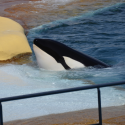
On October 12th 2015, Valentin, a 19-year-old teenager, was found dead in his Marineland pool in Antibes. The cause of his death: a twisting of the bowel probably due to significant stress. And stress, Valentine has had. Valentine is an orca. He should have been born in the ocean and lived in his pod for several decades – Granny, the oldest of the wild killer whales, has surpassed a century. He would have learned the dialect, the traditions and protected the members. Orca families are close-knit; he would have grown up close to his mother, staying by her side, always, even until old. The mother-son bond is very strong in orcas. But Valentin was born in a pool. He was taught to obey and to be applauded. And in June 2015, his mother, Freya, died she was only 33 years old.

Trade, slavery, torture

Freya had been stolen from her family, who was swimming off the coast of Iceland when she was a baby. Her life in a pool has been a long suffering, as for all captive cetaceans. She experienced several miscarriages, all consecutive to artificial insemination. We should not mess with genes in dolphinariums. Many people think that led to Freya falling into a deep depression. Her premature end was a shock for Valentin who had since remained prostrate. The wave of mud that had submerged Marineland had been a last test. But was it death or deliverance? In captivity, orcas do not live long. It is therefore urgent to save Moana and the other companions of Valentine, as well as all the other captive cetaceans!

The biodiversity law: a unique opportunity

The biodiversity law will be reviewed in January 2016. In this context, One Voice has asked for the ban of dolphinariums and has obtained a moratorium. Two new dolphinarium projects have, at least temporarily, been blocked. This text must in fact be based on the application of the principle of ecological solidarity. However, the commercial activity of dolphinariums is contrary to this principle. Indeed, not only do they inflict suffering on captive wild animals because they cannot meet their basic physiological needs (chlorinated water, confined spaces, etc.), but they also present an unnatural vision of the species, further encouraging their capture and exploitation.

A national mobilization

One Voice, with the support of Animalter, ASPAS, Dolphins Libres, FAADA, Marine Connection and SOS Grand Bleu, is calling for the biodiversity law to ban dolphinariums and to order the transfer of all captive cetaceans to marine enclosures, for example, recommendations of Dr. Ingrid Visser. To support our request, sign and broadcast the petition!

Dolphins and the out-dated

Dolphins and the out-dated

Dolphins and the out-dated
15.04.2015
Dolphins and the out-dated
Exploitation for shows

In the D-FE * coalition, One Voice is mobilizing to denounce the shameful exploitation of dolphins by a TV entertainment program currently shooting in Portugal.

Last minute: the show is suspended!

Under the pressure and the actions from NGO’s gathered together such as the Dolphinarium Free Europe (DFE) of which One Voice is a member, the show was suspended. However, the risk of it being produced in other European countries, and particularly in France, still exists. Stay alert!

Presentation of the show

The concept of the program is Dolphins with the Stars – produced by Shine Iberia and broadcast by CIS – it’s to bring together “the most popular stars and the most adored animals” **. Ten couples, formed by a celebrity and a dolphin, must present on prime time viewing an elaborate performance which is duly filmed for thirty days. “Judges” and TV viewers will then decide on the winner.

An unethical broadcast

“The most adored animals” can do without this craze that feeds an increasingly cynical industry. The Zoomarine dolphinarium in the Algarve region of Portugal, where the show is shot, holds 21 dolphins, of which at least five have been captured with certainty from the wild. In addition to captivity, the dolphins “partner of the stars” must undergo additional stress related to the training and the euphoria from this kind of spectacle whose main gaol is to make this show with no consideration for these animals.

A dangerous show

The broadcasting of such a program contributes to the organized misinformation of the general public concerning dolphins, both from the point of view of ethology and that of sentience. This leads to the making of a material object out of a wild animal. The stars, so concerned about their image, should become aware of the out-dated nature of this type of program and the responsibility they endorse by being complicit in such exploitation.

Our action

Considering these violations of Portuguese and European laws that have been perpetrated by this program Dolphins with the Stars, One Voice signed a letter sent today to the Portuguese President asking him to intervene. Other actions are being prepared.

Let’s be vigilant!

For the moment, this program is confined to Portugal. Nevertheless, the concept has already attracted interest with China and 14 European countries, including France. It seems that a French production company has already expressed interest, to the delight of a dolphinarium.

If such a project came to life, One Voice is counting on your mobilization.

* Dolphinaria-Free Europe

** Terms used by La Competencia, the Spanish production company behind the show

*** European Association for Aquatic Mammals

The state intended to protect sheep … who are no longer there!

The state intended to protect sheep … who are no longer there!

The state intended to protect sheep … who are no longer there!
24.11.2014
The state intended to protect sheep … who are no longer there!
Wildlife

In the context of anti-wolf hysteria, prefects believe they can do whatever they want under the pretext of calming farmers who will never be appeased, and are illegally authorising the shooting of wolves, a protected species. Three associations have just won their legal appeals against the State.

The justice system has once again proved ASPAS, Ferus and One Voice right by suspending two illegal orders for the shooting of wolves, this time in the Alpes-de-Haute-Provence. Our associations had attacked these decrees of the Prefect in 24 September which ordered the slaughter of four wolves, with the possibility of hunters being able to hunt them until 25 December in the communes of Allos, Thorame-Basse and Thorame-Haute, so say “protecting herds against predation” … while sheep are no longer on the pastures at this time of the year!

In its order of 20 November, the Marseille Administrative Court therefore considers that these two prefectural orders do not comply with the conditions set by the Ministerial Decree of 15 May 2013. “It is not sufficiently established, by the documents produced by the Prefect, that the herds remain exposed, during the entire period of execution of the decree, to the predation of the wolf […] “.

Let it be known, it is not allowed to slaughter wolves when the sheep have returned to the sheepfold in autumn! The official argument of the “protection of herds” no longer deceives anyone: a real wolf hunt is engaged by some Prefects, with so much zeal that they even forget the respect of the laws. Thirteen wolves have been killed since the end of August. Faced with this delirious policy, our associations appeal to the reason and responsibility of the representatives of the State. We will continue to fight orders considered illegal.

Shooting wolves out of the context of predation on herds is of no use to pastoralism. The Prefects are pretending to respond to the difficulties of the breeders by offering hunters the opportunity to shoot, even if it means putting a protected species at risk. Rather than digging into this trigger-happy policy, the public authorities would do better to really support the breeders in their necessary adaptation to the presence of wolves.

A call on Russia at the Olympics to put an end to animal fighting as done in the Middle Ages

A call on Russia at the Olympics to put an end to animal fighting as done in the Middle Ages

A call on Russia at the Olympics to put an end to animal fighting as done in the Middle Ages
07.11.2014
A call on Russia at the Olympics to put an end to animal fighting as done in the Middle Ages
Exploitation for shows

A new investigation reveals that in Russia, bears are captured, chained up and fed to dogs being tested for their hunting abilities.

One Voice and Baltic Animal Care are today launching an international campaign to reveal what wild animals used as living tools for assessing the abilities of hunting dogs in Russia are subjected to.

One Voice investigators focused on Russia’s national symbol, the brown bear, which will also be one of the symbols of the 2014 Winter Olympics in Sochi. They visited four hunting dog training centres in four different regions of Russia. There they discovered seven bears and the worst cases of animal suffering they have encountered since they began their work several decades ago.

They filmed bears in chains, as well as badgers and wild boars locked up, chased and attacked by Laikas, a Russian breed of hunting dogs. They met the judges who presided over the trials and graded the dogs according to old rules, based in particular on tracking, barking, aggression and courage. In these trials, aggression is rewarded. In a test on a bear, for example, the dog will get a good score if it bites the bear deeply in the hocks, heels or hindquarters, but it will lose points if it retreats or does not bite hard enough.

Our investigators are haunted by what they saw. At a competition they attended, the bear was attacked and bitten by dogs all day long, then remained chained to a pulley overnight, ready to be used again the next day. At another centre, two cubs shared a cage measuring approximately 5 x 3 x 2.5 metres. They were in a pitiful state. They were covered in a thick layer of mud and excrement, as was the floor of their cage. This is a terrible fate for these animals, which are among the most intelligent mammals and renowned for being great travellers and extraordinary explorers. Muriel Arnal President of One Voice Tests using a bear involve chaining it to a pulley system, which operates using a cable stretched between two trees. An employee stands on each side to pull or push the bear. Specialised judges observe and evaluate the performance of the dogs, which must attack and corner the bear. Elena Bobrova Baltic Animal Care

Each time the dog fails to meet an established criterion, points are deducted from a maximum possible score of 100. For example, if its bites are not strong enough, the dog will lose up to 8 points; if it barks but does not bite the bear, it will lose 10 points; and if it moves away from the bear instead of biting it, it will lose between 10 and 15 points.

Given that a ‘test’ normally lasts ten minutes and that several dogs are assessed each day, the same wild animal can be used as a target multiple times.

The price to pay for causing a wild animal to suffer in this way is not high. One Voice investigators noted that a ten-minute test cost between 200 and 400 roubles, or approximately £2 to £4.

In Russia, these activities are referred to as ‘trials’ or ‘field tests’. They are officially supported by dog breeding associations and hunting clubs. According to available information, there are several dozen or even several hundred such training centres in Russia. They are advertised on public roads, in the press and on the Internet. Various wild species are used to train and test hunting dogs: badgers, bears, foxes, martens and raccoon dogs. These animals are usually captured in the wild, but One Voice investigators have discovered that bears are sometimes purchased from circuses or zoos. Various breeds of dogs take part, including Laikas, Borzois and Dachshunds.

Dogs that prove themselves can then participate in regional, inter-regional or national competitions, as well as international competitions. Dogs that do not perform satisfactorily may be refused their pedigree. For Laikas, for example, obtaining a pedigree requires passing several field trials, where they are confronted with different animals, including a captive bear.

The One Voice investigation revealed the total disregard that Russian hunting dog training centres have for nature and the needs of wild animals. They are thus completely out of step with the international community, which promotes knowledge and protection of wildlife and animal welfare.

One Voice and Baltic Animal Care are calling on the international public to take action by writing to President Putin and their country’s Russian ambassador to demand better protection for animals and a ban on the use of wild animals in hunting dog trials.

We hope that our new report and the videos we are publishing on the Internet will serve as a catalyst for the international campaign calling on Russia to stop using captive wild animals to train hunting dogs. There could be no greater contrast to the images of 21st-century cosmonauts carrying the Olympic torch, which the whole world will see today, than what can be seen in these Russian training centres. These scenes of dogs being set upon wild animals, worthy of the Middle Ages, should definitely be a thing of the past. Muriel Arnal President of One Voice

Notes:

1. The paper version of the report, as well as the English version, can be obtained on request by calling 02 51 83 18 10 or via the contact form.

2. Laikas – In Russian, the word ‘Laika’ is derived from the verb ‘layât’, which means to bark. Laikas are descended from indigenous dogs and have long been used as hunting and guard dogs. There are four recognised breeds in Russia: the Karelian-Finnish Laika, the Russian-European Laika, the West Siberian Laika and the East Siberian Laika. The latter three are among the breeds listed by the Fédération Cynologique Internationale (FCI). The Karelian-Finnish Laika is a close relative of the Finnish Spitz, and these two breeds were merged in 2006.

3. Animal protection legislation in Russia – the only animal protection referred to in this study is the limited protection against physical suffering granted to animals by the Criminal Code in Part 2, Section IX, Chapter 25, Article 245, which states: ‘Any act of cruelty towards an animal that has caused death or injury, if perpetrated with malice or for profit, or using sadistic methods, or in the presence of minors, shall be punished (…)’ At first glance, it would seem that this legislation could be applied to prevent the suffering of wild animals in hunting dog training centres. However, Elena Bobrova of Baltic Animal Care explains that attempts to enforce this legislation have failed, as the responsible authorities have deemed hunting dog training centres to be legal. New legislation is urgently needed to prevent wild animals from continuing to be captured and used to evaluate hunting dogs in Russia.

Following the drama of Lizy-sur-Ourcq, the challenges of the trial

Following the drama of Lizy-sur-Ourcq, the challenges of the trial

Following the drama of Lizy-sur-Ourcq, the challenges of the trial
23.06.2014
Following the drama of Lizy-sur-Ourcq, the challenges of the trial
Exploitation for shows

On 30 June, a trial will be held in Meaux following the escape of a circus elephant, which caused the death of a man on 8 September in Lizy-sur-Ourcq. One Voice hopes that the real issues at stake will be addressed.

What are these issues?

The first is to question the presence of elephants in circuses and its consequences for public safety. The tragedy in Lizy-sur-Ourcq sadly illustrates that travelling circuses with elephants cannot guarantee the safety of the public and residents of the towns that host them. How could they, when they are unable to meet the basic physical and psychological needs of animals endowed with extraordinary strength?

The results of the One Voice investigation conducted after the accident in Lizy-sur-Ourcq are damning, both in terms of the conditions in which the elephants are kept and in terms of public safety.

In support of this survey, the report for One Voice written in May 2014 by Dr John Knight on the situation of elephants in circuses and the increasingly deteriorating condition of Samba (whom he had already studied in 2005) speaks for itself. This eminent wildlife specialist points out, with material and scientific evidence to support his claims, the dramatic consequences for the health and behaviour of pachyderms kept in circuses and the safety and health risks for humans.

The second issue is ethical. How can we justify depriving a being with acute sensitivity and recognised intelligence of its freedom and most basic needs (walking, drinking at will, washing, eating a varied diet, having a social life)? Finally, how can we justify forcing it to perform tricks that go against its nature?

Dick Gregory, Martin Luther King’s fellow activist, said that animals in circuses reminded him of slavery because they represent the domination and oppression he fought so hard against. It is time for France, a leading country in human rights, to shake off its inertia and consider the unjust fate of these chained animals, the elephants in circuses! One Voice is open to dialogue with trainers to find solutions together to free these beings, in the interest of all, from a life of indignity that nothing can justify. Muriel Arnal President of One Voice

Companion animals: The better to know our companions the better to live with them

Companion animals: The better to know our companions the better to live with them

Companion animals: The better to know our companions the better to live with them
24.04.2014
Companion animals: The better to know our companions the better to live with them
Domestic animals

As part of the Zoé Unit, One Voice is launching the ‘Animal Companionship’ programme. It aims to provide keys to understanding the lifestyle and nature of the animals that live alongside us, thereby establishing knowledge as an antidote to mistreatment.

‘Animal Companionship’ will be launched on Saturday, 7 December 2013, during a conference on cats led by Dr Nathalie Simon, a veterinary behaviourist. It will take place at 2 p.m. at the Maison Municipale du Bénévolat, 10 boulevard Marx Dormoy, 19312 Brive La Gaillarde, in the presence of the team from the Brive SPA shelter, a local partner of One Voice. From abuse to abandonment, violence against pets often stems from a lack of knowledge.

Within the Zoé unit, which is already combating proven acts of cruelty in the field – several farms have recently been convicted – One Voice has developed an educational approach aimed at taking early action to prevent the emergence of unintentional but abusive behaviour towards animals.

‘Animal Companionship’ is a programme run in conjunction with shelters and associations that are partners of the Zoé unit. It will focus on cats in 2014 and dogs from 2015 onwards.

In order to reach as wide an audience as possible, One Voice has chosen two tools: the publication of information leaflets and the organisation of conferences/training sessions led by Nathalie Simon. The daily life with animals will be discussed with the aim of highlighting the most appropriate actions in relation to them. These conferences will leave plenty of room for interaction with the audience. Aimed at everyone, they are also intended as a practical tool for future adopters, association staff or anyone who comes into contact with animals.

Cats are amazing and misunderstood animals. With Compagnonnage animaux, the public will be able to discover the particularly subtle relationship that is possible with them. Based on mutual respect, it is entirely free of domination or possessiveness… Muriel Arnal President of One Voice The shelter is overflowing with animals traumatised by the humans who were responsible for them. This is all the more sad because the abuse they suffered was often based on misconceptions and a lack of curiosity. I am convinced that with a little relevant information, many tragic outcomes could be avoided. Bernadette Arnal President of the SPA in Brive