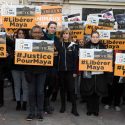
Animal experimentation on dogs: mobilisation for beagles!

Animal experimentation on dogs: mobilisation for beagles!

Animal experimentation on dogs: mobilisation for beagles!
01.09.2017
Auxerre
Animal experimentation on dogs: mobilisation for beagles!
Animal testing

Beagles are dogs known for their placidity and dedication. One Voice reveals what these dogs are going through in the labs with a new, unprecedented report. It will be presented to the cabinet director of the Prefect of Yonne during a unitary protest against vivisection, in Auxerre this Saturday, September 2nd.

The reality of these figures is terrifying: a simple example in 2014, for the whole of the European Union, 22,967 dogs, most of them beagles, ended their life in the hands of the laboratories’ mercenaries, under more than odious conditions of torture. An animal experiment which, besides being useless is unreliable, is done with products whose toxicity has been known for a long time. In our latest report, One Voice presents the inconsistency and cruelty of these tests.

Beagles are famous for their intelligence and kindness. With their small size and reproductive capacity, they have long become the designated victims of international laboratories and their providers. Puppies and adults alike, there are millions who have already suffered the pangs of experimental or fundamental research. From the dangerousness of tobacco or alcohol, to drugs already on the market, or studies on the vascular system, they are spared no ignominy.

Our National Education and Higher Education ministries unscrupulously declare that these dogs are « the most common object of study for the development, production or testing of quality, effectiveness, efficiency and safety of medication destined for human or veterinary use; food, feed and other substances or products ». Our ministerial officials’ nerve goes so far as to claim that these dogs are sacrificed for the sake of « higher education, vocational or technical training leading to occupations that involve the performance of experimental procedures on animals … » Clearly, they are massacred to learn how to massacre and, secondarily, to heal others. Will they ever understand that the vast majority of citizens no longer want this carnage? 83% of French people clearly want to see an end to experiments on cats and dogs (IPSOS / One Voice 2016 survey).

These dogs are stuffed with various products, sliced up during surgical interventions, undergoing treatments that cause heart attack, stress, vomiting, convulsions, epilepsies, organ failure, paralysis and after certain death and in the worst cases a violent one at that. Instead of the warmth and love of a home, beagles suffer the worst.

On September 2nd, One Voice will be present at the unitary protest against vivisection organized by the CCEA in Auxerre. On this occasion, we will be received by the chief of staff for the Prefect of Yonne, where a large business breeding dogs for animal experimentation is established and where we will give him his report.

To help us stop dog and cat experiments, please sign our petition to protect them and spread our report widely!

Air France: Stop the freight of primates for animal testing!

Air France: Stop the freight of primates for animal testing!

Air France: Stop the freight of primates for animal testing!
30.08.2017
France
Air France: Stop the freight of primates for animal testing!
Animal testing

By an action organised this Wednesday in front of the air terminal of Air France, last major airline in the world to be transporting monkeys who are destined to laboratories for animal experimentation, One Voice launched its new campaign for regular flights without suffering in the hold!

It is a body-painted model who spearheaded this One Voice action. Painted in the colours of the association’s tiger-totem, she has become a standard-bearer for the suffering of monkeys around the world, with two other human extras made-up to look like monkeys. In the presence of the media, she carried high the message that One Voice diffuses on the social networks: #PasDeSingesEnSoute to ask the company Air France, a big supplier of imported primates who are to be sent to laboratories in Europe or North America, to stop this trade tainted with cruelty.

Why does One Voice call for the end of these relentless trips without return? Because this monkey merchandise endures an unbelievable stress: separated from their families, confined to narrow cages, without free access to water or food, exposed unceremoniously to changes in temperature, humidity, light, pressure and to the noise and vibration of the journey, not to mention take offs and landings. Coming from rarely controlled breeding centres and often torn from nature, these monkeys from Mauritius, Southeast Asia or the Caribbean endure flights of several tens of hours, only then to reach the hell of laboratories.

All the other big companies have made an ethical choice and stopped this type of freight. Air France-KLM, in the name of science’s best interests, continues stubbornly, while declaring itself a « responsible company ».

Alternatives to animal experimentation exist, and nothing, except profit, justifies these long-haul journeys bringing traumatized primates to the laboratories. Enough with all this suffering!

  • You can also protest by writing to Jean-Marc Janaillac and Franck Terner, CEO of Air France! : An example email to send to frterner@airfrance.fr and jmjanaillac@airfrance.fr

Mr. Janaillac, Mr. Terner,

Your company insures the international freight of non-human primates to laboratories carrying out animal experimentation. Leaving from Mauritius or Southeast Asia, such long-haul flights impose great suffering on the animals. Like a majority of French, whether or not users of Air France, I beg you, in the name of modern and ethically responsible science, to stop this trade as soon as possible.

Regards,

  • Read! Download and distribute the latest One Voice report: It gives information about the extent of the research currently conducted in France on non-human primates, the limits of this template for human health, new approaches and associated case studies from around the world.


Améliorer la science et mettre un terme à la souffrance

Rapport : améliorer la science et mettre un terme à la souffrance

Télécharger

$(document).ready(function(){ $(‘.diaporama’).bxSlider(); });

Mobilization of One Voice against the air transport of monkeys destined for animal experimentation and the role of Air France in particular

Mobilization of One Voice against the air transport of monkeys destined for animal experimentation and the role of Air France in particular

Mobilization of One Voice against the air transport of monkeys destined for animal experimentation and the role of Air France in particular
30.08.2017
Monde
Mobilization of One Voice against the air transport of monkeys destined for animal experimentation and the role of Air France in particular
Animal testing

By an action of protest organized this August 30th, One Voice reiterates its call to Air France to put an end to the aerial transportation of monkeys intended for the laboratories. The association is launching a mobilization campaign against these transports imposed on primates, who are piled into the hold of the plane under the feet of holidaymakers on regular flights …

According to the information gathered by the association and its partners (One Voice represents in France the ECEAE, European Coalition against Animal Testing), 120 long-tailed macaques were sent by Air France from Mauritius to Chicago (United States USA), via Paris, April 26th, 2017. The monkeys, from a local breeder were piled into wooden crates, then transported on the AF 463 and AF 6730 flights: nearly 16 000 km, enduring a 30 hours flight before arriving at Charles River Laboratories. This Lavatory performs preclinical toxicology tests on animals for pharmaceutical, chemical or agrochemical products.

Air France is the last major airline in the world to accept this type of freight from Mauritius, but also from the main exporting countries of Southeast Asia. In 2016, some 8,425 monkeys were exported from Mauritius to laboratories in Europe and North America. Internationally, this trade in animal life involves tens of thousands of individuals according to CITES (Convention on International Trade in Endangered Species of Wildlife) and long-tailed monkeys (Macaca fascicularis) are the first victims.

In the name of science ?

Torn from their families and imprisoned in tiny wooden boxes, suffering in the dark, cold and noisy hold of a plane, these intelligent and sensitive animals are destined to spend the rest of their lives in metal cages and to be subjected to painful experiments. Some supply routes from the Caribbean, the Indian Ocean or Asia, involve journeys of several tens of hours, under terrible conditions for animals, handled like ordinary goods: separated from their own kind, confined in narrow cages, with no access to water or food. Experiencing uncompromising exposure to changes in temperature, humidity, light, pressure, noise and vibration during travel, and the stress of taking-off and landing.

Several times questioned by One Voice, including letters signed by the famous primatologist Jane Goodall, Air France remains in hiding behind the authorization and regulations in force to justify this activity. The company is even the spokesperson for their clients, the laboratories, ensuring that animal experiments on primates are necessary for scientific advances.

One Voice points out here that the European Commission has, however, recognized its objective, eventually, the replacement of animal testing by other research methods. The association, which itself promotes humane alternatives based on epidemiology, computer models and in vitro experiments, refutes that the scientific community is unanimous on an inescapable need for animal experimentation. And remember that 8 out of 10 French people are opposed to experimentation on primates, according to an Ipsos / One Voice poll conducted in December 2016.

For a new model, without animal suffering

According to Dr. Gill Langley, biologist: « Trade to laboratories around the world is an important source of stress, suffering and death for
these animals. They are raised in their countries of origin under conditions that would not be tolerated in the European Union. […]
Keeping confined wild primates inevitably leads to psychological, if not physical suffering.
 »

Citing a variety of scientific studies, Dr. Langley notes that the abnormal behaviours and high levels of stress that primates develop during rearing, air transport and laboratory manipulation are factors that can distort experimentation results.

Muriel Arnal, President of One Voice, calls on Air France management: « In June 2017, Jean-Marc Janaillac, Chairman of the Board of Directors of Air France-KLM, signed a declaration on modern day slavery. Based on the principles of the UN Global Impact Charter, Air France is committed to fighting all forms of slavery and human trafficking. We invite it to go further: we must stop these primate transports intended for laboratories all over the world. The suffering caused by the uprooting and transport by long-haul of these living beings so close to us is immense. Justifying these practices with so-called scientific advances no longer holds: modern science and human health do not need monkeys to make progress, but many new replacement models are available which are ethical and responsible ! »

Very committed to the field of animal experimentation, One Voice, launches a new campaign on this theme – relayed on social networks by the
hashtag #PasDeSingesEnSoute – and publishes on its website (www.one-voice.fr) a report unpublished entitled « Replacing the use of non-human primates in research and safety testing in France: improving science and ending suffering« .

This document describes the state of research currently conducted in France on nonhuman primates, examples highlighting the limits of this model for human health, new approaches and associated case studies, from around the world.

One Voice also invites each citizen, user or not of the company, to directly address a protest message to the Air France KLM general management.

Share on

Circus: One Voice calls for the release of three elephants

Circus: One Voice calls for the release of three elephants

Circus: One Voice calls for the release of three elephants
28.08.2017
France
Circus: One Voice calls for the release of three elephants
Exploitation for shows

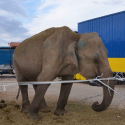
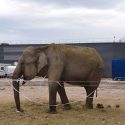
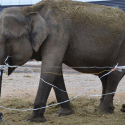
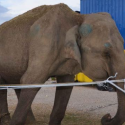
A female model body painted in the style of a tiger, which is the emblem of One Voice, will be in Vannes Tuesday, August 29th at 10:30 in front of the circus of Saint Petersburg to demand the release of the elephants Lechmee, Mina and Kamala. The situation is particularly dramatic for Lechmee, who is blind and lame and cannot eat without the help of her companions and who does not participate in the shows

Lechmee, Mina and Kamala were born in Asia in the 60s. They were torn from their family as infants and bought by the Tyseley Pet Stores. Once in Britain, they were sold to the Chipperfield circus and then to the Medrano group. For almost half a century now, these three elephants have suffered the spikes and screams from their trainer, the cries of the crowd. Confined to cramped trucks where they are transported for hours, one city to another. This treatment made Lechmee lose the use of his right front foot. Walking on the asphalt or the metal floor of the truck accentuates her pain with every step. It is a real handicap more so for an old elephant, whose blindness is already a heavy handicap. One Voice filmed Mina helping her to feed herself because she is no longer able to do it alone, and she has not been involved in shows for a long time. Mina and Kamala, despite their advanced age and their blatant fatigue are still forced to perform.

Dr. Pierre Gallego, a wildlife veterinarian and consultant for One Voice, described Lechmee’s case as proven abuse and found that the three elephants of this circus were in a state of physiological misery. According to him, it is “imperative to get them out of the circus to offer them a retreat in an environment adapted to their species. In addition, it is necessary to plan to keep these three elephants together because they have forged very important social links that depend on their survival.”

A simple application of the decree of 18th March 2011, would require that Lechmee be placed in a fixed residence, given her state of health. But it is unthinkable to separate her from her companions. One Voice has already initiated several proceedings to release them: a request for interim release, based on the violation of their fundamental rights and the referral of the Comptroller General of Places of Deprivation of Liberty, procedures usually reserved for humans. The association also requested the cancellation for the authorization of the owner to open shows for the three elephants and made an application for an interim suspension. One Voice also called on the Ministers of Agriculture and Environment to rescind the 2011 decree, which would prohibit the detention of wild animals in circuses, as which has already happened in 8 countries in Europe, 20 countries in the world, and 66 cities in France.

Muriel Arnal, founding president of One Voice says, “The ordeal that Lechmee, Mina and Kamala are going through is unbearable. Their case must be taken into consideration without delay. How long will Lechmee manage to endure so much suffering, physical and mental? With this action in front of the circus that holds them, we want to make known their fate to a large audience to support our request. It is urgent to free these three elephants!”

“Animals in circuses represent the domination and oppression we have fought for so long, and they wear the same chains and irons”.

Dick Gregory, comedian and civil rights activist, Martin Luther King’s wrestling companion, who died on August 20th, 2017.

Share on

Fanette will not go to the slaughterhouse

Fanette will not go to the slaughterhouse

Fanette will not go to the slaughterhouse
24.08.2017
Ardennes
Fanette will not go to the slaughterhouse
Other campaign or multi-campaigns of One Voice

At the educational farm, Fanette * was this sweet mare that the children loved. But when she was about to retire, she was to be driven to the slaughterhouse. By the way, One Voice was able to save her!

Fanette loved walking around with Maddie, her friend a cow.

Together, at a peaceful pace, they grazed the sweet clover and alfalfa of the Ardennes hills side by side. Sometimes, too, when the barrier was left open, Fanette went off to drink at the frog pond, to watch the little amphibians leap from water lily to water lily. In the evening, she went to join her lover, a stallion who was grazing there, in a nearby meadow. Part of her day was spent with chickens, ducks and goats all grouped together in an educational farm, Fanette’s mission was to awaken children to the love of Nature. And, in fact, everyone liked her.

But hey! Our mare was getting old.

She hobbled a bit from an anterior hoof and moved with difficulty.She had once leaned against a plum tree and finally uprooted it. From then on, the educational farm chose to replace her with a brand-new filly and foal. And Fanette? Ah, Fanette, you see, she’s already 25 years old. And she takes up space, an old horse, it’s expensive to maintain! So, she was returned to her owner, who was renting her and whom, in all probability, sent her quickly to the slaughterhouse.

What did the children say when they asked about her?

« And Fanette, where is she?« . The children undoubtedly asked questions. And what answer would they have formulated without our intervention? For the cruel truth is far from love: « The old mare? Oh, nothing special: we’ll just shoot a metal rod in the middle of her big forehead which is very soft and with her fringe of hair that sweeps over her eyes. Then hang her from a hook in the ceiling and cut her up to make meat. In this world of adults know it well dear little ones, the animals are NOTHING. They are only objects, movable goods that are rented, bought and sold, exploited and killed. »

Fortunately, the sad fate of Fanette has reached the ears of One Voice.

Immediately we took this horse in charge and we placed her safely in a suitable sanctuary. Our kind mare now lives today happy, among her new friends’ donkeys and sheep, some of whom are as old as she is. Sometimes, surely, images come back to her and question her. Where did Maddie go, her cow friend? Do not worry Fanette: she will not go to the slaughterhouse either. We will get her to join you soon!

As for educational farms, let us hope that they will be more educational in the future, by giving children the value of respect for animals that they deserve.

* The given names have been changed 

Freedom for Jumbo, a hippo prisoner of the circus!

Freedom for Jumbo, a hippo prisoner of the circus!

Freedom for Jumbo, a hippo prisoner of the circus!
14.08.2017
France
Freedom for Jumbo, a hippo prisoner of the circus!
Exploitation for shows

At the last minute: the hearing is postponed until August 28 at 11:00am, the circus will present its arguments.

On August 17, seized by the association of One Voice, the judge of the summary of the Administrative Court of Grenoble will examine the case of the hippopotamus Jumbo.

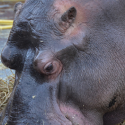
For 30 years, this amphibious hippopotamus, which was made for a semi-aquatic life, is confined to a truck, deprived of any social contact with its fellow hippo’s and its natural environment, including bathing to relieve its body and joints from its own weight. It is only half an hour a day free from its trailer to be sprayed with water from a hose, malnourished and exposed to onlookers. Jumbo is being held in unacceptable and illegal conditions, especially since he does not take part in the shows.

A legal battle

Earlier in the year, One Voice’s request to cancel the opening proceedings which were rejected by the Valencia prefecture, which considered that the circus offered conditions of captivity in accordance with the regulations in force (the decree of March 18, 2011 sets conditions for the detention and use of animals in itinerant establishments). This assessment is erroneous according to One Voice, because the decree provides that animals can meet their biological and behavioural needs, and that they participate in the show. None of these criteria are met for Jumbo.

International experts mobilized

In a report issued in 1997 at the request of the Vienna Environmental Commissioner, three leading Austrian experts – Dr. Gsandter, Pechlaner and Schwammer – noted that the hippopotamus is « particularly suited for life in and around the water, to which he must have continuous access. The water point that hippopotamuses have must be deep enough for them to fully immerse themselves. Keeping them captive in pools that are too small or too shallow for too long causes joint damage. Only permanent pens can satisfy the conditions mentioned above. In addition, hippopotamuses are gregarious animals that live in groups […]. That’s why keeping hippos in captivity in circuses is totally unacceptable! ».

In March 2017, Dr. Pierre Gallego, specialist veterinarian and consultant of One Voice, made several observations of Jumbo in situ, noting that he is « fed after the show during the 30 minutes of his release. It is an extremely short time to exercise outside the trailer and to feed yourself. He is fed with hay and horse pellets, and therefore does not have access to fresh grass which is his staple food in the wild. There is no more enrichment that allows Jumbo to have a natural behaviour, even to take care of himself or to move about […] sufficiently, neither to take baths as is necessary for his species. […] In addition, the frequent transportation in trailers between the various show sites represents significant stress for this animal, which is added to the stress of being exposed to the circus visitors during the only time during which he has access to the outside of the trailer. »

For Muriel Arnal, president of One Voice, there is urgency: « We must save Jumbo! We have timed the exits to which he is entitled, he remains locked in a dark trailer 23.5 hours out of 24 without permanent access to water or participation in any performance. For an
amphibian and gregarious animal, it’s not a life! We demand respect for the physiological needs of Jumbo, as provided by law, and his release. We will ensure his transfer and his welcome into a partner sanctuary which will finally offer him dignified living conditions.
 »

One Voice also denounces the illegality of the 2011 decree, which allows to keep captive wild animals in circuses when precisely they cannot express their natural behaviour.

According to the association, perpetuating such exploitation also jeopardizes the work of raising awareness about the respect and protection of endangered species.

The circus of yesteryear, which heavily exploits animals for unnatural shows, is in decline. Many mayors of France refuse that such companies deploy their marquee in the communal territory, unlike modern troops, offering attractions without cruelty. In large countries (United States, India, Australia, Brazil …), total or partial bans (depending on the species) have been enacted. In the European Union, 20 member countries have already taken similar measures. One Voice is fighting for France to be 21st.

Share on

Dolphinariums: the industry attacks protective measures, One Voice fights back!

Dolphinariums: the industry attacks protective measures, One Voice fights back!

Dolphinariums: the industry attacks protective measures, One Voice fights back!
27.07.2017
France
Dolphinariums: the industry attacks protective measures, One Voice fights back!
Exploitation for shows

The decree taken on May 7th by the Ministry of the Environment, under the authority of Ségolène Royal, is today attacked before the State Council by the dolphinariums, represented by Marineland Antibes (06), Parc Astérix of Plailly (60) and Planète Sauvage of Port-Saint-Père (44). This action for annulment is doubled by a request for the suspension of the decree, to be judged by the State Council this Monday, July 31st at 10:30 am. In summary, this is to obtain a stay on the implementation of measures to improve the conditions of detention of captive cetaceans ..

False arguments

Remember that the decree in question prohibits the possession of any new cetacean from November 7th and requires changes in the operating conditions for the animals currently held. The owners will argue that these developments (especially the work to enlarge the pools, to be carried out in under 3 years) are too expensive, and if they can be written off just for the life of the few individuals that are already captive. A curious argument from those who claim to have the welfare of cetaceans at the heart of their concerns: the average life expectancy of 20 years lent to the cetaceans concerned is fully compatible with the depreciation value of the work prescribed, particularly in relation to the profit generated by this activity each year.

For One Voice and all the scientific experts working with them, the arguments put forward today by dolphinariums in their actions for an appeal are misleading. To argue that the prohibition of reproductions planned in the context of trade is detrimental to the welfare of dolphins is debatable, even more so by establishments where commercial logic dominates all.

Numerous scientific reports, notably those provided by One Voice to the Ministry, attest that captivity is inherently harmful to the welfare of cetaceans. Cetaceans are made for the open sea and not for concrete ponds. For the association, to see today the marine parks setting themselves up as defenders of the happy sexuality of these captives (if they produce new prisoners, these subjects of attraction), really leaves one wondering.

Voices of the many begin to rise

A world-renowned marine biologist and expert, Dr. Naomi Rose said: “Contrary to industry’s claims, this reproductive ban will not have a significant impact on dolphin welfare – which could even improve. Many centres are already regulating conceptions by separating male and female individuals during their favourable hormonal cycles, checking the levels of hormones in the urine of
female dolphins every morning. Without having to physically bear a pregnancy and birth, and without the psychological threat of seeing her new-born die early in an unsuitable concrete pool. These dolphins might even be less stressed than they are now. Is it necessary to
recall that captivity already deprives cetaceans of many natural behaviours, in particular their ability to swim in a straight line
over long distances, much greater than just a few strokes of the tail. To be able to dive deep, beyond just a few meters, to hunt and
to feed oneself. It is no coincidence that the industry talks about dolphin abuse only and not about their ability to produce more exploitable captive dolphins.  »

A lawyer for the rights of animals, legal consultant for One Voice, Arielle Moreau adds: « The dolphinariums want to continue to enjoy an absolute property right on these beings and be able to make them work as they please, to exchange them, to control their sexuality and their motherhood, to dispose of their babies and their children at will, without any regard for their desires and needs. They are in denial of their needs and their nature because for them, orcas and dolphins belong to them they are deprived of their own existence and exist only to serve the interests of these commercial companies. Dolphins and orcas are autonomous individuals, highly intelligent and sensitive, they have the right to be protected and recognized as a person.  »

Other voices are added to the concert of oppositions to the recourse of the captive industry: John Hargrove, 14 years as a specialized healer, former head of the Orques Marineland Antibes, brings all his support and experience, the suffering experienced by cetaceans in captivity.
The testimony given to One Voice by this American specialist, reminds all those interested of the current regulatory framework: « There is no ecological or conservation reason to breed dolphins in captivity and none of those that have been bred in Marineland have been released to repopulate the oceans. This clearly underlines the commercial motivations of the Marineland operation, at a time when the park is trying to evade by all means of the new regulations, which ultimately means the end of the cruel suffering endured by these captive animals. Thank you to everyone in France who fought for such legislation. You are now spearheading the fight that has resumed in other countries, including the United States.  »

Finally, Dr. Pierre Gallego, veterinarian-consultant, brings his medical point of view to the record: « Dolphins are extremely intelligent animals that have a very complex social life and hunting techniques that are extremely elaborate. All of these behaviours cannot be accomplished in captivity. In addition, the pools are totally bare, there is no sand, no rocks, no algae, no fish, and the water is chlorinated. Not to mention the depth of the pools which is at the maximum of 5-7 meters, which gives them no opportunity to behave naturally. In addition, captive groups are formed by park managers, which creates synthetic groups, whereas in nature groups are made and disbanded according to the social structure of Tursiops described as fusion / fission. These synthetic groups are frozen and individuals have no opportunity to avoid each other in cases of aggression, which is quite common among dolphins. The result from this is tremendous stress that can lead to gastric ulcers and other health problems, not to mention the wounds dolphins can inflict on themselves and each other, while in nature this could be avoided.  »

For all these reasons, One Voice, the French representative of the Dolphinaria-Free Europe coalition, calls on the political and judicial authorities not to question the latest texts regulating this commercial activity. Recalling that controlled reproduction in the pools, by contraceptive means or the management of groups, should only serve the expression of a natural sexuality among the prisoners, not to perpetuate the exploitation of generations of captives in a totally dehumanized logic of financial accounting.

The ministerial decree of May 7th, 2017 gave the dolphins and orcas currently captive real hopes: that of seeing their living conditions substantially improved and especially that of being the last of their species to live in France in this unbearable detention. Ethics, common sense and humanity must continue to prevail over commercial logic.

President of One Voice, Muriel Arnal says: « We are surprised at the sudden urgency invoked by the industry and the timing of these recourses … in the middle of summer. The ministerial decree of May 7th gives priority to the dignity of sentient beings endowed with cultures and languages, over the economic interests. It must be above all maintained. By putting an end to family rifts and mourning the
deaths related to breeding programs, this text will improve the living conditions of dolphins and orcas. And these will be the last detainees in France, so badly deprived of freedom and their fundamental rights. Ethics, common sense and humanity must continue to prevail over commercial logic
.  »

Share on

In the county of Drôme: a wolf from Lus-la-Croix-Haute was killed illegally

In the county of Drôme: a wolf from Lus-la-Croix-Haute was killed illegally

In the county of Drôme: a wolf from Lus-la-Croix-Haute was killed illegally
13.07.2017
Drome
In the county of Drôme: a wolf from Lus-la-Croix-Haute was killed illegally
Wildlife

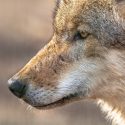
The advocates proved the illegitimacy of this act, but the damage is done: a wolf from Lus-la-Croix-Haute was shot and killed. Indeed, the Administrative Court of Grenoble has just declared to ASPAS and One Voice that the order from the Prefect of Drôme (26) to slaughter a wolf on September 1st 2015 was illegal. They had illegally authorized the slaughter of a wolf by « Reinforced demand shoot to kill » valid for 6 months in 3 communes Drômoises, Lus-la-Croix-Haute, Treschenu-Creyers and Glandage.

At the time, the Grenoble summary judge refused to urgently suspend the permit to kill, and a wolf was quickly shot dead by hunters during a big game hunt on December 12th 2015 in Lusaka, la-Croix-Haute.

The Administrative Court follows today our argument: this levy on shooting was not justified; this wolf was illegally slaughtered.

The administrative judge recalls that a war on wolves cannot be allowed if everything else has not been implemented to protect herds at risk of predation. There are indeed means of protection for herds and there are categories or rankings of shootings that the Prefects can authorize. These categorised shootings are intended to kill wolves, a protected species, only as a last resort, and only if damage persists despite the implementation of protective means and the use of warning shots.

More than being unequal, the death of this wolf has also been a useless exercise! Thus, the attacks were more numerous after the execution of this wolf: 21 attacks in 2016 against that of 19 the previous year (source: DDT 26- Balance sheets of attacks on domestic herds – Year 2016 to 31/12/16 and year 2015 at 31/12/15). Killing a wolf does not make it possible to reduce the damage, this is also noted by experts commissioned from the National Museum of Natural History and the National Office of Hunting and Wildlife, so slaughter is not the solution!

To allow a coexistence between faunistic biodiversity and pastoralism, a profound change in farming practices and the French subsidy system – which currently does not sufficiently encourage the good practices of certain farmers – is necessary.

ASPAS and One Voice renew their request to stop the shooting of wolves, and to cancel the compensation paid to farmers who do not protect their animals.

Celebrities and the public continue their mobilization: cyberaction #SOSloups

Share on

Every day is a day too much! One Voice in action in Granville for circus animals in France

Every day is a day too much! One Voice in action in Granville for circus animals in France

Every day is a day too much! One Voice in action in Granville for circus animals in France
12.07.2017
Manche
Every day is a day too much! One Voice in action in Granville for circus animals in France

Already 20 countries in the world prohibit the use of wild animals in circuses. 64 French cities have also joined in. One Voice launches an inverted countdown and asks France to be the 21st country to refuse their exploitation!

It was July 12 in Granville, where one of the biggest circuses with animals from Europe was performing, time now for an action with the model Juliana Marques.

Locked in cramped trailers, transported from town to town, wild animals have no place in circuses. The experts commissioned by One Voice are unambiguous, nothing can be done to satisfy their well-being in travelling shows. Jumbo the hippo only comes out of his truck for 30 minutes a day. He only gets a jet of water when he should be spending long hours underwater. Elephants such as Maya or Samba suffer from
the loneliness of going crazy. We remember the dramatic escape of Samba in 2013, which cost the life of a passer-by. The elephant Lechmee is blind and handicapped. She is unable to feed herself without the help of her companions and suffers at every step. And we’ve also seen the lion Chirkane rebel against his handler.

Awareness is on an international level. 20 countries in the world have already banned wild animals in circuses, 16 have taken at least partial measures. In Europe, 20 countries have partially banned them. Will France be the 21st country of the 21st century to achieve a ban? 64 municipalities have already positioned themselves in this direction and the circuses themselves have begun their conversion, lately we have seen André-Joseph Bouglione convert.

On July 12th, on the occasion of the launch of its new campaign « One day too many in the circuses », One Voice was in Granville where the biggest circus with animals of Europe raised its marquee. Beside us, the model Juliana Marques carried her message. After 5 hours of an artistic body-painting by the talented Ophélie Nezan, she represented the fight that we lead in the best way possible, in the form of the tiger, the logo of One Voice.

A special internet site was launched on July 11, launching an inverted countdown and prompting the public to metaphorically saw through the bars of animal cages held in circuses. Our latest survey (IPSOS / One Voice in December 2016) indicates that a large majority of French people consider that the animals are stressed (80%) and unhappy (69%). A major turning point is finally announced in this fight that One Voice has been conducting for 18 years! With the support of the greatest number, it can be crossed. Providing these animal prisoners with a peaceful end to this captive life is just a click away.

Muriel Arnal says: « For wild animals who live in circuses life is unbearable. What they suffer there is like slavery. In this prison world, a life of beatings and privation, they eventually go mad. And is it their madness and their submission to this violence that should be shown to the children? It’s time for this to finish. The world is ready. France, which has already positioned itself for dolphins, must go further. The circus of tomorrow will be without animals! « 

Share on