Primatology Centre in Rousset: Europe questions France on primates bred for its laboratories
Long kept under wraps, the project to expand the primatology centre in Rousset has now been revealed. At a time when technological advances, particularly thanks to AI, are leaping forward, the use of our closest cousins in laboratories is giving rise to growing controversy, even beyond our borders. And faced with this outdated French stance, the campaign is changing scale. A group of MEPs is challenging the French authorities and sharing its concerns about this project.
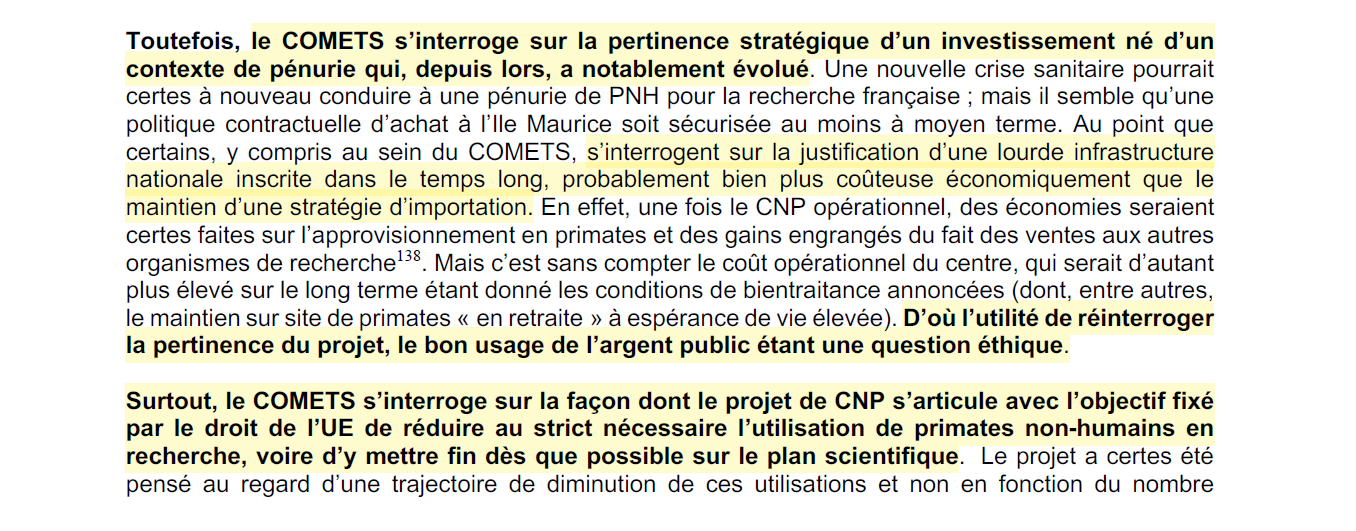
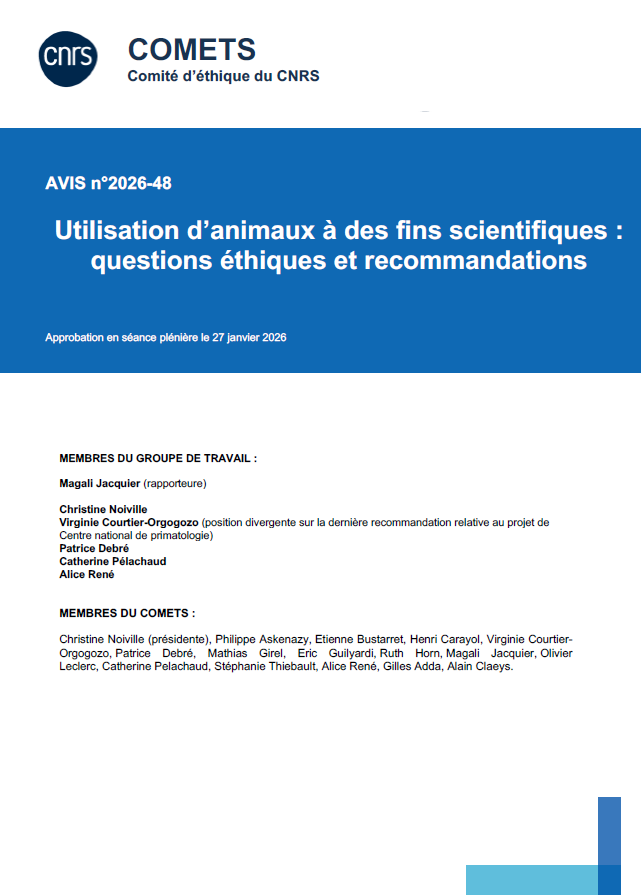
Dated 20 January, the letter from a group of MEPs addressed to the Minister of Higher Education and the CNRS’ Ethics Committee states unequivocally:
An initiative that is clearly out of step with scientific progress, the current and future priorities of European research, and the expectations clearly expressed by civil society
(excerpt from the letter dated 20 January 2026)
Between opposition and ‘deep concern,’ the elected officials clearly question the CNRS’ desire to expand the primatology centre in Rousset in the Bouches-du-Rhône region. This project, which we have been denouncing since the summer of 2024, was developed in complete secrecy. It plans to exploit up to 1,800 primates – compared to 600 at present – and to supply 40% of European research.
Through investigations, petitions and demonstrations, our campaign has broken the silence, and now the voices of these caged primates are being heard within European institutions. Europe refuses to condone the exploitation of macaques, baboons and marmosets, social, empathetic and intelligent beings condemned to years of isolation, torture, hardship and manipulation.
A fight for transparency
Beyond the fate that awaits these animals, the MEPs also denounce the laboratories’ serious lack of transparency. This is a culture of silence that we have been fighting for a long time. In November 2025, faced with the repeated refusal of the CNRS and the University of Aix-Marseille to provide us with public documents detailing their experiments since 2023, we won our case in the Administrative Court of Marseille. This failure was also highlighted by the guarantor of the National Commission for Public Debate (CNDP) in their assessment of the consultation process.
Citizens are also saying no outside France
This public consultation delivered a clear verdict: 93% of the opinions submitted were against the project. Better still, the contributions overwhelmingly raised ethical issues related to animal rights. Opposition to primate experiments is also affecting Germany. A petition launched by one of our partners, Doctors Against Animal Experiments, has already gathered more than 40,000 signatures, paving the way for a public hearing. Here too, society is refusing to look the other way.
The future of primates in laboratories: a political choice
The Rousset case is revealing. It forces decision-makers to face up to their responsibilities given that the expansion of the site is not a scientific necessity, it is a political choice that places France at odds with forward-looking research. If the project is faltering today, it is thanks to our constant mobilisation. The debate is now public. The CNRS must respond to the report of the consultation guarantor by 16 February.
Primates are neither tools nor commodities. Join us in demanding a halt to the expansion of the Rousset facility by signing our petition. The fight continues.
Primatology Centre in Rousset: Europe questions France on primates bred for its laboratories
Following our campaign, the desire to expand this breeding facility which supplies laboratories has caused outrage even among members of the European Parliament.