Baby’s trainer faces justice on May 6th in Marmande

Baby’s trainer faces justice on May 6th in Marmande

Baby’s trainer faces justice on May 6th in Marmande
05.05.2019
Lot-et-Garonne
Baby’s trainer faces justice on May 6th in Marmande
Exploitation for shows

Do you know Baby? Perhaps your thinking no or probably you do. For more than 30 years, this elephant has been surveying film sets, appearing on advertising spots, participating in television shows, sitting on stools in circus shows… His trainer passes before the Agen Correctional Court in Marmande at 2.00 pm on Tuesday, May 6th for the irregular exploitation of a non-domestic animal.

An elephant uprooted

Originally from Africa, Baby was captured in 1985 when she was two years old. Like all baby elephants kidnapped in the wild, she had to live through many traumas before ending up in France to perform in shows. Since then, she has been offered for rental by Gilbert Bauer, she has been used to host both official inaugurations, Christmas trees, trade fairs, municipal parades, children’s snacks, birthdays and other private parties. Listening to the trainer, Baby is like his daughter and swims in happiness by his side … The public is fooled by this illusion, but is this the life for an elephant?

Uprooted from her native land, isolated from all contact with her family-while elephants are highly social animals-and suffering from a disability in the rear left foot, she is so alone … At her age, Baby should live on the burning hot planes of the savannah along with his aging mother and sisters, baby elephants and nephews. Walking would be their daily life, helping to teach little ones, the transmissions from the matriarchs. Their common memory would take them from place to place, those of love, those of meditation, those of feasts…

But Baby is far from this life, she can only dream of it now, forced as she is to turn around on a stool, to return the ball to thunderous music, to pose for photos or to be forced to parade on tarmac, close to humans she should never have met.

The penal procedure

The association has been tracking and monitoring Baby for a long time, and has consistently gathered evidence to denounce and rescue her.

On May 27th 2017, Gilbert Bauer went too far, and our warnings were heard by the authorities. That day the trainer paraded Baby without respecting the regulatory safety measures concerning the presentation of wild animals to the public. Inspectors from the National Office of Hunting and Wild Fauna (ONCFS) were able to observe that no electric barrier or fence separated the crowd from the elephant. Also, these elephants had to support performers that were perched upon their backs and that any of the public, including children, could approach her very closely.

The consequences of this offense could have been dramatic and Gilbert Bauer is now being prosecuted for the illegal exploitation of non-domestic animals. He is scheduled to appear before the Agen District Court on May 6th at 2 p.m. It is a step forward. One Voice however wishes to go further and requests that this criminal procedure be reclassified as ill-treatment and that Baby be entrusted to us.

For her and all of the animals exploited for the entertainment of certain
humans, we call for the ban on this practice. Their place is in a sanctuary !

All in Antibes for Inouk!

All in Antibes for Inouk!

All in Antibes for Inouk!
03.05.2019
Antibes
All in Antibes for Inouk!
Exploitation for shows

Inouk needs all of us. No orca should be in the pools of a dolphinarium, and the case of Inuk is worrying in every respect. At barely twenty years old, he already has no teeth, his dorsal fin almost always out of the water and flopped over on his back… Marine mammal experts have never seen that before. We are determined to offer him another life, a real life. We will be at 5.00 pm in front of the town hall of Antibes Juan-les-Pins on Tuesday, May 7th for him with John Hargrove.

How can you not feel moved for him and also at the mention of his name? Inouk has never known freedom but keeps going around and round in the
Marineland pools. His extremely effective sonar is of no use to him in the jar where he survives. He should be able to dive deep, swim tens and tens of kilometers each day, stay away from the sun. His dorsal fin lies, collapsed on one side, a phenomenon rarely observed and a sign of serious trauma and poor health in wild orcas… The members of his family have either lost their lives or been sent to another dolphinarium. If he had not been subjected to captivity since his birth, nothing would have pushed him to gnaw at the walls of his pool until the pulp of his teeth was exposed and it was necessary to devitalize them, even to tear them off. His freedom would have been unlimited, and his life, one so rich for an orca!

An orca without a future, that’s what Inouk seems to have become. The park does not even try to justify that it contributes to the conservation of the species, or that the demonstration of the domination of an animal by a human has an educational interest… We have filed a complaint against Marineland for acts of cruelty to Inouk at the court of Grasse early in April. The expertise of Ingrid Visser, John Jett and Jeffrey Ventre is documented, well-argued and structured. More than anything, it is without appeal: Inouk needs another life, far from pools empty of meaning, empty of interest, empty of choice, empty of all that an orca needs.

A rally is scheduled in front of the town hall of Antibes Juan-les-Pins at 5.00pm on Tuesday May 7, to make the voice of Inouk be heard, whose place is in a marine sanctuary. It sounds loud and clear in the ears of our leaders! We also call for the closure of dolphinariums and the adoption of a new decree.

Please sign our petition, let’s all ask for a life for Inouk!

Circus on trial for abuse on Jumbo: a first!

Circus on trial for abuse on Jumbo: a first!

Circus on trial for abuse on Jumbo: a first! 03.05.2019
Drôme
Circus on trial for abuse on Jumbo: a first!
Exploitation for shows

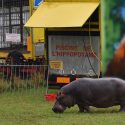
Following One Voice’s complaint against the Muller Circus and its investigation and the glaring evidence, the investigation has finally come to an end. In the end and for the first time ever in France, the trial of a circus for ill-treatment of an animal. The hearing will be held at 9:00am on May 17 at Valence court. After three years of constant struggle for Jumbo, we look forward to his release and the condemnation of the circus! No hippopotamus should have to live in such suffering.

Thirty years until he is to be finally saved from his hell. Jumbo should be surrounded by his own kind and to be carried away by the water flow of the rivers. Instead, he remains alone, locked in a prison truck.

After an exceptional procedure, the urgent referral and a rallying that showed the true face of these circus people, we reinforced our investigation. A new hope had recently appeared in Jumbo’s life, but even in facing the state authorities, these circus people thought themselves untouchable. Jumbo had never been so close to freedom. You have been numerous in your numbers to rebel against this violence and to show us your support in our struggle for him. Nothing will discourage us.

L’hippopotame Jumbo vit dans un cirque depuis 30 ans. Enfermé seul dans l’obscurité d’un camion, il ne sortirait que 30 minutes par jour… L’ONG @onevoiceanimal l’a suivi à travers la France et milite pour sa libération. pic.twitter.com/ex5ASMvPOM

— Brut nature FR (@brutnaturefr) 27 mars 2019


Our complaint for mistreatment, filed two years ago now gives rise, finally, to the trial of the circus! The hearing will take place on May 17 at 9.00 am in Valence. There is room for hope. More than ever now, we will do everything to give Jumbo the life he deserves and has been waiting for, for so long! If Jumbo is entrusted to us, we will send him to a sanctuary in Africa where he can finally relieve his feet during long and peaceful swims, and discover his ancestral lands.

For him, please continue to sign our petition!

Evidence about the Link: New initiatives in the UK

Evidence about the Link: New initiatives in the UK

Evidence about the Link: New initiatives in the UK
02.05.2019
United Kingdom
Evidence about the Link: New initiatives in the UK
Domestic animals

Since 2001, the National Society for the Prevention of Cruelty to Children (NSPCC) and the Royal Society for the Prevention of Cruelty to Animals (RSPCA) have been working together on the issue of the Link. Together with other organizations pursuing similar objectives, such as the British Veterinary Association (BVA), they form the Links Group1, which is affiliated with the « National Link Coalition ».

« The mission of the Link Groups is to promote the well-being and safety of children, animals and vulnerable adults in order to protect them from violence and abuse. »

The main results from the Link Groups to date are as follows:

  • More referencing between the different organisations
  • The first ever law cases won in non-accidental injury cases for the RSPCA
  • The first ever trial won in a non-accidental injury case for the Scottish SPCA
  • Undergraduate training in veterinary medicine
  • The addition by the Royal College of Veterinary Surgeons of an appendix guide to good professional practices concerning the conditions under which it is possible to derogate from the principles of confidentiality in certain circumstances.
  •  Expansion of services for domestic animals

In 2003, the NSPCC published for the first time a pamphlet for child, family and animal care professionals, titled “Understanding the Links (Between) Child Abuse, Animal Abuse and Domestic Violence”.

Written on the basis from contributions to the international conference on the relationship between animal abuse and violence against humans held in 2007 at Keble College, Oxford. Also with the backing of the Oxford Centre for Animal Ethics, the The Link Between Animal Abuse and Human Violence, which has been published by Andrew Linzey, has become a reference publication for global research aimed at a better understanding between the relationship of animal abuse and that of violence against humans2.

In 2018, new initiatives were launched. The link between animal abuse and violence against humans is now indisputable, but the application of this concept in Europe remains practically non-existent. The Royal Society for the Prevention of Cruelty to Animals (RSPCA) now reports animal abuse cases when there is a suspicion of associated child abuse. Of these reports, 86% resulted in the identification of child protection problems previously overlooked by the authorities.

« Protocols (formal) using a risk assessment checklist » are emerging, which could significantly increase the number of reports. Considering that the RSPCA received 129,000 reports last year, the potential for discovering « hidden » abuse cases with an optimized reporting process across England and Wales is considerable. This initiative has drawn the attention of the College of Policing, whose assessment of the risk of domestic violence, harassment or honour-based violence (Domestic Abuse, Stalking and Honour Based Violence, or DASH) is available to all front-line police officers. The crime prevention department of the UK National Crime Agency also expressed interest in this initiative.

Local adult and child safety boards are now working to provide a more comprehensive second-level investigation in response to the risk assessment checklists managed by first responders. This is essential, given that first responders have limited opportunities to conduct comprehensive assessments, while these specialist groups have the necessary authority and competence.

Identification of interhuman violence and mistreatment: Relay procedure between the first two levels of intervention

Referral process for the first responder in an animal abuse case

The first responder investigates a case of animal abuse.

Intuitive checklist and evaluation

  • Criteria fulfilled: reporting to the authorities responsible for the protection of children and
    adults for a second level assessment
  • Criteria not met: no subsequent action

Second level assessment

  • Guilty party identified
  • Proceedings
  • Safeguard
  • Response to vulnerability

Other organization

Needs assessment

Sources
1www.thelinksgroup.org.uk
2Brighton, Royaume-Uni, et Portland, États-Unis : Sussex Academic Press, 2009. Publié en France par One Voice en 2012 sous le titre « Violence sur les animaux et les humains… Le Lien »

Wolves threatened by the pressure from hunters

Wolves threatened by the pressure from hunters

Wolves threatened by the pressure from hunters
30.04.2019
France
Wolves threatened by the pressure from hunters
Wildlife

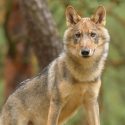
While advocating the “regulation of game animals”, hunters want to eliminate wolves who have the misfortune to eat “their own game”. When will we ever have a healthier relationship with animals who are free?

The return of wolves to France schematically divides hunters into three categories. The first, marginal, is that of those who refuse to shoot wolves, believing that these animals are apart, have a special aura and are not « game ». We may be surprised by this radical categorization but it exists in the minds of some.

The second category of hunters are pleased with the return of the wolves, considering that it is an additional « game », whose « exceptional nobility » promises a more interesting hunt for the hunting parties. They arrange shooting permits issued by the state, giving them the impression of enjoying privileges as regards to a « protected » species.

Finally, hunters in the third category refuse the return of wolves, arguing that these « ferocious beasts » will eradicate « their game », that is to say the wild animals with hooves. These hunters advocate a “regulation” of wolves that hides the real desire to eradicate them, when we really know how scarce these animals are. Many local newspapers take up these arguments or rather the absence of arguments on these gun carriers. In the Alpes-Maritimes, a « group of anonymous hunters » recently spoke in the daily newspaper the Nice-Matin to proclaim the need to « regulate the wolves if we want to preserve our species ». Leaders of hunting federations are accustomed to making such comments.

Wolves certainly eat deer, stags, chamois and other ungulates. It’s their staple food, like foxes eat voles, like dolphins eat fish. Who would have the crazy idea of wanting to « regulate » dolphins or orcas? Like them, wolves are self-regulating predators. In the wild, wolves do not proliferate any more than dolphins, orcas or sharks do.

That is to say that 500 wolves – the estimated number of wolves in France – who naturally kill for food will never have as much impact on nature as a million hunters who only kill for fun. Wolves certainly take their part, a vital one, by influencing the ungulate
populations. However, they have never made them disappear. Prey and predators have co-evolved for hundreds of thousands of years. Wolves are part of European ecosystems, as are deer, stags, chamois and wild boar. Yet some would like to hunt them in national parks.

In France the department of Alpes-Maritimes is one of those which has the most wolves in the wild, around a hundred. With a very wide range, we can estimate that these wolves kill 2,000 wild ungulates each year for food. In comparison, at the same time, the 7,000 hunters in the department have officially killed 12,000 ungulates and several hundred thousand
birds and other small animals.

For years, hunters have told us that « taking » (that is, slaughtering) is essential for the « regulation » of wild ungulates which, without hunters, « would proliferate ». Now that a few wolves live in the country’s forests, these same hunters
suddenly forget the « proliferation » of ungulates to imagine
only that of wolves. The authorities reinforce this madness by
seeking to kill more and more wolves.

The
17 million hectares of French forest can accommodate many more wolves
than of present, displeasing the hunters who want to own « game ».
It is high time to abandon this word, « Game » should not
exist. There are only free animals, the property of no one. Wolves
kill by vital necessity. They do not have the choice. Hunters kill
for recreation. They have a choice. It was a hunter who killed in
2004 the last native bear in the Pyrenees, Cannelle. It is the
hunters who today threaten the survival of the few lynxes still
living in eastern France. These people must know that a forest
without a wolf, without a bear, without a lynx is like an ocean
without a dolphin, without an orca, without a shark. The hunters who
want to eliminate wolves are like fishermen who hunt for dolphins,
killer whales, they are like gravediggers amongst the living. Let’s
say it, they’re criminals.

At Saint-Paul Park, a baby tiger and a young audience in danger!

At Saint-Paul Park, a baby tiger and a young audience in danger!

At Saint-Paul Park, a baby tiger and a young audience in danger!
29.04.2019
Oise
At Saint-Paul Park, a baby tiger and a young audience in danger!
Wildlife

At Parc Saint-Paul, in the Oise department (60), the animal keeper Kid Bauer exhibits a baby tiger as a trophy. Extremely objectified, the little beast passes from hand to hand without care or precaution, and undergoes long photography sessions on the knees of the children. This “attraction” presents as many risks for the feline as for the young public. We are filing a complaint against this establishment.

Come here, ladies and gentlemen … And especially the children! A baby tiger awaits you, almost in « free access », under the tent in Saint-Paul park, in the Oise department (60). Keeper Kid Bauer places his new mascot at your disposal to play with, to rock like a baby and to kiss! Your little one can even be photographed with the animal in their arms, against a 10 euro note. A “marvellous” opportunity to immortalize this “magic” moment where a one-and-a-half-month-old animal is man handled like a toy and in a state of intense stress is placed for a few seconds on the lap of your child… Before it is then passed around on to someone else’s lap !

Caresses and mistreatment

The attraction is a great success … So, think, who would not be seduced by this adorable fur ball, as harmless as a soft toy, presented by trainers as a lover of cuddles? The queue is long, toddlers are thrilled … At their age, it is impossible to imagine that adults can tell and / or do anything … However, the young feline does not need all of them these outstretched hands or the constant chain of caresses… On the contrary, they are terrifying to this baby tiger! Between the blinding neon lights, the deafening din, the oppressing crowd, being carried about by members of staff, the hundreds of unknown fingers foraging through its coat, this poor baby has to endure this ordeal.

Sanitary risks

Our investigators reported a video testifying to the multiple traumatic sources to which the baby is subjected. The only love that his eyes
crave is that of his mother, from whom he was snatched! The unhappy mother is also probably looking for him. Besides, where is she hiding? Her baby is not even weaned yet! We have forwarded these images to Dr. Chris Draper for expertise. The biologist, specialist in the welfare of captive wild animals within the Born Free Foundation, worries as we do about the treatment of this fragile feline. In addition, he underlines the risks that constant handling represents for the baby’s health as well as that of the young audience who touch him:

«There is a risk of disease transmission: neither children nor the baby tiger have yet fully developed their immune systems.»

We must therefore react urgently and not let this situation continue!

We are filing a complaint against this establishment and demanding the seizure of the little tiger and its mother. We have the logistics and infrastructure to welcome them and keep everyone, including cats and humans safe !

The disappearance of insects, an unprecedented disaster

The disappearance of insects, an unprecedented disaster

The disappearance of insects, an unprecedented disaster
28.04.2019
Monde
The disappearance of insects, an unprecedented disaster
Wildlife

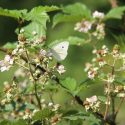
Scientists have concluded, insect populations have collapsed. The consequences are immediate: a fall in the populations of birds, amphibians and bats. One Voice has challenged itself to create a vast network of « Arches of Nature », private sanctuaries and gardens and natural spaces, guaranteeing the absence of pesticides and prohibiting hunting.

If anyone doubted it, the study published in the journal Biological Conservation on February 10th 2019 is very clear, we are no longer running from a disaster, we are now right up to our necks in it! If from year to year we had noticed that we have heard less and less birds singing in our countryside, few of us may have noticed the decline, much more significant however, the populations of insects. However, it is the disappearance of these insects that has caused the decline in the number of birds.

Researchers from the universities of Sydney and Queensland have synthesized a dozen studies that have been done around the world by various scientific organizations. Their observation is formal: the catastrophe announced by Rachel Carson in 1962 in her work « Silent Spring » has indeed arrived! We have destroyed billions and billions of insects with the over use of pesticides, so much so that we may have reached the point of no return !

The point of no return already reached?

Puerto Rico has lost 98% of its insects! Even in German nature reserves the insect populations have dropped by 80%. We have done no better here in France. This is true for most species’ groups, and especially for pollinators. The consequence of these disappearances is as
serious as it is rapid: 80% of flowering plants are pollinated by insects. Without them, eight to nine plants out of ten would not be here today.

On the survival of insects depends ours

The disaster will not only be felt on the diversity of wild flora, but also on the crops used for our consumption. Without insects, only grasses (wheat, rice, barley, etc.) which are pollinated by the wind, will be able to bear fruit and reproduce ! No more tomatoes, zucchini or apricots ! Our menus will become very sad, this situation will inevitably lead to famines around the world, and with them, their share of human and animal migrations and of course the armed conflicts that they will cause. This from the lack of butterflies, bees or pollinating flies !

Birds already impacted

Already, it is our friends the birds who have paid a very heavy price for our thirst for dominating nature, for intensely producing agricultural products that are increasingly toxic to humans and the environment. The passerine populations have already dropped by more than a third and of course, it is the species subservient to open environments, therefore to agricultural areas, who pay the highest price for the disappearance of insects. Some species, commonplace 30 or 40 years ago, have now become very rare. Thus now, we hear and see rarely the buntings or the grey shrike. The larks, which were still so numerous in our yesterdays, have become scarce over their entire area of presence (despite this very significant drop in their population, the larks are nevertheless still hunted in France, using cruel traditional methods of hunting! …).

Most passerine species, even granivores, require insects (larvae or adults) to feed their young and to feed themselves during the breeding season. In Europe, the loss of 80% of insects over the past thirty years has caused the disappearance of 400 million birds !

There is an emergency, let’s act!

Birds aren’t the only ones experiencing starvation. Bats, shrews, frogs and lizards, also consumers of insects, are directly affected by their
disappearance.

It is our responsibility, and even our duty to act. By our patterns of consumption, of course, by favouring products from organic farming, but also by direct actions for insects. Let’s open up our gardens, meadows and fields! It’s urgent!

Join the One Voice “Arches of Nature” network. Leave flowers and even « weeds » to feed and breed insects away from sprayers. This is the biggest challenge we will face. If collectively we do nothing in practice, the government will continue to favour intensive agriculture which has led us to this disaster.

We are counting on you ! Download and sign the « Arches of Nature » charter and return it by post (One Voice, 7 place de la République, CS 20263, 56007 Vannes Cedex) or by e-mail to info@one-voice.

Orcas and belugas trapped in Russia: hope is reborn!

Orcas and belugas trapped in Russia: hope is reborn!

Orcas and belugas trapped in Russia: hope is reborn!
25.04.2019
Russie
Orcas and belugas trapped in Russia: hope is reborn!
Exploitation for shows

Relief! An international scientific expedition, supported by One Voice, visited Russia in early April. Eminent experts in marine mammals have gathered around Jean-Michel Cousteau, they have been able to launch a cooperation program to save orcas and beluga whales captive in the Srednyaya bay.

Unfortunately, it will take a long time, but it is now a certainty: the 97 orcas and belugas illegally captured in the Sea of Okhotsk and sequestered in the Srednyaya Bay, in the Russian Far East, have now a real chance of regaining their freedom! Despite pressure to protect the four companies that appropriated them, local activists have worked tirelessly to alert the international community and to secure the movement of leading experts in the support of these endangered animals who are in great suffering. All of this has been achieved with the consent of the Russian authorities !

International shipping

Engaged in this collective fight since the revelation of this affair and its many twists and turns, having helped to lead a team of experts, we are very happy to be a part of this expedition. The expedition team leader is Jean-Michel Cousteau of the Ocean Futures Society and Charles Vinick of the Whale Sanctuary Project – to Russia has been the organizer from April 3 to 11.

Thank you so much, @onevoiceanimal, for being part of our international effort to free 97 captive orcas and belugas from « whale jail » in Russia and return them to the ocean. #WhaleAid https://t.co/gXm95BTSHp

— Whale_Sanctuary (@Whale_Sanctuary) 10 avril 2019

Their mission: to assess the condition of the 10 orcas and 87 belugas locked up in an open-air prison and to advise the government on a rehabilitation program with a view to their return to the ocean. There is an urgent need to rescue them, because since the start of
this series of captures in July 2018, four of these unfortunates have already gone « missing » !

Joint declaration

This visit allowed a giant step in the coordination and development of the rescue project. Jean-Michel Cousteau and Charles Vinick agreed with Oleg N. Kozhemyako, the governor of the Primorsky region where the prisoners are kept, around a joint declaration. The agreement plans to immediately begin work to keep marine mammals in conditions close to their original environment, while also planning the creation of a re-education and rehabilitation centre for the injured. He also claims to pursue, ultimately, the goal of freeing them all! We will make sure of it.

Russian and international scientists from the Cousteau team will therefore continue to assess individuals to determine when and how to release them. The New Zealand biologist Ingrid Visser, who was on the trip and who saw at first-hand the urgent need to intervene, is delighted with this tremendous advance:

«It was extremely distressing to see the orcas and belugas so detained, but I am relieved to know that the governor of the Primorsky region where they are being held signed an agreement to rehabilitate them before releasing them

Long-term cooperation

Why not release these suffering mammals immediately? Because their nine months of detention requires them to readjust to an independent and wild life. The cold, the stress, the break-up of family cells and the captivity in artificial groups upset all their social references and has weakened them both physically and mentally. Today, we must therefore try first to cure them of the shock they suffered and create conditions favourable to their release.

Lori Marino, president of the Whale Sanctuary Project, stresses the importance of addressing each of them individually, at their own
pace :«Each of the 87 belugas and 10 orcas is an individual and each of them has faced the trauma of capture and sequestration in a unique and individual way. In this aspect, they are really like us. Thus, each of them must be taken care of individually to assess their mental and physical health and what they need.»

Because, even if the lovers of dolphinariums continue to struggle to convince themselves that there is no problem, it remains clear that orcas and belugas are like us. Emotionally gifted, endowed with high intelligence and possess real cultures, it is up to us to protect each of them in their specificity, their own history and their unique psychology !

We must save the primates

We must save the primates

We must save the primates
23.04.2019
Monde
We must save the primates
Animal testing

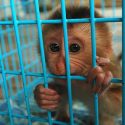
One Voice remains at the forefront of the fight against the despicable international trade of primates for research. In memory of Kéo and Sambo, these two baby monkeys encountered in Cambodia many years ago, we must constantly affirm our fight and our resistance to this market of violence and suffering.

It’s been 10 years since One Voice began a strong campaign of resistance to the exponential growth of primate trafficking from Cambodia to the European market. Our involvement in this fight will soon pass a quarter century and our determination remains intact and assiduous. Our first victories are only the beginning for those to come.

Starting in Cambodia, our investigation denounces all international traffic

When in 2008, the centre of primatology Niederhausbergen, Alsace, imported monkeys from a breeding centre in Cambodia, Muriel Arnal, president of our association, sent investigators into this country to bring back images on the conditions of these captive animals. These
traumatic videos bring us closer to the horror, the pain that emanates from them. Whatever our position on animal welfare, how can we not feel anger at so much suffering? How not to feel helpless in front of these mums who try to protect their little ones to hide them from the intrusive eye of the camera? How do you make them understand that we are here to testify, and help them? One Voice refuses to let this pass in silence, our association has highlighted this urgency with a new resistance campaign started back in 2009. We must again today highlight this ceaseless and vital struggle for our primate cousins.

At the beginning of this year, we learn that China has just cloned five monkeys from a macaque’s modified genes with sleep disorders – one is dead and the others are suffering from serious pathologies, anxiety, depression, schizophrenia – it is high time to give this fight a new impetus.

More than two decades of struggle, we must continue the fight

Taken from their mother’s arms, captured in the wild, raised in cages or cloned, thousands of young primates live the worst of anxieties. It is essential that animal rights activists around the world awaken their sleeping consciences. We who, since the 90’s, are taking action
with our partner, the BUAV (British Union Against Vivisection), we must remember that tenacity can give results. In 1996, we legally rescued 36 crab-eating macaques from a laboratory. They were placed in the L’Arche Refuge. That same year, we blocked the project of the largest breeding centre of primates in Europe (Holtzheim in Alsace). In 2003 the campaign « Air France-Air suffering » began.

As in 2009, we must resume an emergency campaign for new resistance to the growing international trade in primates for research.

Despicable and shameful, because they resemble us

Every year in the world, more than 100,000 monkeys and apes are used for biomedical research. Primates are very intelligent animals, with complex social behaviours. They feel pain and suffering, just like humans. Researchers take advantage of these characteristics to conduct various experiments on them.

But their suffering begins well before arriving in the laboratories. In 1991, the BUAV survey revealed a very high mortality rate amongst monkeys caught in the wild (8 out of 10 primates die before reaching the laboratories). The investigators were able to highlight the cruelty exerted on the captured primates, held in narrow and overcrowded cages in detention centres, and in aircraft holds.

In order to remove all humanity from these transactions, the actors of this traffic hide the monkeys under the acronym PNH, Primates Non-Human. How can we gather more than 550 species under such a cold name? These primates are our cousins, our relatives, in their diversity and their richness.

We refuse the use of primates, as with all living things used in research

This information from China on the cloning of primates should push us to put forward our values and our ethics on the defence of animal rights. We refuse any form of vivisection. We refuse any beneficiation for anybody: traffickers, breeders, laboratories, by the use of primates or animals whatever they are, rodents, dogs or others, for commercial ends. We refuse to condone the trivialization of this exploitation in the publication of writings that give good conscience to those who write and disseminate them.

One third of the primate species are in danger of extinction. For them, we take this reality into account and continue our fight without compromise.

For those who don’t count …

For those who don’t count …

For those who don’t count …
23.04.2019
France
For those who don’t count …
Animal testing

Europe requires its member states to publish annual data on the volume of animals being tested. For without quantifying its victims, science could kill without counting. This is unfortunately the case … So, action !

In 2015, the European Commission wrote: « Animal testing should be phased out. This is the ultimate purpose of EU legislation … « . Without numbers, which places the victims in a real black hole, how do they measure progress? This posture is untenable for One Voice and citizens who no longer want these procedures, nor the opacity that surrounds them.

Obligations not respected

According to Article 54 of the European Directive on the protection of animals used for scientific purposes, as any Member State, France must publish each year figures on its progress towards the abandonment of animal testing. Problem is: the latest statistics from the Ministry of Higher Education, Research and Innovation dated from 2016! In recent years, the Ministry also recalled that because of transitional measures (until the end of 2017), any comparison with previous figures would be inappropriate until 2018. Well ok, we waited and are now in 2019, So, when? Updated, consolidated, legible and in line with the statistical formats of the European Union?


2018 should have been more than one year of fertile figures quantifying the real level of victims of animal testing in France and Europe. The European Union’s last report on the subject dates back to 2013 and is expected to be five years old. We think about the exact balance of the REACH Regulation, governing the use of chemicals in Europe. We also think about the use of animal testing that could explode because of this regulation through the testing of products for registration, required until May 2018.

Without transparency, we are lying

One Voice has been constantly asking for the truth and updated statistics on animal testing in France, by many means of appeal: letters to the
ministry, the last dating from November 2018, but also, in the absence of response, appeal before Administrative Records Access Commission (CADA). This time, the cup is full and we will file a complaint to the European institutions for noncompliance with the directive 2010/63 and violation of its article 54.

Except to flout the rules or to modify the perimeters to dilute the reality, if our virtuous science has really taken the measure of legislation (that is to quantify the number of its victims) and the spirit of its better (to reduce this number) Then, where are the numbers ?

We fear the worst ! The latest figures from the European Union, consolidated on 2011 data, say that about 11.5 million animals are killed per year in European laboratories. In France (2016 figures), there are more than 1.9 million animals. If in 2019 these numbers are not lower, citizens will know that it’s wishful thinking, ensuring that science is working to reduce this massacre is all but lies. It’s a joke. But should these figures be published !