An alert and tears in Sologne

An alert and tears in Sologne

An alert and tears in Sologne
13.01.2020
Sologne
An alert and tears in Sologne
Wildlife

It is a call for help, for a mobilization that we received from Sologne. In this wooded land, where the worst forms of hunting are practiced, the excesses of a so called « leisure » activity practiced on a large scale by the wealthy owners, fuel the distress of ordinary citizens, non-hunters. Testimony…

Our friend Solognot wishes to remain anonymous, but we have felt his strong need to express the uneasiness shared by so many French people that hunting oppresses. Here, certainly more than elsewhere. Straddling three departments (Cher, Loiret, Loir-et-Cher), Sologne is 500,000 hectares, 70% of which is classified as one of the largest Natura 2000 areas in Europe. Historically, this sparsely urbanized territory, full of forests and ponds, has delighted hunters, many of whom come from Paris or abroad. Here, not far from Chambord and its ceremonial hunts, history has devoted these natural spaces to the leisure time of the rich and who have placed their economic weight on the local economy …

Call for resistance

For the residents who do not hunt, but are simply eager to take advantage of their natural environment, the woods, the water features are not walked across without apprehension. Plenty of death, the hunters repeat the same sentence to them: « you go at your own risk ». In fact, the sound of constant shots that ring out are in every corner of the forest, the climate of fear and insecurity is permanently there. « I know a schoolmistress who was confronted by the frenzied cavalcade of a hut during a school outing in the forest. She will not repeat this experience again given the terror that had struck the children … ».

Here, the hunters are at home and in their element. The hunting toll by year compared to the rest of France, is at a record level: especially being made up of private forests, Sologne sees its natural territory becoming more and more surrounded by fences of all kinds which delimit it, carve it up. Almost 4,000 linear km, this is huge! For the owners, wherever they come from, it’s all profit: tax exemption (including the installation of fences), sale of hunting rights in enclosed spaces, attractive venues where hunting is permitted all year, sale of game meat slaughtered in Rungis, sale of wood… For the others, human and non-human animals, it’s hell.

A terrible mess, but with impunity…

The worst part is that to the animals already trapped by fences or in maintained feeding areas, they add imported animals, without much control either, in order to feed large hunting clubs. All the natural gene codes and the behaviour of the wildlife are abused, with its paradoxical consequences… “We see at the edge of the roads groups of pheasants released for hunting. Accustomed to humans, they regroup and let themselves be driven without even trying to flee. Wild boars, manoeuvring as best they can within fenced off corridors, frequently being led onto the roads. The road accidents created by this will of course justify the need to hunt them… ”.

At the end of these ecological continuities, which disrupt the movement of humans and animals, there is visible pollution, close to the Loire, Cher, Sauldre: pellets, cartridges not picked up, bottles of alcohol, mass animal graves, sometimes full and found decomposing by the waysides … All this with perfect impunity: landowners have power, whether locally or on a national basis.

Our witness tells us of his disgust, his feeling of helplessness. He wants to mobilize more people to try to curb this excessive hunting that is devastating Sologne. Anyone wishing to answer their call, in order to protect animals and the biodiversity, can contact One Voice. And our petition to radically reform hunting is also a means of action. Please Sign the petition!   

The Grand Circus of Rome and the mistreatment in show

The Grand Circus of Rome and the mistreatment in show

The Grand Circus of Rome and the mistreatment in show
10.01.2020
Val-d’Oise The Grand Circus of Rome and the mistreatment in show
Exploitation for shows

At the Grand Circus of Rome, we enjoy making fun of people that we consider « smaller than ourselves ». So, we perform pirouettes, riding bicycles, buggies and primates transformed into maidens. When the show is over, it’s at the bottom of their tiny cages that we « throw » them. We are filing a complaint against the director of this establishment whose only rhyme is « maltreatment » with a « smile »!

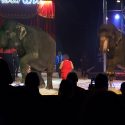
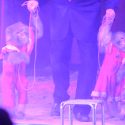
In the centre of the ring, a man, standing straight as an arrow and wearing a sequined suit. At his feet, two macaques, decked out in ridiculous costumes, they follow him attached with a leash. Their backs bent; they are ready to obey the craziest of orders. Here we present the sparkling ringmaster and his pathetic slaves. Here we see the great ape displaying its superiority over the other smaller primates. The act can now begin.

Domination, humiliation, applause

The trainer gets everything he wants from his living puppets. They start the show at the wheel of a motorized children’s cart. A simple snap of the « chef’s » fingers and they follow up with other well-prepared duties. The first macaque, wearing a frilly robe, must play as a tightrope walker and adopt an upright walking position on a beam. For a brief moment, he seemed to rebel. But he quickly swallows his exasperation and performs. There is no other choice.

So, this poor little man runs and tries to find his balance, at first with his arms free, then by adding weighted pendulums on which float three-coloured flags or equipped with small buckets … It’s the second monkey’s turn. Wearing red overalls and with a matching umbrella, it is subjected to similar exercises. Before being forced to ride on the ground on a scooter, then pedalling on a tricycle… The spectators rejoice as the sad little clowns are greeted by their applauding.

For on this evening, is it the end of their torments? Though it appears not. A little later, during the performance of a young Circassian of ten years old, two macaques – apparently the same – are still seen still tumbling and performing under the big top … This time it is four members that are tied to ponies and then these unfortunate beings must endure the ultimate torture: riding at speed, jumps and other antics, all to the clack of the whip…

An alarming evaluation

These surreal scenes seem straight out of a bad movie. However, this is the sad reality of these monkeys who are forcibly recruited by the Grand Circus of Rome. Our investigators followed several representations of this establishment last October and collected videos, each more appalling than the other.

We submitted the images to Dr. Siân Waters, a leading specialist in captive and wild primates. His alarming report concludes that the well-being of these animals is seriously compromised physically and psychologically.

The expert stressed in particular that bipedal walking is not a natural behaviour in macaques and that forcing them to perform abnormal movements can put unnecessary pressure on their bodies, leading to deformity, lameness and injury. She also recommends a rapid examination of one of the primates by a veterinarian. In addition, she denounces the compulsory wearing of clothes which obstructs gestures while causes itching and irritation.

As for the riding act, he is particularly concerned:

«Getting used to such movement restriction is impossible and these monkeys have no control over what happens to them, which seriously affects their psychological well-being. Their physical safety is also greatly compromised when a pony stumbles and falls: bound by their arms and legs, they are sure to be injured. »

Finally, the scientist points to the endangerment of the public when the macaque’s approach them by walking on the surrounding spectator barrier.

The filing of a complaint

At the end of the show, when the lights go out, it is in the shade and behind fences that we find the little monkeys lying flat on the floor. They, as well as other animals, all sequestered in cages and enclosures devoid of any enrichment, where their physiological needs are flouted. On visiting the premises, we noted numerous breaches of legal regulations by the Grand Circus of Rome.

While its owner is strutting around in the media accusing animal advocates of their « fantasies », we are filing a complaint against him based on facts, nothing else but the facts.

Solidarity Fund, Emergency Australia

Solidarity Fund, Emergency Australia

Solidarity Fund, Emergency Australia
07.01.2020
Australia
Solidarity Fund, Emergency Australia
Wildlife

Dear friends,

By choosing to defend animals, we have broadened beyond the horizons the human meaning for family. This is even more evident in the name of solidarity within our great family that I am writing to you about. At the dawn of every new year, I always ask myself the same question: will we be able to face the unexpected, the «hard knocks»?

In January 2005, our veterinarians were the first on site in India and on the Andaman Islands, following the tsunami that had ravaged Asia. Then again in 2010, we were present in Haiti, which had just been devastated by an earthquake of unprecedented violence.

For the animals. Because we refused to make a painful choice: we responded to the emergency, ensuring the work of the underground campaigns that we had set up a «solidarity action fund» to face with maximum responsiveness to the unexpected. We did this without cutting the budget allocated to the campaigns.

Today, the huge fires in Australia claim millions of lives. I must tell you about these animals, even if words are not enough in the face of such appalling images, in the agony of koalas, kangaroos, opossum … burned alive in fires.

We witness their desperate flight, trapped in the middle of the blaze, we hear their cries. The tiny paw of a koala which stretches out to seize the hand of his saviour, a real anchor of gratitude and love in the middle of this apocalypse.

Given the magnitude of this tragedy, to respond to calls for help from our Australian partners (who came in 2018 at our invitation to speak about the situation of wild animals, especially kangaroos) and because we cannot remain spectators to this situation, we need to act. For Australian animals, we have chosen to help two courageous and outstanding organisations: Koalas in Care and WIRES (Australian Wildlife Rescue Association). So, I decided to relaunch this « solidarity action fund », to support them with emergencies, but also to anchor our emergency response capacities in the long term.

It is with great emotion and immense hope that I invite you to participate in this emergency and contingency fund. With a donation, you allow us to intervene immediately in crisis and absolute emergency situations.

With all my heart, I thank you for taking the time to read this, and I sincerely hope for your support towards this Operation of Solidarity Fund for Australia.

I am very grateful to you for your help for the animals.

Muriel Arnal, President and Founder of One Voice

I make a donation

About the Shark Safety Centre “publicity” campaign

About the Shark Safety Centre “publicity” campaign

About the Shark Safety Centre “publicity” campaign
02.01.2020
About the Shark Safety Centre “publicity” campaign
Wildlife

The Shark Safety Centre of the Reunion (CSR, ex-CRA) recently presented to us (press conference on 18/12/19) an « advertising » campaign intended to justify its record in terms of shark fishing. We learned many interesting things on this occasion that we would like to share with the public. Everyone can refer to the articles published in the press on the 18th and 19/12/19, as well as to the presentation from the conference, to the monthly summaries and to the quarterly reports of the fishing operations published on the website www.info-shark.re.

Get over the bulldogs!

In the objectives of its program, the CSR prides itself on « reducing the number of bulldog sharks (mainly responsible for fatal attacks) ».

Between March 29th, 2018 and November 30th, 2019, i.e. in 20 months of fishing, the CSR effectively liquidated 29 bulldog sharks, but also and above all … 114 tiger sharks!

Since the beginning of the CSR’s fishing activity, the proportion of tiger sharks killed has been systematically 4 times higher than that of bulldog sharks.

However – the CSR recognizes this itself – the tiger shark has very little involvement in the accidents.

However, the tiger shark lives offshore and is attracted to coastal environments by the waste brought back by rivers, coastal pollution (wastewater), organic waste (animal killings, waste from fishermen and fishmongers, waste from fishing industries), bait submerged by the CSR, etc., (cf. CHARC and ECoReCo-Run studies on the info-shark site).

Yet genetic studies by the University of Reunion and Australian universities have shown the great vulnerability of its populations in the area.

Yet it is already – like the bulldog shark – included in the IUCN red list with a status « almost threatened with extinction » mainly due to its overfishing. In fact, the tiger shark is mainly used by the CSR to « make up the numbers » to inflate its fishing statistics …

« We respect the environment » they say …

CSR says it is « an environmentally friendly program. » And boasts « to help preserve the entire ecosystem with minimal impact on other predator species frequenting the coastal areas where this fishery is deployed. » No kidding?!

Tiger and bulldog sharks as predators at the end of the food chain are essential links in the balance of marine ecosystems. To say that their systematic elimination helps preserve the entire ecosystem is a shameless lie.

Sharks – in particular the tiger shark, is a true « garbage collector » – they are the guarantors of the good health for populations of marine animals, by eliminating the corpses and sick and / or genetically weak animals. To destroy them is to endanger fishery resources and marine biodiversity.

As for the “minimal” impact on other predator species: in 20 months, the CSR caught 29 bulldog sharks (7% of the catch), 114 tiger sharks (26%) and…. 290 bycatches (67%) of which 56 (19%) were already dead when the fishermen arrived. This fishing program primarily catches bycatch. Indeed, the impact is « minimal » …

This is how for example in 20 months:

  • Out of 11 morays captured, 10 died,
  • Out of 41 Giant trevallies captured, 10 died and 4 were released « exhausted « ,
  • Out of 10 Sliteye shark caught, 4 died and 2 were released « exhausted « ,
  • Out of 35 hammerhead sharks captured (common or scalloped), 13 died and 6 were released « exhausted « . Note that the scalloped hammer has an IUCN “globally endangered” status, while the common hammer is classified as “vulnerable”.
  • 28 Giant guitarfish were captured, 1 of which is dead and 1 released tired (species classified « critically endangered » by the IUCN). In addition to the fact that released « exhausted » individuals have little chance of survival in the short term, because of the consequences of the capture (lack of oxygenation and paralysis of the muscles by lactic acid when the fish has exhausted its reserves of energy by pulling on the line). If they are not simply devoured by other predators …

As the CSR specifies with regard to the scalloped hammerhead shark (synthesis no. 13), « this species is one of the most fragile among sharks because it quickly becomes paralyzed when caught ». Not to mention the obvious damage caused by the hooks to the internal organs when they are ingested deeply and are impossible to remove.

In this regard, the CSR had indeed attempted, in the specifications, to impose on fishermen recommendations concerning hooks, in particular the use of stainless-steel hooks so that, if the hook was impossible to remove, it could deteriorate fairly quickly on contact with seawater. However, this requirement was never met and was eventually abandoned (summary no. 4, quarterly observation reports no. 1 to 4).

So where is the « respect for the environment »?!

… And « we restore the balance »

The CSR claims that « preventive fishing » à la Réunion « (…) contributes to restoring the balance between species in coastal waters ».

Freely assumed and without any scientific basis. Technocrats imbued with their certainties who play the sorcerer’s apprentice with Nature by systematically destroying certain marine species without attacking at least the real causes of the problems in the world: organic and terrigenous pollution of coastal waters and overfishing which deprives sharks of their staple food, fish. What is more, the sub-prefect of Saint-Paul now claims to systematically go fishing for sharks in the enhanced protection zones of the national marine reserve! Probably to restore the balance between species …

The numbers seem rather strange

The CSR claims that on December 18th 2019 (date of the press conference), the targeting of species (% of targeted sharks caught) was in Reunion at 37% while the release rate (and not survival as claimed the CSR) of by-catch was 85%.

As of November 30th 2019, these rates were 33% and 81% respectively.

It should already be noted that since July 7th 2018 (summary n ° 6), the release rate of by-catches claimed by the CSR has been systematically 1 to 2% higher than the real rate. Calculation error (systematic ??) or deliberate deception, the question is asked. For the rest, we are happy to know that these rates skyrocketed in 18 days, just before the press conference, in particular the release rate, which has stagnated between 79% and 81% since August 17th 2018 (summary no. 9) …

A somewhat opaque « transparency »

To underline its « transparency », the CSR states that « independent observers embark regularly to assess compliance with the specifications and fishing recommendations. They prepare quarterly reports available online at info-requin.re. Regular summaries of fishing operations are published monthly on info-requin.re”. We will refer to the summaries in question: the observation is edifying. Example for November 2019:

  • On 10 days of fishing in the bay of St-Paul, 1 single day with onboard observers;
  • On 15 days of fishing in St-Pierre, 2 days with on-board observer, etc.

And everything is in line.

As for the quarterly reports, they state that on-board observations have represented since July 1st 2018 between 4.7% and 7.5% of the fishing effort.
In fact, trips with an on-board observer are the exception! So where is the famous transparency?

What is more, the latest fishing reports and summaries were published two and a half months late … on the day of the press conference. We can’t wait for the next conference! And this notwithstanding the errors that dot the various syntheses and which have never been corrected. Examples:

  • Synthesis n ° 15 shows, in the cumulative total, 2 bulldogs + 1 tiger caught for this period while there are 2 bulldogs + 4 tigers caught;
  • Synthesis n ° 20 shows only one tiger captured but nonetheless counts 2 targeted sharks captured;
  • Synthesis n ° 26 reports 9 targeted sharks captured while there are 2 bulldogs + 9 tigers captured;
  • Synthesis n ° 31 mentions: « 1 living tiger shark, escaped ». But it still counts in the sharks collected.
  • The quarterly observation report No. 5 reports the capture of an exhausted, Gulper shark (Centrophorus granulosus). The latter does not appear anywhere in the CSR summaries. Probably confused with a Sliteye shark (Loxodon macrorhinus).

How to fish without attracting: the CSR recipe

The SRC claims that fishing gear is not dangerous and that « preventive fishing in coastal areas does not attract more dangerous sharks to the coast. » An assertion that would be supported by « a rigorous statistical analysis », the results of which are that « neither the baiting, nor the types of bait, nor the presence of catches on the lines, increased the presence and the duration of visiting dangerous sharks that are detected in the study area ”.

Any scientist knows that statistics can be made to say almost anything.

If baiting does not attract sharks, how is it that the tiger shark, which lives mainly offshore, finds itself caught on the lines at the coast in proportions 4 times higher than a coastal species like the bulldog?!

If the types of bait are of no importance, how is it that the CSR tried, at the outset, to impose on fishermen requirements relating to bait on CAMVAP (vertical longlines with catch alert): usual criteria for baits must be respected (minimum length and weight of baits of 30 cm and 1 kg respectively; baits previously frozen; whole fish). Priority # 1: Skipjack « (RTO Quarterly Observation Report # 1)?

Systematic non-compliance with these provisions has led the CSR to abandon them for the most part – a shame – with the exception of the freezing obligation for which the independent observers specified from 20/04/19 ( RTO n ° 4): « The requirement concerning the prior freezing of bait, poorly understood by fishermen, is maintained in order to limit the attractiveness of gear to a limited area ».

Alas, in the following months, this obligation was also abandoned for more attractive baits (RTO n ° 5), the fishermen being probably anxious to make profitable their outings and the CSR wishing to kill more bulldog sharks: « No constraint on the pre-freezing of baits, fishermen will be able to use the baits freshly caught by them. (…) Live bait can also be used (…)”.

So, they attract or they don’t attract, these types of fishing gear?

And if we say that the presence of catches on the lines does not attract sharks, how can we explain for example this Yellow-edged lyretail and this Giant guitarfish attacked by sharks in May 2018 when they were caught on the hook (summary no. 3)?

And this comment from the CSR itself in July 2018 (summary no. 7) about the Giant guitarfish lines: “two individuals were found with wounds linked to the bites of big sharks, illustrating the fact that this species constitutes a prey potential of large predators like bulldog sharks”?

Clearly, why bother with expensive baits paid for by the taxpayer, if it does not attract the species you want to fish? Better to fish with bare hooks, right?

The CSR is reported to be fishing for sharks with bait that does not attract sharks. No, frankly? How do they do it then?

The justification for overfishing

The « scientific manager » of the CSR declared in the JIR of 19/12/19: « All the sharks collected are dissected and analysed by the University of Reunion so that we can better understand their behaviour ».

We understand little or nothing about the behaviour of a living animal by killing and skinning it. It’s propaganda. At most we will know what it ate based on the contents of its stomach …

To justify the fishery, the same « scientist » says that targeted shark catches are becoming scarcer – and therefore this program is effective in its eyes. Bizarre. Over the years 2013 to 2017 inclusive – i.e. in 60 months – the different fishing programs (Ciguatera 1 and 2 – Valo Shark – Cape Shark 1 and 2) captured 113 bulldog sharks and 137 tiger sharks. In comparison, over 20 months of activity, the CSR captured 29 bulldogs and 114 tigers. For the same duration, if the number of bulldogs caught during the CSR period fell slightly, that of tigers on the other hand literally exploded by being multiplied by a factor of 2.5!

What’s more, between April 2019 and 18/12/19, the number of catches – mostly tigers – remained at a high level, even reaching a peak at 12 targeted sharks in November, with a strong return catches of bulldogs in early December. So how does the CSR make its learned calculations? Quick, a statistical study!

Similarly, he claims that the number of attacks has dropped significantly since the implementation of the first fishing program in 2013.

According to the info-shark site, there have been since the start of the program: 6 attacks in 2013 (including 2 dead); 1 attack in 2014; 4 attacks in 2015 (2 dead); 1 attack in 2016; 3 attacks in 2017 (2 dead); 1 attack in 2018; and 2 attacks in 2019 (2 dead).

Note that the high figure for 2013 is to be tempered by three cases where there were no injuries or deaths:

  1. Spear fisherman simply attacked by a shark because of the fish that were caught,
  2. Surfers for whom « the attack » boiled down to a « slight scratches on the board ».

So honestly, at least in the number of deaths, we don’t see where the « significant » drop is. The death of the « shark crisis » will be appreciated…

For the rest, it seems essential to us to underline that if the number of attacks could appear to decrease, it is also and especially related to the fact that:

  • Since July 2013, a Prefectural decree prohibits swimming and nautical activities on almost the entire coast,
  • Surfers’ frequentation of spots – the main community affected by accidents – has dropped considerably,
  • The latter ended up, willy-nilly, by changing their attitude in terms of practice: they have become more careful, surf less at any time, and are often now equipped with individual repulsion devices (see conclusion). As a result, the probability of encounters between sharks and surfers has also dropped significantly, which the CSR is careful not to highlight: fishing above all!

Silence, we are killing!

In the end, this tissue of untruths finds its explanation in a declaration by the « scientific manager » of the CSR (Daily of 19/12/19): « fishing must be practiced everywhere and all the time ». Overfishing has become the new credo of the CSR and the State, incapable of implementing non-lethal alternative solutions.

Where did the results of the tests funded by the taxpayer and undertaken by the CSR on magnetic barriers, detection sonar, personal protective equipment for surfers go (tests carried out in New Caledonia)? All under the carpet…

Killing sharks is a lot simpler, it calms a segment of public opinion, and it pays off to certain categories of people.

Between the start of the shark hunt in 2013 and November 30th 2019, the state liquidated no less than 415 tiger and bulldog sharks in Reunion waters. To no avail. The overseas ministry has confirmed this to us: unable to find a viable solution, the state does not want the public to say that it is doing nothing and sitting idly by. Even less does he want to be sued in liability proceedings.

So, he opens the umbrella wide and kills sharks, at least there he does something.

The CSR has an annual budget of 2 million euros, including 800,000 euros for shark fishing alone. In the 2020 forecast, the only « coordinator of the fishing program » is paid 5000 euros monthly. Meanwhile the local SNSM (Société Nautique de Sauvetage en Mer) – which works only with volunteers – closed shop on 30/11/19, for lack of subsidies to buy… life jackets in accordance with the regulations. Deplorable!

As a conclusion, we would like to submit this statement to you (Daily 30/12/19) from Mrs. Alice Lemoigne, triple ISA longboard world champion, a Reunion reference in surfing, who returned to live and train on his island at the end of 2018:

«The Reunion is not the Teeth of the Sea! Yes, there are sharks. And you have to be very careful. Take precautions. I train either with the presence of lookouts or with my Shark Shield (an electrical anti-shark repulsion device, Editor’s note) by respecting all the safety rules which consist in not going into the water when the conditions are not good, and I can train without problems. However, I should add that I do not encourage people to go surfing by saying that. I just say how much I measure the risk and how I take my responsibilities by going out protected. There is a psychosis surrounding nautical activities in the Reunion.»

A courageous declaration imbued with honesty and solid common sense, the same that are sorely lacking in the CSR and the French State in this case!

Collective of associations:

Sea Shepherd Conservation Society – Longitude 181 – One Voice – ASPAS – Saving Sharks Integration Sharks – Tendua – WAVES
Ratchaprao, a guaranteed and certified coconut oil without the exploitation of monkeys

Ratchaprao, a guaranteed and certified coconut oil without the exploitation of monkeys

Ratchaprao, a guaranteed and certified coconut oil without the exploitation of monkeys
23.12.2019
France
Ratchaprao, a guaranteed and certified coconut oil without the exploitation of monkeys
Animal testing

Christophe Gambet, a French entrepreneur who decided, after ten years of working in electronics in Grenoble decided to find coherence between his personal and ethical engagements along with his social commitments to create Ratchaprao. This is a brand labelled by One Voice and guaranteed not to have been used in animal experimentation or the exploitation of monkeys in the harvesting of coconuts.

Its goal: to offer people who wish for a more virtuous online trade, to offer the sale of products from far away countries of very good quality and respectful both to nature and to animal and human kind. The discovery of coconut oil from Asia, which sold extremely well in Europe which often casts a shadow over ethics. This convinced him to enter into the online trade of his product. Being vegan himself for a few years, he was keen to select a producer sharing the same values as him, and who does not exploit any monkeys or any other animals.

This allowed him to combine his desires for travel with retraining in accordance with his convictions.

A consistent and comprehensive label

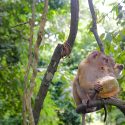
Because millions of tons of coconuts are grown and harvested every day across Southeast Asia. The bulk of the production comes from Indonesia, the Philippines, India, Sri Lanka, Thailand … and the quality is very variable. Up to 8 million coconuts can be processed daily by some very unscrupulous suppliers. They use an intensive farming system exploiting many of the small producers, as well as an ultra-fast harvesting method.

Monkeys, exploited in every possible way

Culturally, in Southeast Asia, monkeys are trained « the hard way, » just like elephants, trained in a way to perform all kinds of tasks for the benefit of humans. It is not uncommon to see monkey’s perform archery or elephants playing basketball, as seen in circuses in France, and applauded by both the local population and by Western tourists. But these poor animals are also trained for other purposes: for agricultural work such as cutting down trees and transporting them through the jungle this task is done by elephants or harvesting coconuts, this task is carried out by monkeys. There is even a dressage school in Thailand which makes this its specialty.

We can also easily come across trucks full of these monkeys when we cross the remote rural areas of these countries – monkeys which make up this free workforce, enslaved for life, who do not benefit from any break during the day and whom, if interrupted are severely beaten. However, it is very difficult to find a coconut producer who displays them: Westerners are known for not appreciating these practices. They therefore hide them from customers and sometimes even from their wholesale purchasers. On the other hand, the rates and tariffs are telling: when a man can harvest one hundred coconuts a day, distinguishing well the maturity of the harvest, a monkey collects more than 1000, or even sometimes 1500. This makes it possible to obtain a low price, especially since in terms of quality, monkeys do not differentiate between damaged or perfect coconuts.

A guarantee of quality and ethics

How did Christophe Gambet do it, to obtain the guarantee to buy coconuts from crops harvested by humans for Ratchaprao? First by avoiding the large companies, which are not transparent and offer prices at a few cents per kilo. Whatever the suppliers say, monkeys are used. They do not guarantee any traceability.

To be able to obtain organic certification, he also had to exclude from his purchases the very small producers, whose quality was not lacking, but whose infrastructure did not allow them to meet European organic standards.

After having prospected for almost two years, he therefore finally selected a single Thai supplier, of medium size, with admittedly higher prices, but who also subscribed to a sincere and quality approach.

Unexpected visits to the plantations were planned by Christophe Gambet. Admittedly, the first visits and all the elements advanced by his Thai collaborator were convincing, but to obtain the One Voice label « without exploitation of monkeys in the coconut farming », he must be sure of this over time.

Ratchaprao is therefore a company which guarantees a premium coconut oil, obtained without exploitation of the monkeys who harvest them and are not tested on animals. This is why it obtained the One Voice label, which is specific to this type of product.

Eleven members of Bosnian parliament submitted request for assessment of constitutionality

Eleven members of Bosnian parliament submitted request for assessment of constitutionality

Eleven members of Bosnian parliament submitted request for assessment of constitutionality
23.12.2019
Bosnia
Eleven members of Bosnian parliament submitted request for assessment of constitutionality
Fashion

Enforcement of the fur farming ban has been unconstitutionally prolonged to additional ten years, just fourty days after the ban took effect on 1st January 2018. For this reason, and with the initiative of “Anti-Fur Coalition Bosnia and Herzegovina” and “EVA” organization for animal rights and environment protection, partner of One Voice in the Fur Free Alliance, a Request for an Assessment of Constitutionality has been submitted to the Constitutional Court of Bosnia and Herzegovina by eleven parliamentary members of the House of Representatives.

Even in their previous mandates, the parliament members Saša Magazinović, Jasmin Emrić, Nada Mladina, Zukan Helez, Nermin Nikšić, Edita Đapo, Mirsad Kukić, Predrag Kojović, Mirjana Marinković-Lepić, Aida Baručija and especially Mr. Damir Arnaut, actively opposed to violating the Constitution of Bosnia and Herzegovina by prolonging the official deadline of enforcing the fur ban, and this time they have officially acted as well, by submitting the mentioned Request to the Constitutional Court.

In 2017, during ongoing parliament discussions and an effort to protect the constitutional integrity of the ban, our Anti-Fur Coalition had, with the great help of PETA Germany and Fur Free Alliance – an international alliance of 50 organisations worldwide, united in their battle against the cruel industry of fur production from which One Voice is the French representative – constantly drawn public attention to negative effects of fur farming in the world, as well as providing valid arguments for why the ban should be enforced in Bosnia, as established by law.

At the same time, an Eko-BiH network had sent an open letter to PSBiH, stating their opposition to prolonging the enforcement of the fur ban, due to the negative effects the fur farming has on the environment.

The exhibition-conference “Make Fur History” in Bosnia and Herzegovina

In April 2019, an exhibition conference “Make Fur History” was held in Parliamentary Assembly of B&H, organized by Fur Free Alliance. The conference enumerated the well established facts regarding animal welfare, environment protection and preservation of biodiversity, as well as a necessary European trend toward banning the natural fur production.

Marianne Thieme, Member of Dutch Parliament, on behalf of Party for the Animals, has also taken participation at the conference. During the conference, the open letter by Eko-BiH was displayed in the form of exhibition panel.
In addition, the attendees could also hear the video messages from European Parliament, as well as the Center for Environment Preservation from Banja Luka (Centar za životnu sredinu, Banja Luka).

«On behalf of Anti-Fur Coalition and EVA organizations, we would like to thank our parliament members for giving their vote against Bosnia and Herzegovina to be viewed as a backward country in the eyes of the rest of Europe.
It is important to mention that, until 2018, Bosnia and Herzegovina was the fourth country in the world that banned fur farming, setting a positive example for Europe and the rest of the world.»

For Mina and Kamala, Christmas will just have to wait …

For Mina and Kamala, Christmas will just have to wait …

For Mina and Kamala, Christmas will just have to wait …
23.12.2019
France
For Mina and Kamala, Christmas will just have to wait …
Exploitation for shows

Loud noises, screams, the crowds and the endless exploitation… This year again, under the big top, over Christmas and New Year’s Day there will be nothing festive for Mina, Kamala and all the other captive animals of the Medrano circus.

Pet Shops I refuse them, stray Cats emergency

Pet Shops I refuse them, stray Cats emergency

Pet Shops I refuse them, stray Cats emergency
21.12.2019
France
Pet Shops I refuse them, stray Cats emergency
Domestic animals

Christmas is here with its gift of animals bought from pet shops, while the shelters are overflowing with « thrown out » animals like vulgar unwanted toys which we get rid of after their use, when all they are asking for is to be loved! Let us turn our backs on this deadly trade and give a second chance to all the lonely hearts of these animal survivors!

December 22nd in Antibes, inter-association gathering to save our orcas!

December 22nd in Antibes, inter-association gathering to save our orcas!

December 22nd in Antibes, inter-association gathering to save our orcas!
18.12.2019
Antibes
December 22nd in Antibes, inter-association gathering to save our orcas!
Exploitation for shows

Following revelations from One Voice, an animal rights association, about the transfer of four orcas held in captivity from Marineland in Antibes to China, scheduled for January 2020. The Anti-Captivity Group (GAC) called for an Inter-association and gathering of citizens on Sunday December 22nd at 2 p.m. in front of the dolphinarium.

This event will be the fifteenth edition of the « Stand Up for Freedom » event and aims to be unitary. Among the thirty groups participating will be One Voice, the GAC, the Animalist Party, Cetacean Network, Sea Shepherd.

For Corinne Bouvot, co-organizer of the rally and administrator of the GAC: «The anti-captivity group (GAC) has been mobilizing monthly for almost 3 years now. When this terrible news was announced, it seemed obvious to us to support the One Voice initiative by joining them. If Moana, Wikie, Keijo and Inouk leave for China tomorrow then we will not be able to do anything for them. If there is the slightest hope that this transfer will not happen, we cannot miss out on this opportunity…»


For Muriel Arnal, president and founder of One Voice: «These orcas, our orcas, must be for a sanctuary, not a dolphinarium in China. There are no laws or regulations protecting animals in China. Parques Reunidos has the means to invest in the creation of a sanctuary, instead of paying for the condemnation of Wikie, his sons Moana and Keijo and his brother Inouk, to a life in hell. And Marineland would come out on top.»


We will not let this happen without intervening! The One Voice petition has already reached more than 48,000 signatures in ten days.

Date, place and time of the gathering
1715 Route de Nice, 06600 Antibes, France
December 22nd, 2019 at 2 p.m

Rwanda: wildlife and its many facets

Rwanda: wildlife and its many facets

Rwanda: wildlife and its many facets
14.12.2019
Rwanda
Rwanda: wildlife and its many facets
Wildlife

Nestled in the heart of Africa, between the Congo, Sudan, Kenya, Tanzania and Rwanda, areas well known because of the terrible genocide that occurred in 1994, when nearly a million members of the Tutsi ethnic group were massacred over a few months. What is largely forgotten is the richness of the wildlife of this small country in Central Africa, in particular its mountain gorillas clinging to the slopes of the Virunga mountains. These gorillas were highlighted by the primatologist Dian Fossey, but also its lions, giraffes, rhinoceros, elephants, wild dogs, antelopes … So many of these animals have suffered from the madness of men.

A revival, in pictures

Mathieu Courdesses, a young photographer whose work we support on wildlife and in particular his Photogr’Afrique project, completed whilst in Rwanda. He is indeed always in search of wild places to go where he will witness by the use of his images the conditions of life. He has even witnessed survival and fatalities, he is a committed actor, working towards the preservation of the environment.

From his last trip to Rwanda (Akagera Park, Volcanoes Park, Nyungwe Forest, Ahazaza School), Mathieu brought back a report which is full of promise. He saw zoological parks equip themselves with personnel (rangers, trackers or veterinarians), armed to restore viable and healthy ecosystems. There are wildlife sanctuaries that are recreated to include African animals and open to eco-responsible tourism, carried with ambition by a new local political class, especially women and which benefits local communities.

A New Logic

« Today, they are bodyguards for the gorillas and the government offers them at a fixed salary, offering the possibility of staying legal and also preserving their environmental heritage, » says Mathieu. He talks about former poachers, who understand that ecological tourism redistributes more sustainable income here than the mere price of bushmeat. This help revitalizes the attractiveness and strengths of an entire ecosystem. Here and this is rare, it is a question of dialogue between actors, the understanding of the issues, real animal knowledge…

Threatened yesterday by extensive tea plantations munching on the Nyungwe forest, the chimpanzees and colobus monkeys now seem to coexist as equals with local farmers, eco-friendly lodges allowing them to come and mix with them, to develop a new wealth, which is no longer plundered, even if it remains rare.

Then there is education: in Ahazaza, in one of the schools in the country of a thousand hills, Mathieu shared his images and his emotions with the children: he felt the powerful bond of love and pride that unites these young locals to the wildlife around them, this is the same bond which made Patience who he is, one of Mathieu’s field guides who expressed this very touching confession: « Gorillas are our brothers. »

Proud to do something…

The promotion of tourism to this battered Central African country must take different paths and this is currently the case. This is how the use of unprecedented means will allow its wildlife to flourish again tomorrow, in islands of rediscovered peace. We give everyone the opportunity to see the images brought back by Mathieu from his reports (stories on Instagram), which also contribute to the preservation of wild life, by testifying to its beauty, its rarity, its fragility… Please support these Steps!