A little slave has been born at port-saint-père
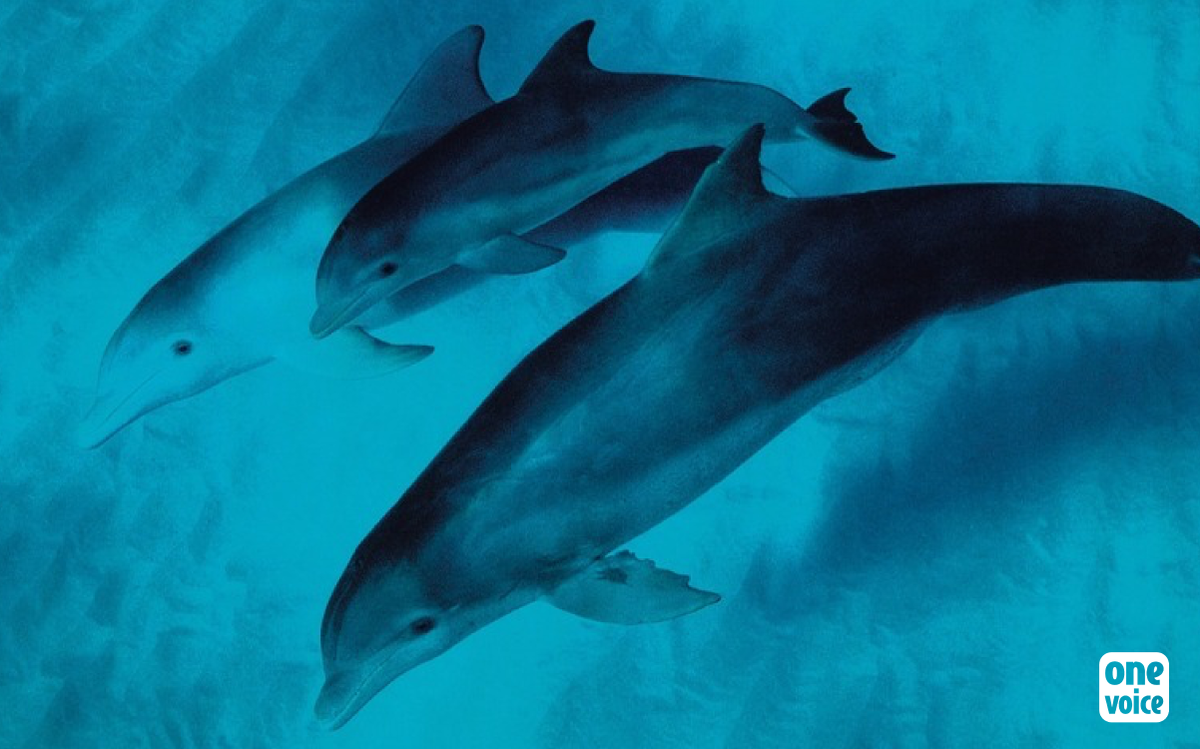
A baby dolphin has just been born at Planète Sauvage. But what will become of this little captive? One Voice is calling for an end to the breeding of captive dolphins, as well as the closure of all dolphinariums in France.
Clinging to its mother’s side, a baby dolphin spins in the warm water beneath the blazing sun
It must have been born just a few days ago and is still breathing awkwardly at the surface, bobbing its head slightly. Its mother, Amtan, is a young female dolphin, sixteen years old, born at the Dolfinarium in Harderwijk. She has been at Planète Sauvage since 2008 and is giving birth to her first calf here.
No one can guide her in learning the ways of motherhood. Entrusting her to Lucille’s care would be too dangerous. Last year, this unfortunate, severely depressed dolphin killed Parel’s baby—also a first-time mother—in a fight. A senseless act in the wild but common in captivity. Yet Lucille is the only one who knows how to raise a child, the only one to have learned it from her own mother.
Where is Amtan’s mother?
Who is she? She’s Molly, born in the Gulf of Mexico in 1980. Her daughter would have needed her so much right now! But Molly stayed in Holland. Because that’s how dolphinariums operate: they separate calves from their mothers long before they reach adulthood. So the young mother is worried. She isn’t quite sure how to care for her calf. A trainer offers her a fish, but she doesn’t even approach the edge. The fish is thrown into the water, but the dolphin doesn’t touch it. Is she sick? Stressed? We can understand her. No calf has ever grown up in the tanks at Planète Sauvage. Above all, there have been many deaths in just a few years.
First there was Sammy, a young blue-and-white dolphin
He died in 1999 in the newly built pools at Planète Sauvage. Then it was Théa’s turn, a young female who arrived from Holland with her friends Parel and Amtan in 2008. She died three years later at the age of nineteen without ever having had a calf. Minimos, who arrived from Parc Astérix, died at the age of eight. The cause of his death remains unknown. And then there was Little, Parel’s daughter, who survived less than a week.
Will this fragile little creature swimming alongside its mother Amtan live much longer? Should we even wish that for it, knowing the life that awaits it? … By the time it’s five or six years old, this dolphin calf will face the same fate as Galéo and Aïcko do today: it will have to fight, ceaselessly, in a sort of never-ending saga where the bullies always win. And if it is a female, she will be bred to the point of exhaustion. This young dolphin, with a body built for speed, will never swim in a straight line for more than a few meters without hitting a wall. It will never dive deep in pursuit of fleeting fish. This marine mammal will never know what the sea is.
Photo caption: Family life is essential to dolphins