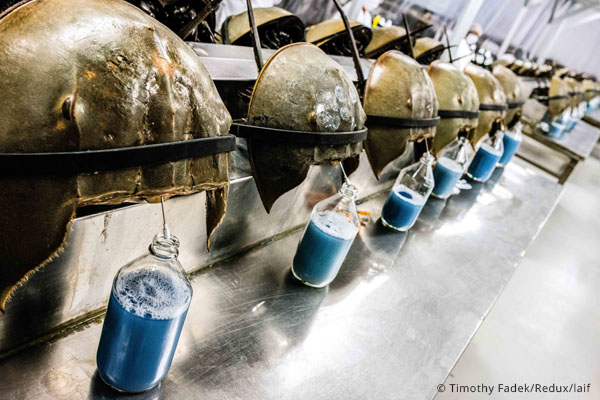
Save the horseshoe crabs, victims of the biomedical industry's blood factories
Despite more effective alternatives having existed for decades, pyrogenic testing* is still widely practised on animals. Although the European Union finally banned it on rabbits in 2024, horseshoe crabs are still subjected to it. Having existed for millions of years, they are now classified as endangered. More than 550,000 of them are captured each year for their blood, and of those around 150,000 do not survive. One Voice is joining forces with the ECEAE coalition to call for an immediate ban on these cruel tests and the systematic use of existing alternative methods.
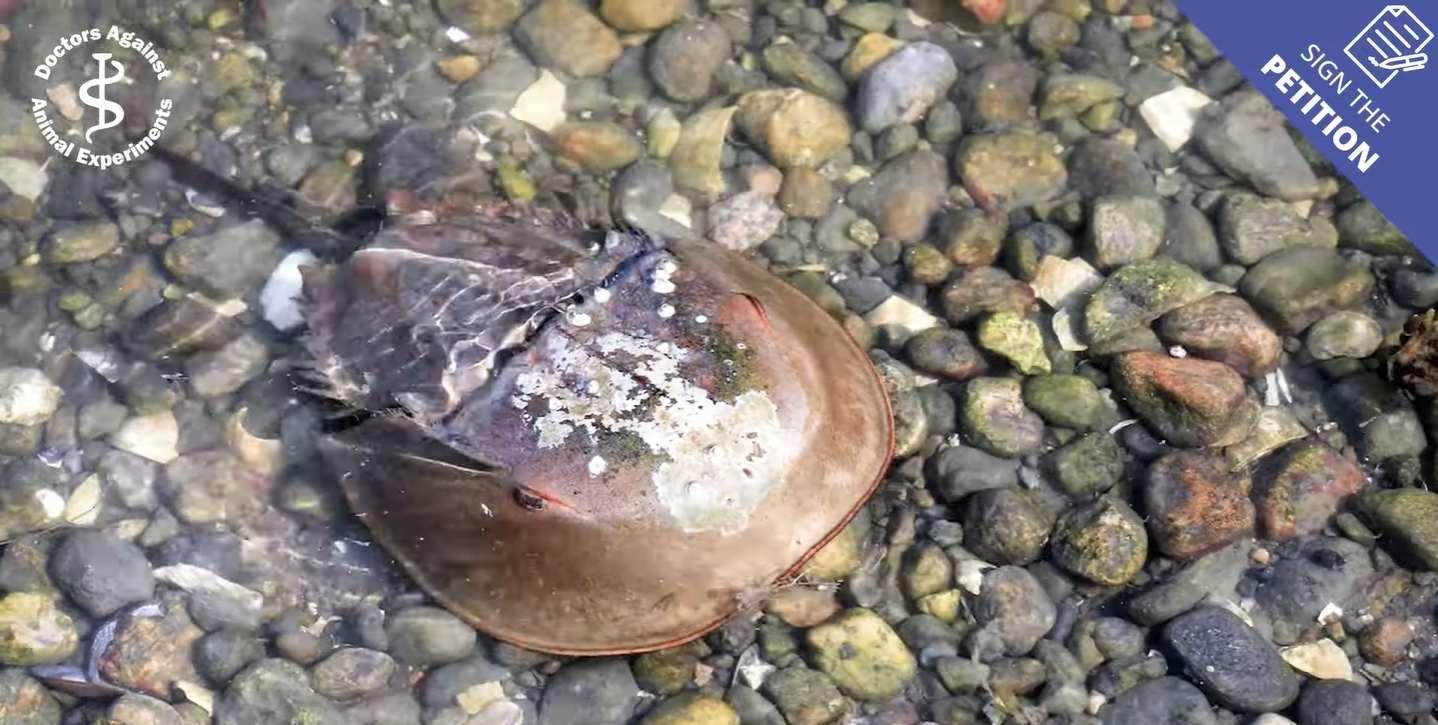
Horseshoe crabs are not actually crustaceans. They belong to the same family as spiders and scorpions and live on the coasts of America and Asia. Protected from wild predators by a large carapace, they have ten eyes and five pairs of legs and have existed for around 450 million years! It is not however for their importance in the evolution of life, their exceptional morphological conservation or their ecological role but for certain properties of their blue blood that they are coveted by the biomedical industry, and for their flesh by the fishing industry. The four existing species are unfortunately classified as endangered.
Horseshoe crabs, survivors of five mass extinctions but threatened by the biomedical industry
Their blood is used in the vaccine and medical device business for pyrogenic testing to check the safety of products. Horseshoe crab blood coagulates on contact with certain bacteria. The LAL (Limulus Amoebocyte Lysate) test is based on this phenomenon.
Captured in the wild, horseshoe crabs are then kept out of the water in collection chambers where laboratories insert a needle into their hearts without anaesthesia and remove 30% of their blood. Horseshoe crabs have a nervous system, which makes them reactive to the stress of capture and blood collection. Released with a third less blood, between 10% and 30% of them die.
This exploitation is not only extremely cruel, but it also gradually weakens the global population of these creatures, even going so far as to decimate 90% of one species of horseshoe crab known as the three-spined horseshoe crab, in Asia.
Heterogeneous regulations around the world, which govern but do not protect
In the United States, biomedical companies must obtain an operating licence, comply with capture seasons and accurately report the number of animals collected. Blood is collected from live horseshoe crabs who must be released after collection in order to reduce mortality, even though a significant proportion of them do not survive.
In Asia, these living creatures are subject to varying restrictions depending on the country: protected areas, bans on capture during breeding season, or limitations on export.
In Europe, where horseshoe crabs do not live naturally, regulations mainly concern the importation of animals or animal products.
And yet a synthetic alternative has existed for decades
The European Union has been encouraging and, since 2020, authorising the use of a synthetic substitute, recombinant factor C (rFC) which has been available since 2003. This product replaces the molecules sought in horseshoe crab blood, it is already used in many applications, and it is much more effective.
The European Pharmacopoeia is the regulation that requires the pyrogenicity of medicines, vaccines and medical devices to be checked. Despite the existence of methods that do not use animals —and which produce superior results— the LAL test using horseshoe crabs is still mentioned in this regulation and is therefore widely used.
Let’s take action to end the suffering of 550,000 horseshoe crabs every year
One Voice is part of the European Coalition to End Animal Experiments (ECEAE) which is committed to ending animal experimentation.
The coalition, represented by Doctors Against Animal Experiments, will meet with the European Commission on 12 December to demand that it withdraw its authorisation for tests using horseshoe crab blood and instead promote the use of its more effective synthetic substitute.
Help us put an end to this lucrative and cruel business by signing the petition to give more weight to our request before 30 November!
*Pyrogenic tests are used to check whether a substance or medical product causes a reaction in the recipient in the form of fever. Historically, these tests were carried out by injecting the product into rabbits, then observing their temperature rise before killing them. Other methods use the blood of other animals, including horseshoe crabs.