Dogs in China: what happens when there is no animal protection law…

Dogs in China: what happens when there is no animal protection law…

Dogs in China: what happens when there is no animal protection law…
20.06.2016
Chine
Dogs in China: what happens when there is no animal protection law…
Other campaign or multi-campaigns of One Voice

In 2008, One Voice conducted a survey in China on the dog meat industry. The way they live is a nightmare.

A high-risk survey

China was preparing for the 2008 Olympics when One Voice investigators began their investigation. They had managed to infiltrate the network of the dog meat producers. At the risk of being arrested – or worse – if their true identity was discovered, they managed to gain the confidence of their guides and were able to film some particularly violent scenes. While the country was cleaning up Beijing and closing the restaurants selling dog meat, the investigators had uncovered a sinister reality.

The horrors and the suffering

The conclusion of their investigation is without appeal: in China dogs are not « only » eaten, they are mistreated beyond all comprehension and put to death through unbelievable cruelty. Crammed into cages while they are still alive, deprived of water and food for days, they are sometimes fed with the flesh of other dogs to enhance the taste of their meat … Among them, dogs with necklaces, probably abandoned by their owners, others come from specialized farms. In their eyes can be seen the sheer terror of their situation.

Extremely violent killings

Our investigators witnessed industrial killings, within the « production factories » but also on the sidewalk, in front of the specialty restaurants: live dogs wait at the entrance and are killed in public. There is no less violence here. Before they are immersed in boiling water the dogs are beaten, knocked out with a club then disembowelled. They do not die straight away. In an atmosphere of growing panic they suffer for a long time under the gaze of their fellow captive companions.

For China to change

https://www.youtube.com/watch?v=ksDs4CUseb4&rco=1

Faced with so much violence, more and more Chinese people are becoming indignant and are joining animal protection associations. The consumption of dog meat is decreasing but it is not enough. To help them obtain animal welfare laws in their country One Voice has launched a petition to the Chinese president: You can download and sign the petition on this website. The more we are, the stronger our voice will be!

Support the One Voice campaign

Dog and cat abattoirs in France

Dog and cat abattoirs in France

Dog and cat abattoirs in France
17.06.2016
France
Dog and cat abattoirs in France
Domestic animals

Tens of thousands of dogs and hundreds of thousands of cats are killed there. Their bodies end up in the knackery. No longer required after an often short life, they are abandoned and thrown away…

Euthanasia. We are not talking about putting down an animal out of love to relieve pain. We are talking about euthanasia being performed for commercial reasons, or being performed reluctantly when no alternative is available due to ignorance, a lack of awareness or a ‘consumer’ attitude. This is unacceptable! It is undergone on a large scale, in unimaginable proportions. Every year, tens of thousands of dogs and hundreds of thousands of cats are forgotten, thrown away and put down following irresponsible breeding, or because they are no longer useful, they get in the way, or they are traumatised from bad practices which makes living with them impossible, or even because they don’t live up to our expectations…

This ‘complaisance’ massacre is staged in veterinary surgeries. Overwhelmed refuges are resigned to this sacrifice because they have no other choice, and the commercial pounds that have already made their money from the victims play a strong part…

In certain refuges there are weekly ‘slaughter days’, and more frequently for the pounds. The killing takes place on a production line, with corpses taken away by utility vehicles, filling big freezers… Imagine the cat kennels; the floor covered in bodies, cats killed one after the other by intra-cardial injection (a highly technical act used for efficiency to avoid the expensive preliminary anaesthetic). There is also home ‘euthanasia,’ avoiding expensive fees. This is mass killing, no less.

However, there are simple solutions which can be put in place to protect animals from this cruel practice.

These abandonments are often the result of big misunderstandings which make living together impossible and sometimes result in serious traumas. This has been brought to light in our investigation into canine clubs. For a harmonious life with our animal companions, One Voice has launched the ‘Companionship’ campaign, which has already hosted successful conferences on cats and dogs in the last two years!

But what also fills up the refuges is the overpopulation caused by random and irresponsible repeated breeding… In making sterilisation obligatory, we can avoid mass euthanasia and the unlawful commerce which goes in parallel with it. Our companions are not consumables!

Please help us correctly protect our dogs and cats, sign and share the petition: « Dogs and cats: our family ».

Those who are anti-wolves ban a conference: are they afraid of the truth?

Those who are anti-wolves ban a conference: are they afraid of the truth?

Those who are anti-wolves ban a conference: are they afraid of the truth?
15.06.2016
Nyons
Those who are anti-wolves ban a conference: are they afraid of the truth ?
Wildlife

They are afraid of the wolf, afraid of everything. But not ridicule! A conference on the biology of wolves that was to take place Wednesday, 15 June in Nyons (26) has been cancelled under the pressure from farmers. After the ban last May, behind the fluffy toy representing a wolf, the anti-wolf farmers continue to impose their unpopular decree.

Entitled « Wolves, the biology of a myth », the long-awaited conference at CFPPA (1) in Nyons had to be cancelled by this public establishment, under the pressure of a small group of farmers and the sub Prefect invoking the threat of disturbing public order. However, this conference proposed by the SFEPM (2) has already been welcomed without problem in several places in the south-east of France since the beginning of the year, especially in agricultural colleges at the request of teachers or students. They present in a dispassionate way the scientific knowledge available about wolves, in order to attempt to inform the students and the public on what is a very complex subject.

On 27-28 May, the organizers of the Giro (cycling tour of Italy) had withdrawn their mascot during the passage of the race in France, under the pressure from local elected officials and the prefecture of the Hautes-Alpes obeying the injunctions of farmers who threatened to block the race. The unique cause: the mascot represented was a wolf. Once again, local officials are the accomplices to a handful of farmers who dictate their desire to eliminate wolves right up to the stuffed animals of their effigy and up to the scientific information on this species.

Farmers live on public subsidies and must know that 80% of the French want to protect wolves (3). Will the citizens who help pay the famers with their taxes endure for a long time that an obscurantist minority thus imposes its law? The conference of the SFEPM (2) will be given in other places including in Drôme, to promote the sharing of knowledge and to exchange with the public, particularly with farmers who are
open to information and dialogue. Next conference scheduled: this Tuesday, June 14 at 20h, at the House of Geology Puy-Saint-André (Hautes-Alpes).

Associations
CAP Loup (Wolf)

(1)
CFPPA: Centre for Professional Training and Agricultural Promotion

(2)
SFEPM: French Society for the Study and Protection of Mammals

(3)
IFOP ASPAS / One Voice survey, September 2013

Share on

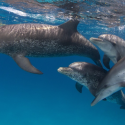
Farms for dolphins in France?

Farms for dolphins in France?

Farms for dolphins in France?
13.06.2016
France
Farms for dolphins in France?
Exploitation for shows

A law is soon to be discretely passed. This law will authorise the opening of dolphinariums on the pretence of an advance in legislation! This law will lead to the number of dolphins suffering in captivity multiplying… We must do something!

Cetaceans suffer and die in captivity. In France alone, the orca Valentin died only a few months after his mother’s death, followed by the young dolphin Alize. And today, the cases of Galeo and Lucille are attracting concern. How long can they hang on for? Despite cases like these, dolphinarium projects keep hatching, as is the case in Amneville and recently, in Beauval, where the project was abandoned following a pressure campaign lasting several months.

To authorise, as this law proposes, the dolphinariums to multiply, is to make France a nation of dolphin farmers, not only going against morality, but a regression from the planetary wake-up call much influenced by the
Blackfish effect: the place for cetaceans is in the ocean. No cetacean should undergo the imprisonment, isolation and craziness that these institutions cause.

For One Voice, this decision is unacceptable. It has sent its comprehensive case to the Minister of Ecology to stop this immoral project. The measure’s ban on keeping orcas and dolphins who are not normally detained would mean that dolphins born in captivity are excluded from this protection… The law therefore authorises the breeding of dolphins. We can draw close comparisons to battery farming in these tiny concrete chlorinated pools.

At no point does the law take into account the physiology or the psychology of dolphins who are not compatible with captivity. Whether they are born in captivity or not doesn’t change anything! And as for the orcas, there is nothing sufficiently precise in the decree to endorse their progressive departure from the aquatic parks, as the ban on keeping them suggests. Furthermore, the 6 month waiting time before entry in force of the legislation raises concerns that the aquariums will rush to fill themselves, and will then have … 10 years (!) to conform to the new legislation. It’s enough to make you mad and then die of it.

Empty the dolphinariums ! Don’t endorse the filling of these pools. Cetaceans are not merchandise: they are
sentient beings.

Sign and share our petition to
save Galeo and to close the dolphinariums!

It’s urgent for Galeo

It’s urgent for Galeo

It’s urgent for Galeo
09.06.2016
Port Saint Père
It’s urgent for Galeo
Exploitation for shows

A damning report by Dr Ingrid Visser, instigated by One Voice, has revealed the shocking situation of the dolphins at Planet Sauvage (Wild Planet), France, and the worrying case of Galeo. One Voice has lodged a complaint on his behalf. We must save him!

What has happened to Galeo?

When young Galeo left Asterix Park in January 2015, leaving his mother and his early childhood friends behind, his skin was still untouched. Today it is riddled with rake marks caused by other dolphins scraping the skin with their teeth, cuts, open wounds and vicious bite-marks from his tailfin to his nose. The mix of old and new scars show that he has been suffering for some time. Of course in the wild there are fights over females, but you don’t see scars on this scale, as we do on the young Galeo. Constantly harassed, his poor body is getting more damaged every day.

Galeo has also lost a lot of weight. There is a depression at the back of his head (the ‘peanut head’ characteristic) which often indicates a nutritional problem in cetaceans. His body is also covered by little black marks and dolphin pox lesions, an infection mostly brought on by stress.

https://www.youtube.com/watch?v=EOx1bULE2Zc

Born in the show pool

Galeo’s mother Bailly went into labour at the end of a show in August 2009, which was stopped so that she could give birth. As there were no appropriately isolated pools, shows were suspended over several weeks to allow Bailly to look after her child without being bothered by her companions’ acrobatics. There was much excitement surrounding this newborn, and until the age of two, his premature training was recorded with photos and constant updates on the Park Asterix website.

Torn away from his family at the age of 4

When he arrived at Port-Saint-Père with Aicko, Galeo suddenly lost the support of his mother. He found himself alone, a young immature male, and confronted by ‘scarface’ Peos, the tough guy of the park, ten years older than Galeo. Also born at Park Asterix, Peos had dislocated his jaw in a fight there over some females. Below Peos in the hierarchy were also the young Ocean, just arrived from Bruges, and three females from Holland; Parel, Amtan and poor
Lucille, freshly deported. From the moment he arrived, Galeo was the group’s whipping boy.

According to Dr Visser’s report, the other dolphins’ situation is not much better

The dolphins display stereotypical displacement behaviour, patterns of comportment repeated incessantly by captive animals. Through the viewing windows we can hear the hullabaloo of noise and snapping jaws, indicating continual conflict and tension in the group. Seven of them share the big show pool with no toys or objects, the pool floor littered by deposits demonstrating defective filtration systems. Three small lateral pools allow the dolphins to be isolated but there is no shelter from the sun or from people. They are constantly observed through the viewing windows.

The report by Dr Ingrid Visser is damning

But it confirms concerns which could have been raised in 2008 and were subject to a ‘study’ when authorisation for the park was requested: What happens when we re-group several young dolphins that are born in different parks and removed early from their original families?

The reply is clear; we end up with an unusually brutal captive society, a bit like in the ‘Lord of the Flies,’ institutional violence which is also present amongst the Loro Park Orcas in Tenerife (read the article about Morgan). It is not surprising that in this stressful environment, Lucille cracked in front of Parel, killing her youngster. If all captive societies are essentially human creations, Planet Savauge is a prime example of ‘failed social organisation,’ with all of the dramatic consequences that we could expect.

Confronted with Galeo’s urgent situation, One Voice filed a complaint on the 4th of June and is currently preparing a new case for the prosecutor. We need to get him removed before it is too late. Each day could be his last! There is still time… Sign and share the petition!

The dolphins:

  • Lucille, born at SeaWorld on the 16th of April 1989 (to Ralph and Louise), transferred to Harderwijk on the 9th of June 1997 then to Planet Sauvage on the 7th of April 2015 leaving her two children behind.
  • Peos, born on the 23rd of June 1999 at Park Asterix (to Amaya and Pichi). Transferred on the 1st of October 2007 to the Harderwijk dolphinarium. Returned to Park Asterix the 17th of April 2008. Transferred to Planet Sauvage in December 2008.
  • Amtan, born on the 13th of May 2001 at Harderwijk dolphinarium (to Molly and Moby Dick). Transferred in October 2008 to Planet Sauvage.
  • Ocean, born on the 13th of August 2003 at Boudewijn Sea Park (to Roxanne and Tex). Brought to Planet Sauvage in April 2014.
  • Parel, born on the 8th of June 2008 at the Harderwijk dolphinarium (to Roxy and Prince). Transferred on the 29th of March 2012 to Planet Sauvage.
  • Galeo, born on the 10th of August 2009 at Park Asterix (to Baily and Guama). Brought to Planet Sauvage in January 2015.
  • Aicko, born on the 14th of August 2010 at Park Asterix (to Aya and Guama). Brought to Planet Sauvage in January 2015.

Coming soon… an elephant sanctuary in Europe!

Coming soon… an elephant sanctuary in Europe!

Coming soon… an elephant sanctuary in Europe!
08.06.2016
Europe
Coming soon… an elephant sanctuary in Europe!
Wildlife

The elephants will soon have their European sanctuary, in France! Thanks to the partnership and support of One Voice, the Elephant Haven refuge is taking the big step, opening its doors to the first elephants in the beginning of 2017…

One Voice was entrusted with Vicky in 2006, rescued from a circus, and they transferred her into a Polish zoo that takes in animals in need. But the pachyderm problem is ongoing. Rescue them, yes, but where can they be homed? In 2013, the same dilemma arose with Samba, a circus fugitive who had killed a man whilst running away. At that point in time, Elephant Haven was unable to help.

One Voice’s president, Muriel Arnal says, « There is an increasing citizen uprising against circuses with wild animals. The local authorities have taken this on board and a growing number of municipalities are refusing them. It is the right time to organise this type of sanctuary, already in place in the United States, and also in India created by One Voice with Wildlife SOS. Sofie and Tony have turned the dream into reality here with this project. We are really excited to see the first elephant reach the sanctuary! »

Tony? Tony Verhulst. With fifteen years of full time experience looking after elephants at the zoo d’Anvers from 1993, the Elephant Haven idea was born thanks to his passion and his knowledge. Sofie Goetghebeur worked at Anvers Zoo at the same time as Tony, and, like Tony, she was deeply affected by the state of certain captive elephants that she came across during her career. The solution was clear to them: open the first elephant sanctuary in Europe.

Elephant Haven will be constructed at Bussière-Galant, in the Haute-Vienne region, 400km south of Paris

On gently rolling hills, the haven comprises of 28 hectares of agricultural land, which will expand even more in the future. The Haven’s ambition is to offer a safe haven to elderly elephants, tired from a life in the circus or isolated in a forgotten zoo. They will be able to discover a calm and sociable existence until the end of their days on this undulating property scattered with small woods. The elephants of course will be unrestricted, free to roam without chains or training. The public will be invited to view them, but only at a distance, with no contact allowed. There is no reproduction programme in mind, the aim being to accommodate as many elephants as possible without creating a zoo.

Upon the announcement of the One Voice partnership, Tony exclaimed on the social networks, « We are happy to announce that, thanks to One Voice, we have taken a big leap towards creating an elephant refuge in Europe! We and the elephants thank you from the bottom of our hearts! »

As for Sofie, she had this to say, « Very happy about the partnership with One Voice! We can do so much working together… And together, we will see the first elephants arrive at the beginning of next year! »

Thanks to the One Voice partnership with Elephant Haven, we hope that, soon,
Samba will walk side by side with Betty or Syndha in the Limousin plains, shaking their ears in happiness…

Dory: a message of freedom or the beginnings of a massacre?

Dory: a message of freedom or the beginnings of a massacre?

Dory: a message of freedom or the beginnings of a massacre?
07.06.2016
Afrique
Dory: a message of freedom or the beginnings of a massacre?
Wildlife

Millions of children are waiting with impatience for the release of the film, “Finding Dory”, on the 17th of June 2016. But this global curiosity could be a death wish for its eponymous heroine, Dory, the blue tang fish. One Voice is sounding the alarm for this beautiful creature.

In the sequel to « Finding Nemo », which featured the clownfish Marlin and Nemo, it’s their forgetful friend Dory’s turn to hold title role.

The scenario has remained secret until now, but the films trailer gives us a glimpse, showing belugas and sharks languishing in pools resembling those of SeaWorld, an octopus trying to escape relentlessly, and tropical fish screaming in terror when a hand descends to seize them at the bottom of their aquarium. The Pixar screenwriters freely admit that they were affected by the Blackfish documentary. Ellen DeGeneres, the voice for Dory, has also made it known that a message for freedom is at the heart of the film. « I think that fish should be in the ocean », she maintained.

But One Voice is rightly worried about the impact of the wave of popularity for the « blue tang » or « blue surgeonfish », already being named ‘Dory’ by aquarium lovers. We know that the success of the animated film, « Finding Nemo », was sadly responsible for the deaths of thousands of clownfish. In effect, running a saltwater aquarium is complicated and beyond the capabilities of a lot of people. In Europe and in the United States, this craze has gone viral, with the rush to have the biggest squid or shark in the sitting room…

The blue surgeonfish can become quite large, requiring a bigger and more expensive aquarium, which is rarely provided. For this reason, few of these fish reach adult age in captivity and all of them die without producing offspring. Like with many other tropical fish, the blue tang is incapable of reproducing in an artificial environment. In France, some sellers will try to make you believe the contrary, but it is not true. This intelligent fish needs a marine environment to socialise and to reproduce its complex rituals.

In the world aquarium market, most saltwater fish are caught in their natural habitat, often illegally, and always in very cruel circumstances. The traffickers spray sodium cyanide on the coral and then collect the temporarily paralysed fish. Some of them suffocate and drown, lots die later. The cyanide also damages the coral, with one square metre of reef destroyed for each living fish taken in this way! The losses are significant but the profits are fabulous… After having crossed the globe by plane in highly oxygenated water, the survivors find themselves stuck in an aquarium, surrounded by fake stones and filter pumps. The blue palette surgeonfish’s home is the coral reefs bubbling with life, sensations and adventures in the warm waters stretching from Eastern Africa to Micronesia. Not this life of infernal boredom locked in a jar, going endlessly round in circles under the blue beam of the aquarium lights…

One Voice is delighted with the strong anti-captivity message of this film, but urges parents to explain to their children that these wonderful creatures belong in the ocean. And we plead with all adults to give up aquarium fish! Fish are also sensitive and conscious beings who suffer equally from having their freedom taken away from them as any other captive human or non-human animal…

The gorilla and the child

The gorilla and the child

The gorilla and the child
03.06.2016
Etats Unis
The gorilla and the child
Wildlife

When Harambe saw the young boy fall down into his enclosure at the Cincinnati zoo, he went straight to him. A human child or a gorilla child, to Harambe, it’s pretty much the same thing, they look so similar! The young gorilla was not yet a father himself but he showed the same concern for the little human as he would have for one of his own. He checked that the child was still alive and then shaded him with his strong body.

This is when the cries started, screams of « Oh my God! », as people assembled on the guardrails in an eruption of mass hysteria, looking down at the pair and throwing objects.

The gorilla, surprised, dragged the child a bit further away using the strength that he possesses. They then stopped again near the fountain. The gorilla took the boys hand. He stood him up, pulled up his pants and adjusted his t-shirt. The gorilla looked into the boys eyes for a long time. Then without warning, in one shot, a bullet exploded his skull. The beautiful Harambe was dead at the age of 17, the day after his birthday.

We could have distracted Harambe with treats, or distanced him with a jet of water. We could have evacuated the excited public, calmed the big primate, spoken gently to him. In the days following this sad event, Franz De Waal and other primate behaviour specialists have reiterated: at no point did Harambe show the slightest sign of aggression, he just showed concern regarding the public’s reaction.

But it was just a monkey after all; whose life has never had the same value as that of a human. Rather than taking the slightest risk, we prefer to fix the problem with arms.

For the Ohio zoo, who had acquired the male in 2015 from Gladys Porter Zoo, Harambe was just an incubator of precious genes. The crazy eugenic logic of the reproduction programmes values the species more than the individual. So, the sperm was quickly taken from his body to be refrigerated and injected one day into a specially chosen female. Births at the zoo are also very lucrative.

Yet however many gorillas from the western plains are battery farmed, this will never save the species itself. None of these big primates born amongst humans would be capable of returning to their ancestral home and surviving. Gorillas are cultural beings possessing intelligence, gentle vegetarian people who have evolved in the primal forests over thousands of years. They pass down their knowledge from generation to generation; humans are not capable of teaching them this.

The real importance is not to multiply them in order meet industry and leisure requirement for little groups of show gorillas, that families can visit for a fee whilst eating popcorn. The real emergency is to save the large primates habitat as quickly as possible, whilst we still can, investing the resources required to act seriously in areas such as the Dzanga Sangha reserve or the Virunga mountains. Without the forest, the gorillas are no longer gorillas, but are monsters in a fair, pathetic phoney King Kongs on display for the crowd who tremble from a safe distance.

Harambe was not King Kong. He was just a young prisoner born in captivity into a confined world where he had absolutely nothing to do, both literally and figuratively. What has come from this tragedy? A pointless debate about parental responsibility, a great sadness amongst the gorillas at Gorilla World, but not yet, sadly, a radical review into the real reason that Harambe was killed: the zoos. It’s one
zoo that brought him into the world, another that killed him, demonstrating the same level of concern for production that is given to the poor battery chickens.

Rest in peace, Harambe. We will do our very best to ensure that in France and in the rest of the world, that one day an event such as this will never be repeated.

One step nearer circuses without animals!

One step nearer circuses without animals!

One step nearer circuses without animals!
30.05.2016
France
One step nearer circuses without animals!
Exploitation for shows

Banned in more than 30 towns, the end of the exploitation of animals in circuses seems more inevitable than ever before.

From its very beginning, One Voice has helped municipalities confronted with the illegal occupation of circuses, providing authorities with training when having to enforce that regulations, often ignored, are respected concerning the detention of wild animals. (See our fight’s background here)

Circuses with animals are not only places of much suffering for the animals detained, but they also present a threat to the security of the public and residents. Accidents, sometimes fatal, are constant reminders of this.

In 16 years of campaigning, their number has dropped dramatically from 200 to less than half of this… One Voice praises the towns who have clearly expressed their refusal to see these organisations there, organisations who consider subservience to be entertainment! If circuses contest their refusal, One Voice will provide all legal aid necessary to townships in order to assert their rights… For fifteen years now, One Voice has been offering aid to circus performers to retrain as real circus artists. The human performances are magical and amazing expressions of liberty… The ethical circus of tomorrow is for today!

Discover
the map of municipalities that have already adopted this position, updated regularly.

Horse torturer

Horse torturer

Horse torturer
24.05.2016
France
Horse torturer
Domestic animals

Monitored by One Voice for ten years now, Mr. P has been keeping dozens of horses in criminal conditions, with some dying as a result. After two seizures, Mr. P was banned from keeping animals. But this man didn’t stop, nor did One Voice.

It all began in 2006

Our investigative department was alerted about Mr. P regarding the mistreatment of his horses. A young stallion had just died when One Voice intervened. An initial seizure took place, saving 45 horses. Their physical decline was extreme. Neglected, their hooves were damaged, they were suffering from malnutrition, lymphangitis, arthritis, and thrush, an aliment which affects the area just above the hoof and also the back and the rump, leaving the horses skin inflamed and scabby. No water or shelter had been provided for them. Certain mares were pregnant but not one of them was capable of delivering a living foal because of the lack of care and inadequate living conditions.

Celeste, aged around twenty years old, was top of the list to be saved, but her owner managed to conceal her for two years. When the One Voice investigator eventually managed to locate the little mare in 2008, it was already too late. Celeste was in a terrible state in the corner of a field. Her head dangling, leaning against a wall, she was hardly able to stay on her feet as her leg was so devoured by fibrous tumours. The horse owner had bred her twice, but both times her young had died because of a lack of milk. The DDPP* rushing to the scene, made the decision to quickly put Celeste down in order to end her horrendous suffering. One Voice couldn’t save Celeste, but luckily this was not the case for other horses.

The breeder’s long history of abuse

At the end of the seizure in 2006, Mr.P was definitively banned from keeping animals. Discrete but constant surveillance shows, however, that this man just doesn’t care. He purchases new horses which he then hides on friend’s properties. At One Voice’s request, a new seizure was organised taking place over three days, from the 6th to the 8th of February 2014. During this operation several horses were once again found in worrying states of health.

Baloo, a young four year old male discovered in this operation, was the size of a ten month old foal. He was suffering from such malnutrition and was so weak that he had to be put on a drip before we could even think about moving him. Octave was isolated in a field on the edge of a forest. No water was provided for him, he was drinking out of puddles. He also resembled a one year old foal even though he was already three. We also discovered Annabelle and her foal at the bottom of a soaking field accompanied by other horses, behind a makeshift electric fence without hay or food of any kind provided for them. The foal was very weak, his ribs were showing and he was almost wild, it would appear that he had never had contact with humans. 19 horses were taken in this new seizure.

But will these rescues suffice to stop these criminal horse breeders? Nothing is less certain. Surveillance, investigations, seizures, official complaints and legal processes are likely to figure again for these serial torturers.


* Direction départementale de la protection des populations: Local French authority concerned with animal welfare (amongst other things)