Big protest against hunting on Saturday 1st October

Big protest against hunting on Saturday 1st October

Big protest against hunting on Saturday 1st October
28.09.2016
France
Big protest against hunting on Saturday 1st October
Wildlife

The French are fed up with hunting. A recent survey* conducted by One Voice in partnership with ASPAS showed that 78% of French people want to ban hunting on Sundays for obvious safety reasons. 91% of French people want hunting to be reformed.

September 28th 2016

The French are fed up with hunting. The survey* conducted by One Voice inpartnership with ASPAS has just recently shown that 78% of Frenchpeople want to ban hunting on Sundays for obvious safety reasons. 91%of French people want a hunting reform.

Yetthe public authorities are strangely deaf to this strong expectationof our fellow citizens. And our politicians even more.

LaurentWauquiez, President of the “Republicans” of theAuvergne-Rhône-Alpes, has just offered some 3 million euros tohunters in its region to restore their hunting huts or to intervene in our schools to “train” our children in a certain idea of biodiversity…

The President of the Republic has killed it in the bud the long-awaited National Agency for Biodiversity, by not including in it the National Office of Hunting and Wildlife. This public establishment and its 1200 officials remain in the hands of the hunters who are in the majority on its board of directors.

To denounce this, but also the death of 30 million animals each year for a “Past Time” from another age, the Collective of September 21st which brings together 78 associations (joined by Sea Shepherd, the Foundation Brigitte Bardot and One Voice), organizes a large demonstration to end hunting and trapping.

October 1st from 10 am to 1 pm, Place Joachim-du-Bellay (Paris 1st)

Numerous association stands and catering on site

After the demonstration a Kate Amiguet’s film, Hunter- killer – imposter?

will be screened at the Jean Dame cinema at 2:30 p.m. (entrance at 2:00 p.m.)

It will be followed by a debate with the director, Gérard Charollois (president of the CVN, author of the book On Ending the Hunt) and Pierre Athanaze (president of Action Nature, author of the Black Book of Hunting).

List of associations from the collective of September 21st:

269 LIFE FRANCE, Acta Anti speciesism (or Acta Gironde), Embassy for Pigeons, Action Nature Rewilding France, AEC, Animal Cross, AEP,
Animalsace, Animalibre, APIE (Environmental Protection and Initiation Association), Association of the Animal Collective of 06, Association Protection of Château de Flée, AVES France, AVF (Association Vegetarian of France), AVRE, Bio Living in Brie, Brouillard
Définitif, CAUSA, C’est Assez, C’Topoil, CCE2A (Collective Against Animal Experimentation and Exploitation), CHAMADE (Animal Theaters and Mediation), C.H.A.N.T (for Harmonious Cohabitation with other Animals and Nature on Earth), CNPA (Collective Nantais For the
Animals), Collectif Société Anti-Fourrure, Combactive, CHÂTEAU de FLÉE, Monument historique, C.RÉ.DO. Pigeons et Protection Animale, CREL (Recognition and Self Help Club with Greyhounds), CVAAD, CVN  (Convention Life and Nature), DDA (Animal Rights), Droit des Animaux Sud, Dignité Animale, Entre Chiens et Loups, Groupe d’Actions Animales Moselle, Guadeloupe Animaux, F.G.N. (fairy gardians of
nature), GREEN, Humanimo, INFO VÉGANE, Initiatives Terre, Jack et Jessie Protection Animale, la fondation M.A.R.T. (Movement for the
animals and respect of the land), La Griffe, La Voie de l’Hirondelle, La Tribu de Sapeur, L’arche de Valudo, Le Klan du Loup, Les Désobéissants, L214, Laissons Leur Peau Aux Animaux (LLPAA), Les compagnons de Freya, Ligue Universelle pour la Nature et les Animaux, Les 3A, Les Crins Verts, Liberté Égalité Animale 49, Matoucœur, MFP (French mission for the protection of monkeys), Mouvement pour la Cause Animale, Oïkos Kaï Bios, Oiseaux Nature, Patacha, Point Info Loup Lynx, RAC (RAssemblement pour une France sans Chasse), Protection Faune Sauvage Sedan, RAN (Respect of animals and for Nature), Respectons, Initiatives Terre, Refuge « Ame’Ni’Maux », Refuge
« Amis des Bêtes », Sauvetage et Chats en Détresse, Secourisme Animalier, SSA49, SVPA (Société Vosgienne de Protection Animale), Stop Souffrances Animales 49, Vigilance Citoyenne pour le Pâtis, Wolf Eyes Asbl.

Share on

Dolphin Production?

Dolphin Production?

Dolphin Production?
Dolphin Production?
Exploitation for shows

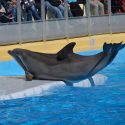
While monitoring Galéo, One Voice was able to see Amtan’s newborn baby in a pool at Planète Sauvage. Since then, Parel has also given birth to a baby dolphin. Beyond immediate concerns about their future, is it reasonable to mass-produce dolphins in this way?

On August 31, One Voice visited Planète Sauvage to observe little Galéo and the other dolphins. On this occasion, they saw Amtan’s newborn baby for the first time. In mid-September, it was Parel’s turn to give birth to a baby dolphin.

This is, of course, cause for concern, given that a year ago, Parel’s newborn was killed during a fight with Lucille. But there is worse to fear: this hasty production of dolphins, on the eve of a forthcoming ministerial decree regulating captivity in France.

Industrial farming appeared in France in the 1970s as a way to produce meat, milk, and eggs at a lower cost. To this end, animals are treated as commodities and most often raised in enclosed buildings.

The same is true for dolphins, whose industrial production only began in the early 1990s. CITES regulations had put an end to the influx of dolphins from Florida and Cuba. Breeding programs modeled on those in zoos had to be set up, which was fairly easy. Dolphins are naturally very sexually active, and boredom from confinement exacerbates this behavior. They were therefore provided with “maternity pools,” while dolphinarium research focused on artificial insemination and pregnancy monitoring. As Taiji’s customers know, capturing a wild dolphin is much less expensive than breeding one in a tank. But the Western captivity industry had no other choice. And so it “produced” dolphins in abundance.

For what purpose? Not for meat or milk, and certainly not to repopulate the oceans. From birth, these dolphins learn to live not as real dolphins, but as “performing” animals intended exclusively for shows. Some become very skilled in this limited field of knowledge, and amusement parks marvel at them. For example, about Bahia at Parc Astérix: “Very playful, she often imitates the adults during shows. She is always ready to have fun, alone, with other dolphins, or with her trainers.”

Trained in this way, these dolphins would obviously be incapable of catching live fish. Their instincts, culture, consciousness, and dignity have been skillfully erased in just two generations. It would take a thousand generations to begin a process of true domestication, but two generations are enough to create beings that are dependent on humans and physically and intellectually diminished. According to the director of Amnéville Zoo, French dolphinariums produce so many dolphins that they no longer know where to put them. Hence their export to Greece, Spain, and Belgium, like ordinary parcels in the mail.

In strictly commercial terms, is all this really reasonable? In the US, SeaWorld’s descent into hell continues, and the Baltimore Aquarium promises a sanctuary for its former inmates. In Finland, the last dolphinarium has closed its doors due to lack of visitors. Most dolphinariums in northern Europe are now struggling to fill their stands.

One Voice believes it is time for dolphinariums to close and for marine sanctuaries to be created to offer a well-deserved retirement to all captive cetaceans. Sign and share our petition!

Photo caption: In the wild, baby dolphins grow up with their families.

France-Turkey: the unbearable ordeal of exported cows

France-Turkey: the unbearable ordeal of exported cows

France-Turkey: the unbearable ordeal of exported cows
27.09.2016
Europe
France-Turkey: the unbearable ordeal of exported cow
Domestic animals

The CIWF has just released shocking footage from its investigation into the transport of cattle from Europe to Turkey. France, a major player in this trade, must stop participating in it and ban this cruel practice, and we must rethink our consumption habits to adopt a cruelty-free lifestyle.

They are thirsty; they lick the bars of the trucks. They are hungry. They eat their own feces. They are full-term and give birth to a baby, which is immediately taken away. They are exhausted and they die there, in the trucks. This is the Turkish border. Some were born in France; the others come from elsewhere in Europe. Their ordeal is indescribable; the images are unbearable.

The CIWF Investigation

CIWF is a partner organization of One Voice. Its partners—Tierschutzbund Zurich, Animal Welfare Foundation, and Eyes on Animals—conducted an investigation in Kapikule, on the border between Bulgaria and Turkey, last June as part of an inquiry that began in 2010. Of the 200 trucks that passed through, 109 were inspected. The cattle had been confined there for several days, in direct sunlight, without clean water or food. The temperature exceeded 38°C inside the vehicles, where the smell of ammonia mingled with that of the carcasses. Because under these conditions, not all of them survive. Five calves were born there. One of them was delivered by cesarean section: his mother was cut open on the spot, in the street. He was already dead. She, exhausted, her belly still open, was unable to climb back into the trailer. So she was slaughtered while fully conscious. Next to the truck.

France is guilty

France’s involvement in this major scandal is far from trivial. France was the leading exporter of live animals to Turkey in 2015. The number of animals exported subsequently declined due to the bluetongue epidemic, but agreements are currently being negotiated to increase exports once again. It is also worth noting that over the course of the six-year investigation, 350 trucks transporting sheep and cattle were inspected. Of these, 89% of those originating from France were in violation of European legislation. And the French and European authorities have been aware of this situation for a long time!

We must say stop!

In the face of this horror that has already gone on far too long, One Voice supports the request made by CIWF to Stéphane Le Foll to halt all exports of live animals to Turkey. You too can take action by sending him a petition on the ministry’s dedicated page.

And help us change consumer habits—veganism is no longer a utopia! Because these cows belong to the dairy industry—there’s no doubt about it. Treated as production machines until the very end, and their calves as byproducts. So, to support the shift toward a plant-based diet, visit Vegan Pratique!

Photo credit: www.AWF-TSB.org & Eyes on Animals

The French are afraid of hunting

The French are afraid of hunting

The French are afraid of hunting
19.09.2016
France
The French are afraid of hunting
Wildlife

The majority of French people do not feel safe in the countryside during hunting season, as evidenced by this recent IFOP poll for ASPAS and One Voice (1), from 12th to 14th September 2016. It confirms that 8 out of 10 French people want to see Sunday become a non-hunting day, and reveals that 9 out of 10 are in favour of a reform of the organization and regulation of hunting.

A Sunday without hunting? The question does not divide! 78% of the respondents are in favour (compared to 54% in 2009 (2)). This demand is not driven by “urban ecological woes” so vilified by the hunting world, but by 76% of the population living in rural areas.

Hunting accidents remain a taboo subject in France. Yet no other recreational activity than hunting poses such a public safety problem. This weekend in Loire-Atlantique, a woman took a boar bullet in her thigh while she was gardening. An accident that occurred during the opening of the game hunting season which did not begin until the next day in this department! Of the 71% of French people who regularly frequent
the countryside (several times a month), 61% do not feel safe when they go out during the hunting season. Last year, nearly 2 out of 10 victims were not hunters. The death of Samuel (20 years old) in Isère, then that of Gaël (43 years old) in Haute-Savoie had once again underlined the difficult cohabitation of hunting with all the other outdoor activities.

Since 1982, there is no longer a perimeter of security around homes (3). In 2003, the obligation of a national day without hunting per week was abolished by Roselyne Bachelot. There is no regular evaluation of the knowledge or physical abilities of hunters, nor is there any alcohol tests during hunting: a laxity that the majority of French people find unjustifiable.

It is not surprising that today, 91% of our fellow citizens are in favour of a reform of the organization and regulation of hunting to
adapt it to today’s society!

For more than 20 years, ASPAS have been asking governments to take a simple and democratic step in sharing the space between a small million hunters and the majority of the population: the truce of Sunday hunting. Did you say lobby?

One Voice fights against the practice of hunting in France and around the world, and has been campaigning for a Sunday without hunting since its creation in 1995 under the sponsorship of Théodore Monod.

(1)
Download the results of the study

(2)
IFOP / ASPAS survey conducted in July 2009.

(3)
Excerpt from How to walk in the woods without getting shot « Sincethe circular Deferre of October 15 1982 the Prefects are invited to no longer prohibit hunting in a perimeter around houses, but to regulate shooting in the direction of these dwellings. For example, shots « within range » or within a certain distance (usually 150 meters) are generally prohibited in the direction of « dwellings, tracks and public roads, railways and railway rights-of-way ». power lines, airports, public meeting places and stadiums. In this context, there is nothing to prevent hunters from leaning right against a house and shooting outwards! »

One Voice infiltrates the Angora industry and reveals the torture of rabbits in French farms

One Voice infiltrates the Angora industry and reveals the torture of rabbits in French farms

One Voice infiltrates the Angora industry and reveals the torture of rabbits in French farms
15.09.2016
France
One Voice infiltrates the Angora industry and reveals the torture of rabbits in French farms
Fashion

On September 15, One Voice, an animal rights association that has been active since 1995, will release a video and an investigation report summarizing months of undercover work inside several French Angora rabbit farms. The images and the comments of the breeders gathered on this occasion are without appeal: not only are the rabbits raised in battery style conditions of feeding, but comfort and hygiene are more than doubtful here. They are overexploited in a cruelty that falls on
deaf hears the screams of their agony.

Stacked in multiple cages, the angora rabbits filmed by the investigators of One Voice in the French farms finally have no fate more enviable than those of China. It will be remembered that a film broadcast by the PETA association on Chinese rabbit farms (90% of world production)
chilled the opinions in 2013.

Unfortunately, good animal welfare practices, though recommended by the Ministry of Agriculture as the guiding principles of a five-year plan to 2021, do not seem to be more concrete. And yet, here and there we boast about the reputation for fine quality French angora, something that is just tied to the hair of an animal bred for only one thing and not for the hideous methods of those who exploit it for profit.

A furious investigation …

This is important investigative work. Investigators from the Whistle-blower Association have infiltrated this environment for months (In France there are about forty farms operating with thousands of rabbits, figures obtained during our investigation and for which we have not been able to obtain any official documents as the sector seems to be poorly regulated). Their objective was to study the whole chain, to document the hair removal from rabbits because it does not happen every day. The rotation in the activities plays: phases of reproduction, the sexing of baby rabbits, food production with the flesh from unwanted males (males have less hair, they are mainly intended for pâté or the butchers). A lot of waiting between hair removal, three times a year, which means permanent stress for rabbits, stripped after the “harvesting of hair” and exposed to thermal shocks, with no further temperature protection in their hutches.

The association One Voice therefore worked for one semester, from February to July 2016, in six different farms: their findings take stock of the state of play in a sector in decline, but still harmful, if we judge by this simple workers recorded comment, among others: « the females are a little more fragile than the males at the level of the skin. It happens that it tears. Sometimes, like, oops, there is a piece of skin that comes with it. When it starts, I have had times when I have torn off everything, I had to finish removing hair with scissors because all the skin came off, so there you spend more time. I have seen it sometimes where you spend up to two hours on a rabbit that was tearing everywhere. Sometimes you say to yourself, you’d better knock her on the head that one.  »

Large-scale public action

Disgusted by the screaming of rabbits hastily being stripped of hair, not simply combed as one would like to believe, Muriel Arnal, president and founder of One Voice, takes the same position here as in the case of the use of all animal fur: Angora must be banished from France, and we have great hope to make things change for these animals. Our investigation legally supports our demand: yesterday we obtained the ban on the sale of fur from dogs and cats imported from China. There is no reason that products of angora, obtained in such conditions, can be freely circulating on home ground.  »

State mediation is essential to act with stakeholders in this sector, which visibly enjoys great flexibility in terms of regulations and controls with the Departmental Directions of the Protection of Populations (DDPP). “To stop such practices, surviving form the Middle Ages and based on an unworthy cruelty, we are ready to work with the breeders to support them in their conversion,” explains Muriel Arnal.

One Voice (France representative of the international Free Fur Alliance coalition) has chosen to lodge a complaint against the main local breeders, located in Loire-Atlantique (44), on the basis of several breaches of the regulations in force (breeding conditions and slaughtering, acts of cruelty). A practice deemed unacceptable, the sale of rabbits that have developed breast tumours to an experimental laboratory, where they will experience a second ordeal, weighed up in
the choice of a legal action that targets the top of the chain.

Angora, out of farms and cabinets

On the stopangora.fr site, a petition has been launched to the Minister of Agriculture so that emergency measures, precautionary measures or controls are taken in place on these farms, and that in the long run both their activity and trade in products of Angola are banned in France. In addition, the association invites the public to stop buying Angora wool fabrics and to empty their closets. “From the footage, I would not understand why people could continue to wear sweaters with a smile in angora. We will be able to collect them and bring them to cat shelters, where they will be much more useful,” concludes Muriel Arnal, who hopes for an influx of cartons containing “angora” signed clothing, resulting from animal suffering to the offices of her association…

A little slave has been born at port-saint-père

A little slave has been born at port-saint-père

A little slave has been born at port-saint-père
09.09.2016
Loire-Atlantique
A little slave has been born at port-saint-père
Exploitation for shows

A baby dolphin has just been born at Planète Sauvage. But what will become of this little captive? One Voice is calling for an end to the breeding of captive dolphins, as well as the closure of all dolphinariums in France.

Clinging to its mother’s side, a baby dolphin spins in the warm water beneath the blazing sun

It must have been born just a few days ago and is still breathing awkwardly at the surface, bobbing its head slightly. Its mother, Amtan, is a young female dolphin, sixteen years old, born at the Dolfinarium in Harderwijk. She has been at Planète Sauvage since 2008 and is giving birth to her first calf here.

No one can guide her in learning the ways of motherhood. Entrusting her to Lucille’s care would be too dangerous. Last year, this unfortunate, severely depressed dolphin killed Parel’s baby—also a first-time mother—in a fight. A senseless act in the wild but common in captivity. Yet Lucille is the only one who knows how to raise a child, the only one to have learned it from her own mother.

Where is Amtan’s mother?

Who is she? She’s Molly, born in the Gulf of Mexico in 1980. Her daughter would have needed her so much right now! But Molly stayed in Holland. Because that’s how dolphinariums operate: they separate calves from their mothers long before they reach adulthood. So the young mother is worried. She isn’t quite sure how to care for her calf. A trainer offers her a fish, but she doesn’t even approach the edge. The fish is thrown into the water, but the dolphin doesn’t touch it. Is she sick? Stressed? We can understand her. No calf has ever grown up in the tanks at Planète Sauvage. Above all, there have been many deaths in just a few years.

First there was Sammy, a young blue-and-white dolphin

He died in 1999 in the newly built pools at Planète Sauvage. Then it was Théa’s turn, a young female who arrived from Holland with her friends Parel and Amtan in 2008. She died three years later at the age of nineteen without ever having had a calf. Minimos, who arrived from Parc Astérix, died at the age of eight. The cause of his death remains unknown. And then there was Little, Parel’s daughter, who survived less than a week.

Will this fragile little creature swimming alongside its mother Amtan live much longer? Should we even wish that for it, knowing the life that awaits it? … By the time it’s five or six years old, this dolphin calf will face the same fate as Galéo and Aïcko do today: it will have to fight, ceaselessly, in a sort of never-ending saga where the bullies always win. And if it is a female, she will be bred to the point of exhaustion. This young dolphin, with a body built for speed, will never swim in a straight line for more than a few meters without hitting a wall. It will never dive deep in pursuit of fleeting fish. This marine mammal will never know what the sea is.

Sign and share our petition!

Photo caption: Family life is essential to dolphins

Endless violence

Endless violence

Endless violence
Bretagne
Endless violence
Domestic animals

It was thanks to its whistleblowers that Cellule Zoé learned of this case. At this farm in Brittany, more than 200 pigs are kept in appalling conditions. Worse still, they serve as a vent for a violent farmer.

In indoor pens, pigs are kept locked up in the dark. They have no water, no food, and no bedding. There are too many of them, crammed together in the mud. Some are suffocating.

In outdoor pens, where they should only stay long enough to eat, pregnant sows are locked up for hours. On the concrete, without water and regardless of the weather—blazing sun or pouring rain—they must wait for him to remember they exist.

Let’s admit that sometimes, however, it’s better to avoid him. Because this farmer beats—the piglets, the sows… He beats them with a club until blood flows. He beats them despite their screams. He often beats them to death. But the cumbersome corpses, the suspicious corpses—the rendering plant doesn’t see them. Those, the farmer abandons in the wild…

His wife managed to escape with the dog—for here, once again, the bond reveals itself in all its horror. But she managed, in the end, to survive his violence, to escape. However, for his other innocent victims, it is up to One Voice to act. A complaint has already been filed. The proceedings are underway. We must put an end to their suffering and prevent this breeder from harming anyone again! We are fighting for that. We are fighting for them.

A new case of the Link between all violence

A new case of the Link between all violence

A new case of the Link between all violence
23.08.2016
A new case of the Link between all violence
Domestic animals

Morbihan (56) – The wife of the farmer ran away. She did not hesitate to take a stand against her brutal husband, because now she is safe from his violence, she knows what is happening on the farm. She denounces the blows from iron bars or clubs that unceremoniously fall on piglets and sows’ in her testimony, she mentions that the breeder goes so far as to plant his fingers in the eyes of the animals, beating them until they bleed. The most ill-fated corpses will not reach the abattoir, who themselves could raise the alarm. They will be discreetly abandoned in the countryside. One Voice filed a complaint  to ensure that the 200 pigs from the farm were kept safe.

If there is still a need to exemplify the link between animal abuse and violence against humans, here is a new individual case that will
convince. The Zoe cell, responsible for investigations within the One Voice association, was alerted before the summer of an untenable situation. The investigations are without appeal. The wife complained of domestic violence, but she was worried about the fate of the pigs of the farm, delivered to the free will of the master of the place.

Everyone is king at home, until mistreatment, punishable by law, requires outside intervention. The story of the fugitive wife and initial findings of investigation on the conditions of detention of animals have led One Voice to file a complaint and to mobilize around such unworthy behaviour.

Set in a perimeter without much maintenance, the buildings are in rough blocks, with tin roofs. These primary boxes have neither light nor litter, and the grated area much smaller than the mud where the piglets amass in number. Some suffocate, all dirty, either nervous or have given up. Pregnant sows remain enclosed in metal stalls, exposed without water in full sunlight, frothy lips, dehydrated. They will be in the wind or driving rain for hours until the farmer remembers them. A spell totally inappropriate for animals sensitive to climatic conditions, like the cleanliness of the buildings they occupy.

The farmer does not care. His cruelty is exercised freely. It is to be feared that the departure of his wife accentuates the resentment towards the animals under his responsibility. Such conditions are unacceptable, regardless of the economic context.

One Voice, an association committed since 1995 in the defence of the animal cause, has decided to make a complaint so that first protective measures are taken before definitive replacement of the pigs away from the farmer. This complaint, so-called duplicates with that of the battered wife, was initially classified without consequences. A second complaint was therefore lodged emphasizing these new elements, so that the authorities intervene urgently. A petition also circulates on the website and the social networks of the association.

Muriel Arnal, president-founder of One Voice, justifies the will of action of her association: « The suffering inflicted daily on defenceless animals is intolerable to us. When it is the work of violent individuals who are also guilty of mistreatment of other humans, which is generally the case with such owners, we do not sit idly by and watch. I hope that they will be put out of harm’s way and that we will quickly find a permanent solution for his pigs that we forget that they are indeed sentient beings. »

Press
contact, Muriel Arnal

Share on

The world according to orangutans

The world according to orangutans

The world according to orangutans
19.08.2016
Bornéo
The world according to orangutans
Natural habitat

Jambu’s story is a true story. It is the story of a wild people disappearing before our very eyes, a people rich in culture and wisdom that we will lose forever if we do not act. It is the story of Borneo’s last orangutans, driven from their forests by oil palm planters and now crammed into reserves.

The nest

Through the curtain of cascading orchids, the orangutan anxiously scans the horizon of the Gunung Tarak forest. He stands twenty meters above the ground, finishing the construction of his nest on the fork of a main branch. His mother spent a long time showing him how to weave the vines and line his bed with twigs and moss to make it cozy. He even adds a roof of branches, in anticipation of the coming rain. Humans have named him Jambu. He is still a young male, whose smooth face with dreamy eyes reveals all the gentleness characteristic of his people.

The fire

Jambu was very lucky. Six months earlier, an arson fire had destroyed his entire world. His mother perished in the flames, along with his younger sister and many others. So, for days, Jambu wandered. He walked through the scorching ashes, stumbling over the charred bodies of his kin, searching in vain for tall trees to climb, but nothing, nothing remained.

In the distance, trucks were already crowding around the smoking ruins of the forest, while planters brought in the first oil palms—those trees with trunkless trunks and inedible fruit.

So Jambu ran as far as he could. He walked until his feet—so much like hands and so ill-suited for walking—were raw, until one evening he came upon a large rambutan orchard. He ate all night long, but when he returned the following night, the farmers greeted him with gunfire. Thirteen pellets pierced his skin. What had he done wrong? He was so hungry, and those hairy red fruits were so good! Besides, there were plenty for everyone. But no. They chased him away. So Jambu took refuge at the top of a kempas tree.

The Humans

Humans came and shot at him, just like the farmers. But when he woke up, he was cared for and fed in a very strange enclosed place. There were humans everywhere, big and small. They made lots of sounds and gestures, and they handled all sorts of strange objects, but they were indeed monkeys like him—just a different species! Those humans were kind, and not just to Jambu. From the enclosure where he was regaining his strength, he could see lots of little orphans. They were being cared for and fed, too, and even nursed when they were babies.

Gunung Tarak

Time passed, and then one day, they took him in a small crate to release him into another forest. He threw himself onto the first tree trunk, climbed to the top, and discovered a new territory.

The trees there are tall and dense, the fruit abundant, the bark delicious, and the landscape magnificent as he gazes out from his nest. Vines coil around the moss-covered trunks that rise toward the sky; enormous branches connect each giant to the next, like roads beneath the canopy that the orangutans travel slowly. There are three females with their young, working together as a team.

He watches them pass by peacefully, moving from branch to branch with deliberate movements, using their hands and feet to secure their grip. Around them, lighter proboscis monkeys leap from tree to tree. A rhinoceros hornbill with an orange beak greets them with a call.

It’s crowded here, Jambu thinks. Perhaps too crowded. He also spotted some young males this morning; he’ll have to face them soon, one after another, in fair combat. In the meantime, an elderly patriarch serves as a guide to them all. He is very old and was born here.

In the morning, his powerful roar—amplified by his goiter—provides them with all sorts of information. He announces where the day’s ripe fruits are: the large durians, the figs, and even the honey when there is any. Jambu listens and learns the cycle of flowering. He builds a complete map of the forest in his head; he observes everything around him closely, finding the healing plants and the tender bark his mother had shown him. He is happy.

The smoke

But images of flames stir questions in his mind that an orangutan shouldn’t ask. He sees that things are getting worse, that the real world is shrinking a little more each day, that his people are being decimated, that there are refugees everywhere. Some of them even imitate humans—they do laundry, saw planks, use a hammer, or steer a canoe. They’ve lived among humans for a long time!

Tonight once again, before the sun sets over the misty jungle, Jambu scans the horizon. Rain begins to fall on his cocoon of flowering vines. Little by little, his fear subsides. No smoke has risen on the horizon today—no fires, no threats. He turns around and curls up into a ball. And he falls asleep in peace until tomorrow…

One Voice is calling for the recognition of orangutans as legal persons—it’s urgent!