Shark Fishing in Reunion Island: Associations Stop the Massacre!

Shark Fishing in Reunion Island: Associations Stop the Massacre!

Shark Fishing in Reunion Island: Associations Stop the Massacre!
13.05.2016
Reunion
Shark Fishing in Reunion Island: Associations Stop the Massacre!
Wildlife

Under the direction Shark 2 programme, the State authorized the fishing of an unlimited number of tiger and bulldog sharks in one of the most protected areas of the Réunion Marine Nature Reserve, until 31 December 2016. Seized by the associations ASPAS, Longitude 181, One Voice and Sea Shepherd (1), the Administrative Court of Saint-Denis has suspended this order and put an end to this fishing!

The judge considered that the consultations necessary to adopt this order had not been properly carried out, which undermines the scientific basis of this fishing. In fact, the Prefecture had not submitted his decision to any scientific council worthy of the name, so that no protocol had methodically regulated this fishing.

An anti-scientific decision

Through the media, the scientists of the Reserve have had the opportunity to express their opposition to this fishing in the middle of a rich natural area still in reconstruction and therefore particularly fragile. Obviously, such fishing in a protected area goes against the ecological interests of the reserve whose official mission is the optimal preservation of all species, as the interrelations are strong between fish fauna and coral production.

The fisheries Committee is the structure responsible for conducting the Shark 2 program. However, these fisheries scientists, who are not scientists, design the program, implement it, and control it. The conclusions they draw from their own analyses do not present any impartiality or scientific credibility. However, it is on the basis of these conclusions that the prefect authorized the capture of sharks in the heart of a protected marine area, itself valuable for the economy and tourism.

Non-selective fishing and opaque methods

Recall that many species of sharks, key species in the ecosystem and ocean food chains, are considered threatened by IUCN (2). Capturing them without further study as to their population, movements and behaviours necessarily has negative consequences for the entire equilibrium of the ocean and more particularly for the already fragile coastal area of Reunion.

The fishing methods used are vertical longlines (drum line) where baits are hung that do not attract only the targeted species. Two-thirds of
the catches made under the program would be bycatch. It is difficult to know what is being done, since no sworn and independent observer is accepted on the fishing boats (the reports of the Technical Committee of the Fisheries Committee admit some difficulties in collecting the information). Many animals are paying the price, such as the Great White Shark, protected species, killed last October, for lack of a real training of the actors of the program and the presence of independent competent persons on board.

A dangerous but lucrative fishing

According to a completely absurd logic, the prefect wishes to secure the water activity areas by attracting sharks near these areas! This fish has the potential to attract animals to a space they might otherwise not have occupied. Far from decreasing, this system where public money and natural heritage are sacrificed on the altar of obscurantism has just been institutionalized within ACRAR (3), a new association which is based on the old methods, allows to the main architects of this absurd system to carve out a lion’s share. That certainly explains that…

(1)
Supported by Tendua, Safeguarding Sharks, Waves, Requin (Shark)
Integration and Brigitte Bardot Foundation.

(2)
International Union for the Conservation of Nature

(3)
Association for Shark Risk Resource and Support Centre

Share on

Animal Petition: Stop the suffering in the laboratories

Animal Petition: Stop the suffering in the laboratories

AnimalPetition: Stop the suffering in the laboratories
12.05.2016
Europe
AnimalPetition: Stop the suffering in the laboratories
Animal testing

One Voice has launched a new campaign with its partners in the European Coalition. Objective: an awareness in favour of the animals who are objects for experiments.

If a light tone has been chosen, the problem is none the less extremely serious. What is happening behind these lab doors, many still do not know. One Voice and its ECEAE* partners have chosen humour to alert as many people as possible.

These and cats that make us laugh and share our lives; these fellow creatures of all kinds are exploited in the worst possible way and they are the same. With the same needs, the same desire to live, the same joys, the same sorrows… And yet, some inflict terrible pain on them… Outside the laboratories, these practices would be condemned as acts of cruelty!

Dogs, cats, rabbits, pigs and all these animals are exploited in laboratories, they can undergo over many years’ invasive experiments, that cause acute pain! And when they are not being experimented on, they are locked in cold empty cages, without seeing the light of day, terrified to hear footsteps approaching… those who have the chance to share their lives with us, One Voice hopes to draw attention to them. We do not cross them in the streets, we never see traces of them, we do not hear their screams of pain… This torture is discreet and hidden. Everything is done for us to forget it.

But enough! They certainly do not have a human companion to love them, but they are nonetheless sensitive! Their fate must be known to all, together, stop this torture! Science now has other effective methods that can save lives. It’s time to implement them…

Please sign and share the AnimalPetition here: www.animalpetition.fr

And to learn more about these animals, check out One Voice reports:

L’experimentation animale en France en 2014: un état des lieux

*ECEAE: European Coalition to End Animal Experimentation

When Zimbabwe sells off its wild fauna

When Zimbabwe sells off its wild fauna

When Zimbabwe sells off its wild fauna
09.05.2016
Zimbabwe
When Zimbabwe sells off its wild fauna
Wildlife

Zimbabwe has put its reserve animals up for sale to avoid them dying of hunger and thirst. One Voice denounces the systematic haemorrhage of these sensitive beings, under threat from profiteering by zoos and hunting reserves, and above all from a not very democratic regime.

Whilst the country is being hit by severe drought threatening more than a quarter of its population from starvation, we have learned that the Zimbabwe Parks and Wildlife Management Authority, (ZIMPARKS) is inviting potential buyers to declare their interest: lions, elephants, rhinoceros… They will go to zoos and also private hunting reserves. Zimparks manage a surface area of 47,000 km
2, spread over ten national parks, the equivalent of 12.5% of the country’s territory. No precise information has been given on the species to be sold and their price, but rumours say that a baby elephant could be worth up to 60,000 dollars.

This isn’t the first time. In 2012, four terrified baby elephants were torn away from their herd in Zimbabwe and transported to zoos in the centre and the North West of China. They survived the voyage but one of them died shortly after its arrival. The three surviving elephants are in very bad health.

In 2014, Zimbabwe offended again: 24 new elephants were taken from their families. Sent to China, today they are learning to dance whilst their trainer brandishes his rod to a background of deafening music. In China, like in Amneville, zoos are also circuses. Rare images show the elephants looking thin, covered in dust with bleeding wounds, worked up. Their homeland, the savannah, is far away… Their sale in 2014 was not justified by a drought, but by the need to pay the salaries of the eco-wardens and to diminish the population of invasive pachyderms who were threatening crop production.

We see these pretexts over time. Zimbabwe is however the only country in the region to evoke such economic problems as a reason. And also the first to welcome wealthy trophy hunters with open arms, such as the American dentist Walter Palmer who decapitated the lion, Cecil, last summer. These massacres generate fabulous cash injections, but they certainly don’t go into the right pockets. Robert Mugabe has managed his country with disastrous consequences, making many African individuals rich off the back of a population hard hit by poverty. This hero of the war of independence has put the culture of his country into the hands of corrupt courtesans, incapable of looking after it, and driving it to ruin. Today’s Zimbabwe is crushed under the weight of a senile dictatorship: one that is homophobic, racist, sexist and freedom eradicating. Mugabe proudly declared in 2003:  »
Hitler had only one objective: justice for his people, sovereignty for his people, recognition of the independence of his people and their rights over their resources. If that is Hitler, then let me be Hitler tenfold »

Today other countries like Kenya, Tanzania, and Rwanda are trying to make eco-tourism profitable. These thousands of hectares of virgin forest, populated with rare and threatened species, are green gold in their hands. Zimbabwe is home to several species of wild animals, within this the famous « Big Five »: the lion, the leopard, the elephant, the rhinoceros and the buffalo. More than 80,000 elephants and 750 black rhinoceros live there.

Robert Mugabe’s behaviour is worrying. Essentially, he could inspire other tyrants who haven’t hesitated already to deliver the Virunga mountains to oil prospectors. Never has the traffic of endangered species thrived so well, supplying the zoos, circuses and private collections of Dubai billionaires.

One Voice thinks that France should intervene, as have other nations who support the African development effort. It should demand the strictest preservation of the local fauna as a condition in any cooperation agreements from its African partners. As for Zimbabwe, it deserves international diplomatic condemnation.

Sharky & Lotty, the elder captives

Sharky & Lotty, the elder captives

Sharky & Lotty, the elder captives
07.05.2016
Antibes
Sharky & Lotty, the elder captives
Exploitation for shows

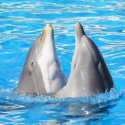
A dolphins memory is equal to that of an elephant. If we could speak with Sharky and Lotty, they could tell us all the difficulties they had survived in the tiny enclosures, journeys by plane, the farewells and the grieving. They would also speak of their childhood. But the dophinariums don’t want their dolphins to talk. So we are telling their story for them.

Lotty is the eldest of the Marineland dolphins. Captured in Florida in June 1983, she lived ten years in Great Britain, before being sent to Sweden, then finishing her journey in Antibes, in 2005. Sharky had the same fate. Captured in October 1983, also in Florida, she survived the English doplhinariums as well, and, it would seem, the flooding that submerged Marineland on the 5th of October 2015.

Childhood in Charlotte Harbour

The Charlotte Harbour estuary, to the South West of Florida, is a dolphin’s paradise, they have been living there for centuries. The fresh water of two rivers mixes with the salty water of the Golf of Mexico generating big marine plains thriving with shellfish and fish. The dolphin clans group themselves into small marine ‘villages’, scattered around the network of islets and lagoons. The water is calm, warm and shallow, journeys are just visits between neighbours, life is calm, and time stands still. Lotty and Sharky lived there when they were small. They played chase between the mangroves scaring the waders perched on the shores by squirting water at them, and should have grown up in their sub tropical mangroves and become mothers and grandmothers. But the doplhinariums took this destiny away from them, and have devastated their population. Since the beginning of the 1960’s and for more than thirty years, persistent raids have taken children away from their families, broken up tribes and weakened the populations exposing them to epidemics. Today the free dolphins of Charlotte Harbour are protected. They are slowly bouncing back from this wave of captures, but Sharky and Lotty did not escape.

Fair at Flamingo land

The senseless explosion of dozens of small dolphinariums started in Great Britain with Flamingo Land. Opened in 1961, this establishment was the first to exhibit living dolphins in a happy fair atmosphere. They didn’t survive a long time and were consecutively imported from Florida. In 1984, Flamingo Land received its three last dolphins. They would stay there until the closure of the park in 1993. Meanwhile, a civil battle triumphed.. Following relentless campaigning, the English dolphinariums had to conform to rules so strict that they all closed, without exception.

Rocky, Missie and Silver were rehabilitated in the Caribbean, welcomed by Jojo, the lone dolphin. After having been held respectively 20, 22 and 15 years, the three dolphins successfully rediscovered their freedom. But the public’s generosity did not reach far enough to finance re-homing all the captive dolphins in the sea. For the last three prisoners of Flamingo Land, the nightmare continued. They were sent to the North of Europe.

From Sweden to Antibes

Open in 1969, the Kolmarden dolphinarium was the first to be built in a Scandinavian country. Right from the beginning, a mass of Florida dolphins were stranded here, torn away from their luminous mangroves for a death in a dark pool. Lotty and Sharky managed to survive in the Swedish park, with Lotty even giving birth to Fenix there. In 2005, Lotty and Sharky were transported to Marineland with Fenix. Far from enjoying the scorching sun, the youngster couldn’t cope with the park’s environment and died four years later, at only eight years of age.

In 2011 Sharky gave birth to Jo, her one and only child. Today, the two friends always swim side by side, having spent 33 years of their life in captivity. Could they still go back to the small islands of their childhood, in the Charlotte Bay estuary? Without doubt, following a well managed rehabilitation programme. It all depends on the dolphin and its desire to live. And our two friends have this desire. Lotty and Sharky have been hunting fish together since they were three. They haven’t been seperated since their capture, and it is their strong friendship that has allowed them to survive.

If they can’t be released, these dolphins deserve at least to be placed in a marine bay with their family. It is urgent, Lotty and Sharky will soon be 37 years old. In Marineland, Antibes, no dolphin has lived beyond 38 years of age…

Thrown into hell

Thrown into hell

Thrown into hell
03.05.2016
France
Thrown into hell
Domestic animals

In the middle of a sea of rubbish, starving dogs, who have suffered immeasurable pain, are waiting, scared. Bones are lying around, bodies too. Here, the dead feed the living. Welcome to hell.

Urgent seizure

One Voice investigators, the authorities and all of the collaborators present still have nightmares about this. It was supposed to be a breeder of Tibetan dogs. But they discovered a mortuary. One Voice intervened immediately. Hardly eight days after an authorities inspection, our teams were called up to put an end to this hellhole. Everyone wanted to act urgently to save not only dozens of dogs but also three donkeys.

A horror scene

The scene is indescribable. A dead horse, in an advanced state of decomposition, is partly concealed in the mud and covered by a tarpaulin. There are around a hundred puppies and adult dogs, some in plastic bags, some uncovered: in the open air, stocked in out of order freezers or even stuffed in trunks… The survivors are scattered across the ground. A car shell contains a mother and her offspring. Another is tethered in the middle of rubbish and bones – because the bodies have also been used as food… Under the house, more are chained, in near obscurity, living in their excrement. Stones are found in a puppy’s stomach. Across the site the vets note the complete absence of water and food… One Voice rescues sixty-one dogs from this sordid area, and three donkeys. Sixty-one traumatised dogs. They are all sick and the majority are shockingly thin. The coordination of the relocation and all medical treatment required taken on by the Association.

The torturer convicted!

One Voice’s lawyer, Fabienne Filpi, obtained an exemplary conviction on their behalf as civil prosecutors. The animal abuser has received a prison sentence! The survivors are now licking their wounds in host families, including Zoe, the crisis centre namesake. And also Lhassa, still traumatised to the point where she would only eat wood and stones, has found a patient and secure home where she can recover from her trauma. As for the donkeys, they were tied together for so long that it took them some time to understand that they were no longer glued to each other, and that they were free to frolic in the fields.

Support the work of Cell Zoe, to allow them to urgently intervene where needed to save lives!

Jo’s death

Jo’s death

Jo’s death
22.04.2016
France
Jo’s death
Other campaign or multi-campaigns of One Voice

Abandoned in the pouring rain with a broken pelvis, without food or water, Jo spent the weekend in pain. Well he was going to die anyway wasn’t he? One Voice has filed a complaint.

The circumstances surrounding his death would probably have gone unnoticed if the Society for the Protection of Animals (SPA) didn’t share a wall with the incriminated abattoir. Jo, as One Voice has named this calf, experienced a complete disregard for his suffering, with authorities only being alerted thanks to the vigilance of an SPA aid worker. But how many others in France undergo similar tragedies, or worse, because of a lack of witnesses?

Jo fell. He fractured his pelvis when getting out of the lorry that brought him to the abattoir. He hadn’t travelled far: local produce, organic, meat sold in blocks of kilos to individuals, far removed from the wholesale distribution networks. The illusion of a perfect life… But no one managed to get him on his feet again. In a case like this we end the suffering as quickly as possible don’t we? No, not on a weekend! He ended up waiting until Monday, nearly two days! Two days unprotected from the October rain, cold and incapable of moving on the rough ground, without bedding, water, food, or even a tarpaulin to provide him with some form of protection against the elements…

Despite requests from the SPA to the manager of the abattoir to allow the SPA vet to intervene, Jo suffered, with the manager eventually telling them to mind their own business. Why? To save vets fees? There must be a good reason to leave an animal in such a state, surely?

Jo is no longer in pain. He was anaesthetised on the Monday morning before being slaughtered. His meat will not be sold. The manager of the abattoir is being accused of maltreatment and One Voice has filed a complaint, hoping that Jo’s plight will be recognised and severely punished…

Following the recent scandals surrounding abattoirs, the minister for agriculture has announced that these mistreatments will no longer be considered as simple offences (that are punished with a fine), but as penal crimes (to be judged before a tribunal). For One Voice, this measure is completely inappropriate, the objective clearly being to reassure consumers, allowing them to continue eating meat without stress. But the fundamental reality is that abattoirs remain environments of unimaginable cruelty.

A study conducted by One Voice in twenty-five randomly chosen abattoirs has revealed the same barbaric practices. Can we really be humane, ethical and compassionate in an environment designed to kill? In our Western society we conceal and industrialise the slaughter of animals to the point where we ignore the reality. What generates this slaughter…? Consumption.

Global week of action for victims of animal experimentation

Global week of action for victims of animal experimentation

Global week of action for victims of animal experimentation
17.04.2016
Monde
Global week of action for victims of animal experimentation
Animal testing

In honor of this week dedicated to animals exploited in laboratories, Aroma-Zone has partnered with One Voice to offer our readership a unique, ethical, and organic recipe for a healthy glow!

Being healthy means taking care of yourself, maintaining your home, eating healthily etc.: but your daily routine should not necessitate animal sacrifice. When consumers actively choose to buy cruelty-free products, manufacturers listen because it is in their best interest to meet consumer desires. Just by living ethically we can actively participate in large-scale societal shifts.

Last week, One Voice president Muriel Arnal took part in the Coalition meeting on animal experimentation in Berlin. The consensus seemed to be that the future for laboratory animals is beginning to look up, so now is the time to act!

Aroma-Zone, a longtime One Voice partner, has been embracing the cruelty-free label for the last ten years. For this week’s occasion, they offered us a recipe for a skin serum for spring found at the bottom of the page.

All of One Voice’s initiatives are independently financed with your donations. So when you choose a One Voice certified product, transparency is always guaranteed. Since French corporations still do not comply with industry standards, it is crucial that the truth about how products are manufactured and regulated is made known.

During this special week, One Voice has been offering initiatives and petitions on its social networks. Follow us on Facebook and Twitter! Let’s stop animal suffering in laboratories.

Do your part and write to brands you would like to see adopt cruelty-free labels.

Together we have the power to make significant changes!

Healthy glow serum for spring

Price: 4 euros for 30ml

Level of difficulty: beginner

Preparation time: 5 minutes

Bottling: 30 ml dropper bottle

Ingredients: 30ml

  • Macerated organic carrot oil: 1 10 ml dose
  • organic apricot oil: 1 10 ml dose
  • organic prune oil: 1 10 ml dose
  • organic grapefruit oil without furocoumarin: 10 drops

  Instructions:


  1. put the ingredients together in the dropper bottle
  2. close the bottle and shake 


Usage:
Apply 3 to 4 drops of the fruit serum in the morning before daily care routine for a healthy glow!

Conservation:
create and conserve in hygienic conditions, your product can be saved for at least 6 months

The State Council has just announced that it will once again permit dissections in middle and high school, although the Ministry of Education has the option of disputing the decision. Write to the
Ministry of Education requesting that dissections are prohibited for academic purposes, along with the use of organs and/or vertebrates and cephalopods. Children and young adults should not be subjected to participating in such cruel and inhumane practice.

When minks eat whales…

When minks eat whales…

When minks eat whales…
12.04.2016
Norvège
When minks eat whales…
Fashion

As the populations of larger whales are being driven to extinction, whalers are turning to smaller species. Japan has been launching fleets to hunt minke whales, whose meat is coveted as a delicacy, while Norway sells their flesh to fur farms. One Voice calls on France to strongly condemn these barbaric acts.

Several weeks ago, Japanese ships returned from Antarctica with 333 minke whales, many of which were pregnant females. This past weekend, a Japanese whaling fleet made its way toward the North Pacific for an annual hunt aimed at capturing 51 minke whales. While these killings are conducted in the name of “science”, the agency that sets the quotas includes whale meat recipes on its website. Yet ironically, the meat is so toxic that Japan is barred from importing it to other countries.

On the otherside of the Eurasian landmass in Norway, whale meat is hardly eaten, so instead it is used to feed foxes and minks on fur farms.
Rogaland Pelsdyrfôrlaget, the largest fur industry food manufacturer in Norway, used over 113 tons of minke whale meat, approximately 75 individual whales, to feed its captive animals

Are these hunters even aware that they are killing conscious sentient beings? The minke whale is the smallest member of the rorqual whale family, just three times larger than a human. These animals move alone and in small groups, sometimes joining larger communities if krill is abundant in a certain area. They are very fast swimmers and curious creatures: they have been known to unabashedly approach ships or ports and jump acrobatically in the air like dolphins. While we know little about their dialects or social habits, their song is quite remarkable and unique.

These very same beings, who have been frequently known to socialize with human divers, are murdered to supply grocery stores and fur factories with tainted meat. There is something wildly disturbing about the concept of capturing this rare species from the wild and skinning them alive, only to feed them to animals living hellish existences of their own, in tiny cages on fur farms—they too will face the same destiny of being skinned for profit.

The French government must et an example by being more vigilant in condemning whaling, both domestically and abroad. Like Australia, our government must denounce Japan’s activities, along with those of Iceland and Norway. Given that these countries have violated the code of conduct delineated by the International Whaling Commission, Europe is obligated to respond with sanctions.

Rasputin’s walk

Rasputin’s walk

Rasputin’s walk
05.04.2016
Antibes
Rasputin’s walk
Wildlife

Rasputin paces along the fence. He always starts the same way, rolling his head around, then walking the path to the enclosure walls. Rolling his head again, he turns and goes in the other direction, again, and again, until he is exhausted.

This is stereotypical behaviour. This compulsive ritual, very common in zoos, is exhibited by an animal unable to satisfy its normal behavioural needs in an unnatural environment. With summer temperatures reaching 40°C, Antibes on the Côte d’Azur in South Eastern France is not the ideal place for homing Polar Bears.

Of course, Marineland has spent 3.5 million euros on the layout of their enclosure: sea and fresh water pools and prairie plants similar to those found in the Arctic plains, fountains, rockeries, shady shelters and to top it all off, two refrigerated caves with a bed of ice, wow!

But sadly, Rasputin doesn’t even see the prairie plants. He doesn’t want to lie down all day in a fridge or shimmy about in a poky pool, where humans push their faces up against the glass. What polar bears want more than anything, are the immense white ice plains, seals, and the ocean, where they can walk and swim far removed from that smell of fast food and the constant noise, far away from the metal walls and that stuffy enclosure. Their huge bodies with claws, fangs and paws to dig the snow were made to swim under the ice and roam the prairie.

Born in Moscow Zoo, Rasputin joined little Flocke in Nuremberg in 2008, then the pair were transferred to Antibes Marineland in April 2010.

Why did they bring them? Why invest so much money in this new attraction?

Because of Knut, without doubt, and “Knutmania”. When the little polar bear was born in Berlin Zoo in 2007, he attracted lots of attention. Knut was everywhere, on TV, in books, in blogs, in songs. They even made ‘Knut’ toys, ringtones and sweets! The zoo loved the hype: doubling the value of its share actions in one week.

The same year, Flocke (Flake in German) was born in Nuremberg zoo. Quickly removed from Vera, his mother, who threw him against the rocks, it was attempted to create a “Madame Knut”. His name became a registered trademark. His image was posted everywhere, but without success. An ecological association took the zoo to court claiming that this exploitation of Flocke interfered with her well-being. In any case, as the polar bears grow, the public lose interest. Flocke and Rasputin were sent to Antibes. Little Hope was born in 2011, but there wasn’t really any ‘Hopemania’ in France.

Marineland states that “the reproduction and preservation of polar bears is an essential issue for the park. They are ambassadors for a species greatly endangered by global warming and its impact on the ecosystem”. As it happens, of the 330 or so polar bears living in 120 zoos across the world, none of these will ever be released, nor will any of their children, so there will be no effect on the preservation of the species. The only solution to save polar bears is to stop hunting and to protect their territories, rather than looking for petrol. It is better to give up fossil fuels rather than building refrigerated caves which generate global warming gases. Whatever we do, polar bears will never be happy in a zoo. Their life is a metaphor of Rasputin’s walk: desperate and hopeless.

One Voice is currently lodging a complaint to local authorities to allow Rasputin to be urgently removed for his own well-being.

A good day for the animals, a wake-up call for the circuses!

A good day for the animals, a wake-up call for the circuses!

A good day for the animals, a wake-up call for the circuses!
05.04.2016
A good day for the animals, a wake-up call for the circuses!
Exploitation for shows

We got there. No more waiting, no retraction possible. The 18th of March decree is finally in application. These regulations, now obligatory, may also help us give the animals their freedom!

One Voice has been impatiently waiting for this day. Circuses are now obliged to comply with the legislation covered by the 18th of March 2011 decree. As well as being pushed out of a growing number of towns, circuses are finding it increasingly difficult to pursue the exploitation of animals. One Voice is continuing to offer assistance to circuses to help them to convert to non-animal status, as it has done for the last fifteen years. In parallel, One Voice investigators will work even harder to obtain evidence to assist in the numerous legal procedures which will follow!

Some of the following important points established by the decree:

A list of authorised species has been established (see the box at the bottom of this article). Other species can only be exhibited if a dispensation is obtained. Importantly, the decree specifies that only animals that currently participate in performances (out of all those in training) can be kept. One Voice investigations have frequently revealed animals confined to their cages, mostly due to their age… From now on circuses are legally obliged to provide them with a fixed home for their retirement…

In addition, the decree bans animals from participating in performances if:

  • they have a health impediment;
  • the nature of the performances represent a danger to their health (for example, elephants and other animals who are required to adopt unnatural positions for performances);
  • the security of the public and personnel cannot be guaranteed, due to animal comportment or inadequate handling of the animals (although reports conducted by our experts clearly indicate that public security cannot be guaranteed…)

Following on from this, animals in poor health must be excluded from any presentation to the public, even outside of performances. In other words, they mustn’t be visible in their pens if visiting is possible…

The following text is particularly important, stipulating that the
« animals must be kept and trained in conditions which endeavour to satisfy their biological and behavioural needs, in order to guarantee their security, their well-being and their good health […] The animals’ accommodation must meet the minimum requirements set for each particular species, in annexes I and III of the current decree. » Incidentally, animals must be allowed to go outside, out of their enclosures, except in cases of bad weather…

On all of these points, One Voice investigators are going to increase the number of related inspections, and will take legal action as often as necessary!

Get involved: let us know if any circuses may be violating the law, and share this information!

Together, we shall end animal slavery in circuses!

The following species are subject to regional authorisation:

– Mammals: Macaca spp. (macaque), Papio spp. (baboon), Puma concolor (cougar), Panthera leo (lion), Panthera pardus (panther, leopard), Panthera tigris (tiger), Otaria byronia (South American sea lion), Zalophus californianus (Californian sea lion), Arctocephalus pusillus (South African fur seal), female specimens of the species Elephas maximus (Asian elephant), female specimens of the species Loxodonta africana (African bush elephant), Equus burchellii (Grant’s zebra, Chapman’s zebra);

– Birds : Psittaciformes (parrots, parakeets), Accipiter spp (goshawks, sparrowhawks), Buteogallus (buzzard), Parabuteo spp. (buzzard), Buteo supp. (buzzard), Aquila spp. (eagle), Hieraaetus spp. (eagle), Spizaetus spp. (hawk eagle), Falco spp. (falcon), Bubo bubo (eagle owl), Struthio camelus (ostrich);

– Reptiles: Python regius (royal python), Python molurus bivittatus (Indian python), Python reticulatus (reticulated python), Boa constrictor (boa constrictor), Crocodilus niloticus (Nile crocodile), Alligator mississippiensis (Mississippi alligator);

Other species could be subject to exceptions.