Read urgently: human beasts? For a vegan revolution

Read urgently: human beasts? For a vegan revolution

Read urgently: human beasts? For a vegan revolution
04.08.2016
France
Read urgently: human beasts? For a vegan revolution
Other campaign or multi-campaigns of One Voice

Vegan abolitionists advocate a real revolution to end the exploitation of animal persons and consider them as our equal by virtue of their conscience and sensitivity.

Inspired by the immediacy in the United States during the nineteenth century that demanded the immediate abolition of the slave trade and the recognition of their civil and political equality, they rejected the principles of gradualism (policy of « small steps »).
Hostiles towards the well-meant speeches and campaigns aimed at improving the daily lives of animal victims of slavery, loudly and clearly proclaim their rejection of the animal object and its exploitation by humans. They point out that the problem lies not in he way animals are used, but in the use of them. Farming, production of meat, milk, fur, wool, leather, honey, silk, etc., aquatic “shows”, hunting, fishing, bullfights, zoos, deportation, imprisonment, vivisection, genetic manipulation, domestication, confiscation, destruction and pollution of territories…: all of these crimes of speciesism that we are collectively collaborating in and that we have always turned a blind eye to.

Since we do not need animal products to live, we humans continue to unnecessarily enslave and massacre members of other species. The only reason we harvest and kill hundreds of billions of terrestrial and marine animals each year is that we like the taste of their flesh and their body-made products: eggs, milk, etc., just as we have always done. We love to put on their skin, their fur and their wool by habit.

This manifeston upsets our values and points to the good conscience behind which the followers of the «organic» and of a so-called ethical consumption of animals. Without detours or concessions, the authors claim that there is no « human » exploitation of others, nor is there any torture or « human » murder. They denounce the millennial concept of continuous consumption and defeat our alleged moral superiority, which is disproved by the way we treat other creatures who share with us the Earth – creatures we have enslaved, reduced to the state of means at the service of our own ends. To awaken the consciences, they do not hesitate to describe our behaviour as genocidal, quoting the famous sentence of Isaac B.
Singer, Nobel laureate of literature: « When it comes to animals,all men behave like Nazis. »

Writers, philosophers, legal experts and lawyers agree to give a voice to these silent victims who, like us, have the right to life and respect. This book is a platform for women and men working intellectually, practically, peacefully for the animal cause. To work for animals means to put an end to their exploitation and not to regulate them; it means proceeding to their emancipation and not planning their slavery. It means working for a more just world that includes in the community of equals all beings endowed with sentience, by virtue of that very sentience. Such goals can only be achieved through the adoption of a vegan lifestyle, a practical application of the abolitionist theory and fundamental moral principle.

This book (the first devoted to abolitionist veganism to appear in France) is still a powerful tool to lead others to reflect on animal liberation and its implications. Finally, he hopes to contribute humbly to stave off the circle of violence that we initiated and of we are tragically prisoners of.

Human beasts? For a vegan revolution (dir Méryl Pinque) was published by Autrement on March 11, 2015 in the collection « Universités populaires & Cie ».

With, in alphabetical order, the contributions of: Gary L. Francione, Valery Giroux, Patrick Llored, Meryl Pinque and Gary Steiner.

Preface by Michel Onfray.

Helping chimpanzees at home

Helping chimpanzees at home

Helping chimpanzees at home
01.08.2016
Congo
Helping chimpanzees at home
Wildlife

The true protection of endangered species can only be done in the wild, not in a Zoo. That’s why One Voice has joined partners with P-WAC to save the last chimpanzees in the Congo.

One Voice’s Project for Wildlife and Apes Conservation is led by Amandine Renaud, an experienced and passionate primatologist.

In France, P-WAC intends to raise awareness about deforestation and the disappearance of great apes in order to change the public’s perception of our closest cousins.

In the Democratic Republic of Congo, the association is setting up a rehabilitation centre for poached chimpanzees. Its objective is to protect this critically endangered species in situ, while contributing to the sustainable development of the local population. The creation of such a centre, in close collaboration with the women’s community, is indeed creating jobs for the villagers who are involved. Responsible ecotourism is still underdeveloped in the Congo despite the richness of its fauna and flora, while it would at the same time save the great apes, the heritage of the country and also to finance projects of this type.

It is indeed in Africa that chimpanzees live, not in a Zoo. Sanctuaries such as proposed by P-WAC are the only way to preserve not only the great apes as species, but also as animal people bathed from childhood in a particular culture, closely related to the world of trees and the forest, using tools, rituals, remedies, to track signs and gestural codes transmitted from generation to generation. Locked up on top of each other in a concrete enclosure, moved from one Zoo to another for breeding purposes, captive great apes can only give birth to mentally hybrid beings, born under human control in a socially and sensory impoverished space. Otherwise conserved in a refrigerated gene bank awaiting cloning!

And the great apes are also part of those other hominids that we have systematically massacred, from Australopithecus to Neanderthals, before moving on to indigenous peoples, threatened like chimpanzees by the destruction of their tropical forests.

It’s enough. Gorillas, bonobos, chimpanzees and orang-utans are the ultimate representatives of this abounding bush of anthropoid primates whose territories we have reduced only for Homo sapiens. We can still save them, if we really want to.

Many people today demand – and One Voice first – that fundamental rights be granted to great apes, the latter not only sharing with humans an ancestry barely 6 million years old, but also a great number of emotional and cognitive abilities.

An appeal has just been launched for UNESCO to finally adopt the concept of « living world heritage » and integrate great apes. This is the least we can do for those « tropis » on the blurred border between humans and non-humans that Vercors describes in his book “The Denatured Animals” and who have the misfortune to look so much like us.

And it is in this spirit that One Voice supports the P-WAC initiative.

Two young dolphins on their way to greece

Two young dolphins on their way to greece

Two young dolphins on their way to greece
19.07.2016
Plailly
Two young dolphins on their way to greece
Exploitation for shows

Two dolphins from Park Asterix will soon leave France. The zoo which will rehome them is in a country in the midst of an economic crisis. One Voice demands this transfer to be stopped immediately.

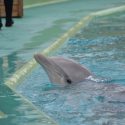
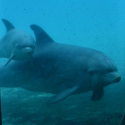
The cabin door shuts with a bang on Ekinox and Naska. The two dolphins jump in their harnesses, despite the huge doses of sedatives that they have received. Soon, the airplane will vibrate from the roaring motor as the plane flies towards Greece. The two young dolphins, only five and six years of age, have just left their mothers forever. Farewell Bailly! Farewell Femke! Despite the fact that they are way off being adults yet, the park thinks they are mature enough to be sent to new aquariums, as part of the « European Endangered Species Programme (EEP), for the breeding and conservation of endangered species, » which dolphins are not.

All of their life, these young ‘stallions’ will encounter unknown inmates, furious to see them disembark into an always confined space. Each transfer is a nightmare for them. Recently, in 2014, the young Angel died of stress on the tarmac. In 2016, Galéo exposed the glaring problem of a bad social integration in an out of control community of detainees.

This is the fate that awaits these two young males who will be leaving Park Asterix. In a few weeks, they will be sent to Attica Zoo. They won’t be the only ones: Veera, Delfi, Leevi, and Eevertti will also soon join the Greek aquarium from the Tampere dolphinarium in Finland. Lacking visitors, the establishment was forced to close last October. After trying for some time to send them to a marine sanctuary, the Särkänniemi theme park finally decided to send the four survivors to Greece. But these survivors consist of an old couple of tired dolphins and their two young sick dolphins. And the remaining two Lithuanian dolphins from Attica Zoo will be the dolphins with which these French dolphins will share their new life? Are they hoping to recreate a new family with this motley crew?

At first populated by 11 Lithuanian dolphins, 3 of which were caught in the Black Sea, the Attica Zoo dolphinarium, like all of the others, can’t offer good conditions for dolphins. Two dolphins died and two were still-born between 2010 and 2015. And Park Asterix and the Särkänniemi theme park have decided to send their ‘specimens’ there instead of looking at a rehabilitation solution in a sheltered sea location.

Why? It should be known that for a few months now, there have been strange movements afoot in the European dolphinariums. Harderwijk seems to want to rid itself of its surplus in Spain or Dubai, whilst other dolphins circulate from one country to another in strict secrecy, discretely discharged and re-embarked. Is the dolphin market already reorganising itself?

One thing is certain, that supplying new dolphins to the Attica Zoo will reinforce its position. In Greece, the law banning wild animal shows was voted by parliament in 2012. Still not in application, it is just as valid for circus animals as it is for dolphins. In artificially increasing the population at Attica, the industry undoubtedly hopes to prevent its definitive closure and indefinitely slow the implementation of this law.

In their damp hammock, their skin covered in white lanolin, their eardrums screaming under the horrendous pressure, shivering with cold, our exiled dolphins don’t think about all of the above. They simply have to endure the long voyage and suffer the sadness and anguish, as they travel further away from their mothers and their family, left much too early to never be seen again.

This isn’t how wild dolphins travel. This isn’t how they create new ‘pods’ either.

Who would still like to lead us to believe that dolphinariums care about the dolphins that they exploit? How can Park Asterix justify such a commercial decision?

One Voice has written to them to ask them, backed up by experts, to put an immediate stop to the reproduction and exchange programmes for the dolphins.

Emergency: Wolfs and wolf cubs in danger

Emergency: Wolfs and wolf cubs in danger

Emergency: Wolfs and wolf cubs in danger
19.07.2016
Savoie
Emergency: Wolfs and wolf cubs in danger
Wildlife

The wolves of Savoy have been the target of the Prefect for a few days now and they need you, your peaceful presence in the places they frequent, because they are threatened.

After the slaughter of a nursing wolf in the department, leaving her cubs defenceless and without food … it is the turn of her companion who tries the impossible to feed her young, to be targeted, with other wolves. The associations for the defence of animals and nature are mobilizing to prevent these massacres.

If you are on holiday or if you have free time, if you like hiking and watching wolves is your interest … You can help us.

We need witnesses, on the spot who can take turns morning and evening essentially since during the day the sector isquite well attended by observers, in order to watch and monitor the area (Méraloup sectors, ruines chien-loup Chavanu, Les Jeux, the Charmettes, Le Loup ruine), and to alert us if anything happens. Take with you a camera and a mobile phone and go out in two’s, it’s safer.

We remind you that every citizen is free to walk is these areas and is entitled to check what is happening on the ground, but of course remaining within the law, in a 100% peaceful way. If ONCFS agents, officers of the law, park rangers or other uniformed authorities ask you to follow them do not resist. We are not here to provoke confrontation, but to observe and testify. We did this for the ibex of the Bargy, successfully, today it’s the wolves who need us.

Thank you for your mobilization!

Contact:
info@one-voice.fr

Adam’s challenge on behalf of animals

Adam’s challenge on behalf of animals

Adam’s challenge on behalf of animals
19.07.2016
Pyrénées
Adam’s challenge on behalf of animals
Other campaign or multi-campaigns of One Voice

On the 27th of August, the athlete Adam Pardoux will cover a distance of 84km in the Tour des lacs in the French Pyrenees Mountains for One Voice. Here is a little more about this committed sportsman…

Adam Paroux is undoubtedly a fantastic example, demonstrating that we can compete at a very good level and be vegan at the same time. Sharing One Voice’s values, he wanted to take on this challenge to highlight the importance of the respect for animals and the planet. He is fund raising to support our campaigns!

One of his sources of inspiration is the professional athlete, Brendan Brazier, the author of a series of vegan recipe books for people who undertake intense sporting activity.

Adam says: « From a sports point of view, I am more focused, les tired and I recover more quickly between sessions, (…) vegan cooking also has the advantage of minimising the impact on the environment. (…) I buy locally where possible and I have a personal goal of ‘zero waste.’ (…) this objective goes hand in hand with the vegan lifestyle. »

Travelling between France and the United States, Adam noticed that the choice of vegetarian and vegan products and their accessibility was more developed over the Atlantic. The majority of restaurants there offer a vegetarian or a vegan option. In France, even if vegetarian or vegan restaurants are becoming more commonplace, the population is more interested in the consumption of organic and non-gluten products. Animal products are very much present.

Competing for One Voice, Adam wants to « defend the right to life of those who cannot express themselves in words, who are the precondition for our survival. I also want to raise awareness of the impact that modern life has on animals and our environment. »

Supporting him in this event will help raise public awareness of animal suffering caused by human activities and will contribute to One Voice’s campaigns. Find the link to his fundraising platform on Leetchi here: https://www.leetchi.com/c/asso…!

A gathering for mice!

A gathering for mice!

A gathering for mice!
18.07.2016
Japon
A gathering for mice !
Animal testing

While manufacturers of botulinum toxin are committed to no longer using the LD50 test, a Japanese firm continues to sacrifice mice on masse. One Voice and Doctors against Animal Experiments are mobilizing !

Since 2010 One Voice has campaigned for mice killed in large numbers inlaboratories (see the history of its actions for the abolition of animal  experimentation). The case of those sacrificed for the production of botulinum toxin is particularly cruel. The LD50 (or median lethal dose) test is performed for each batch of toxin to determine the dose that will kill 50% of the mice. The substance is injected into the abdomen, causing them intolerable suffering. Gradually paralyzed, they finally die by suffocation.

In 2011 the Allergan laboratory, the American manufacturer of Botox®, announced that it had found an in vitro method for the development of its product, signing a first victory for the European campaign led by the ECEAE, of which One Voice is the representative for France. Its direct competitors, IPSEN and Merz, have recently followed suit, although validation procedures are still in progress. Only a Japanese firm is still reluctant to give up using mice …

Eisai is a Japanese laboratory. It sells in Europe Neurobloc®, a botulinum toxin type B drug. Initially intended for the treatment of torticollis, its use is spreading today among those whose wrinkles have become resistant to botulinum toxin type A the competition … According to our sources, the German laboratory LPT, which carries out the tests for its account in Europe, was authorized to carry out the LD50 on 60,000 mice in 2014! And if Eisai declares that a replacement procedure is being studied, how many will still be tortured before the final analysis? Let’s mobilize for an immediate stop of the sacrifice of these mice !

Action for the mice

One Voice and Doctors against Animal Experiments, its German partner in the ECEAE, launches a pressure campaign on Eisai.

  • Write to their representative in France !

laboratoire@eisai.net

Or Eisai SAS 5/6,
Place de l’Iris Manhattan Tower 92095 LaDefense

France

You will find below the text we recommend you to use:

Dear Sir or Madam,

I am horrified to learn that your firm is commissioning the LPT contract laboratory to do tests using LD50 your NeuroBloc® product with botulinum toxin B. In 2014, no less than 60,000 mice have been killed! Other have already abandoned animal testing in favour of
methods using human cells.

Therefore, I ask you to immediately stop the LD50 tests on mice and replace it with an ethical alternative, one without animals.

Regards,

Name_________________________

Address________________________

  • Support the actions of One Voice for the abolition of animal experimentation !

Three elephants in the prairie

Three elephants in the prairie

Three elephants in the prairie
11.07.2016
Périgord
Three elephants in the prairie
Exploitation for shows

Lechmee, Mina and Kamala, who are now quite old, are still locked up in the Medrano circus. Thanks to Code Animal and One Voice, they can have the retirement that they deserve in a sanctuary in France. It is just up to the circus to make this choice.

Three elephants walk in the prairie. The blind Lechmee is guided by her friends, Mina and Kamala, to the chestnut trees where she inhales the smell of the leaves and delightedly muzzles the rough bark with her trunk. Hills and scattered clumps of trees stretch out around them, with crop fields and the road on the foggy horizon. Lechmee can’t see any of this, just vague shapes, but she feels it, she listens, and she shakes her ears. She is happy. The noise of the circus is behind her. After fourty-three years of noisy fanfares and cracks of the whip, she finally discovers birdsong, mumbling conversation with her two companions and endless promenades in the heather land against the setting sun.

How peaceful! How exquisite it is to finally live for these much-travelled elephants! Born in Asia in the 1960’s, they were taken away from their families and then bought as children by Tyseley Pet Stores. Once in Britain, Lechmee, Mina and Kamala were first sold to the Chipperfield circus, and then found themselves under the iron rule of the Medran circus, but luckily always together.

Today, their suffering has ended. Lechmee and her friends have come to the Elephant Haven sanctuary, in the Périgord-Limousin regional park, receiving the very best care from the elephant experts there. They have joined other elephants, all tired by a life in captivity, who occasionally jump into a compulsive dance from one foot to the other, or swing their trunk manically. The trace of chains will remain in their minds long after the physical signs have gone, probably forever. Their memory is powerful, they can recall every detail of their violent lives: the prods in their groin, barked orders, the shouting of the crowd, the shows, the travelling, the carparks and the freezing mornings with the pain in their joints against the metal lorry floors. Lechmee has lost the use of her front right foot, and can only move slowly now. But her friends wait for her and stay close, as they always have done.

We have to stop dreaming now…This happy picture is still just a dream. Lechmee, Mina and Kamala are still shackled to the Medrano circus and still take part in shows. Lechmee is required by the 18th of March 2011 decree to be placed in a fixed residence, due to her state of health. But not on her own, this would kill her, and would destroy her two companions. These old elephants, who have been inseparable for half a century, should be able to live the rest of their lives together in peace. This is what Code Animal and One Voice are asking for with Elephant Haven.

Their destiny is hanging by a thread. One word. One decision. The circus can allow for a dignified and peaceful retirement for its elephants in a natural sanctuary. This gesture would be received by the public with gratitude.

If this decision is not taken, Lechmee, Kamala and Mila will die one by one from exhaustion, without ever having found the happiness of walking free, unchained, as when they were children. And that will be a failure for everyone.

But we don’t think for an instant the Medrano circus will make the right decision!

Arturo, polar bear

Arturo, polar bear

Arturo, polar bear
05.07.2016
Mendoza
Arturo, polar bear
Exploitation for shows

Arturo has just died in Mendoza zoo, having spent 31 years of his life suffering in a cage. One Voice is demanding a ban against keeping polar bears in zoos in France and around the world.

Lying on the floor with his mouth open, eyes closed, Arturo has just been put down. His lifeless body can be seen through the cage bars. These are the final images of the « world’s saddest bear ».

Born in the United States in 1985, Arturo was transferred in 1993 to the grim Mendoza Zoo, near Buenos Aires, which is temporarily closed at present following the deaths of too many animals. Arturo endured the Argentinian sun and heatwaves but at least he was not alone. For 23 years, he just had a small puddle of lukewarm water a couple of centimetres deep to refresh himself in, and a small red ball to play with around the cell perimeter. But in 2012, his friend Pelusa died of cancer. Arturo’s fragile world came crashing down, and he plunged into a depression which would last until his final days.

As he battled the heat by spreading himself out as long as possible on the floor, and his state of health deteriorated in front of the worried international public, 1.5m people signed a petition demanding his transfer to Canada. Assiniboine Park in Winnipeg was prepared to offer him a place of refuge, where he could see snow for the first time in the company of other bears.

But the offer fell on deaf ears. Gustavo Pronotto, the director of the Mendoza Zoo affirmed that the old bear would not cope with the journey and that he wasn’t used to the cold. On the 3rd of July 2016, at the age of 31, Arturo died just before his euthanasia, despair in his heart.

We know that all polar bears suffer in captivity, with all of them demonstrating behavioural problems to various degrees, like Rasputin in Marineland, Antibes. And all of them without exception have to cope with climates that are far from being ‘polar’. Arturo is probably the most tragic symbol of their distress.

But why? What good does this suffering do? Has Arturo’s despair been in vain? Did Argentinian visitors act to save the Antarctic after having seen him in his cage? Was Arturo a martyr who prompted the rescue of other polar bears? No, of course not. The only way to save the polar bears is to respect the minimal commitments of the COP21, to stop building useless airports on wetlands, to urgently stop the global warming which is destroying the bear’s habitat as well as ours. But it is important to remember that if the polar bear or the panda have been chosen as ambassadors for menaced species, rather than the southwestern water vole, it is because of their spectacular image and the positive impact on a zoo’s turnover that a bear’s birth can have.

Captivity is a stretched out torture for polar bears in France, Europe, Chile, South Africa, and all around the world. Russia captures dozens every year to sell to Chinese zoos. Little by little, the leisure industry is becoming their principal threat. This is why France must set the example and stop exhibiting these wild and magnificent creatures in attraction parks. The tragic death of Arturo should not be in vain.

Fort Boyard: circus and vermin

Fort Boyard: circus and vermin

Fort Boyard : circus and vermin
02.07.2016
Fort Boyard
Fort Boyard : circus and vermin
Exploitation for shows

Fort Boyard is back on our screens with its big cats and mishandled « vermin ». One Voice is firmly opposed to these cruel games and demands the ban of all animals trained for television.

At the same time as the movement in many French towns against circuses with animals gains ground, France 2 is screening the second edition of its televised ‘middle-age style’ circus show, Fort Boyard, which starts this Saturday.

It is a shame that a public TV channel is broadcasting these types of programmes. Without doubt, the sports challenges and the boldness of the competitors are admirable, which alone is worth seeing. But the Fort Boyard concept repeats the Fear Factor principal, a phobia based game which involves the presence of some four hundred animals shut up night and day, from June to August in a fort in the La Rochelle sea, who are used to scare the players, make the spectators tremble, and to impress viewers.

The ‘ferocious’ big cats are always part of the game, even if in the real world it should be their decimation that is generating concern, not them. Myn, Cali and Kanji, the tigers in the programme, were born in captivity. Trained from the beginning of their lives, they mope around all day long in their damp cells on the ground floor, bored, beneath the Treasure room. They wouldn’t hurt a fly, well aware of the price they would pay for a roar too far. Yet they perform the role of the blood thirsty tiger. Big cats don’t cope well with production sets and bright stage lighting. This is why contemporary cinema has stopped using them, as well as large primates and other animals, and has replaced their use by computer images. But French TV hasn’t stopped, or at least, not yet.

The eels, maggots, cockroaches, bats, craps, toads, grasshoppers, frogs, lizards, flies, tarantulas, rats, scorpions, snakes, mice and other little swarming creatures who participate against their will in the Fort Boyard challenges since 1998 play into the old cliché, from ancient times, defining ‘vermin’.

Vermin, for the much older generations, was the dark mass of pests swarming under the wooden boards of the thatched cottages, and descended from the devil. According to the chemist Van Helmont, this shady fauna was born spontaneously, a generation at a time, in a dirty shirt rolled into a ball in a bottle, in a time when the noxious vapours of pests, black bile and rat invasions were chased by processions. This same evil vermin was thrown at people’s heads to treat anxiety. Just some poor rats that drown, some spiders that are crushed, some cockroaches that are trodden on, some snakes handled violently, some mice bred to feed the snakes, all conscious and sentient beings, who experience fear and are capable of suffering.

By incessantly repeating the same phobic stereotypes regarding ‘vermin’ and big cats, France 2 can maintain the public’s interest. Nothing is more fun than reaffirming old anxieties and preconceived ideas. But surely the role of public television is to move forward, to distance itself from this blind clamouring for market position and to renew TV content with modern paradigms? Jacques Chancel said: « We mustn’t give people what they like, we must give them what they could like »; a citizen-based approach, based on morals and respect for the living, for example? Surely people would like this!

A summer school on meat consumption!

A summer school on meat consumption!

A summer school on meat consumption!
27.06.2016
Oxford
A summer school on meat consumption!
Other campaign or multi-campaigns of One Voice

Arriving from all over the world, researchers studying human sciences, ethics, philosophy, art, and politics will come together in July for a summer school on the ethics of eating meat, organised by One Voice and the Oxford Centre for Animal Ethics!

Just months after the COP21, whilst scandals associated with the farming and slaughter of animals multiply, One Voice and the Oxford Centre for Animal Ethics are organising the third summer school on animal ethics. From the 24th to the 27th of July, at St Stephens House, the ethics of animal consumption will be the hot topic…

There has been such high interest from universities all over the world wanting to participate that there was not enough place to accommodate everyone. Amongst the participants will be the French philosophers Corine Pelluchon and Thomas Lepeltier. The collective objective of the event is to conduct a knowledge overhaul on the themes relating to the consumption of animals, with particular emphasis on the moral, philosophical and religious aspects as well as the historical, legal, psychological, scientific and sociological ones. The moral issue linked to the act of killing will be high on the agenda, as well as the subject of suffering experienced by animals in the food industry, animals portrayed as meat, the link between meat consumption and climate change, the impact of industrial farming on the environment, the use of meat substitutes, in vitro meat and strategies for change…

The Oxford Centre for Animal Ethics, founded in 2006 at the prestigious Oxford University, explores the questions of animal ethics through university research, teaching and publications. It is run by Professor Andrew Linzey, who is also One Voice’s vice-president.

Each conference member’s contributions will be compiled in a book edited by the Oxford Centre for Animal Ethics in English and in French. It could serve as a base for work to come, as did the first conference on the
Link in 2007.