Archives: News
Fur: the unbearable images of a young mink devoured alive
20.08.2018
Lithuanie
Fur: the unbearable images of a young mink devoured alive
Fashion
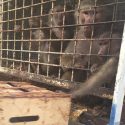
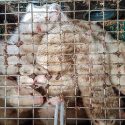
These are the images of a survey conducted in a fur farm in Lithuania, shared by Tušti narvai, one of our partners in the Fur Free Alliance. We see a young mink being devoured alive by his brothers and sisters. This horrible scene is only a tiny part of the nightmare of mink reared for their fur. It is time for this to stop. Please sign the petition! #VisonsLeRespect
A nightmare scene
« This is the most shocking scene I’ve seen. » Thus, the investigator who conducted the investigation describes the images he filmed: a young mink, locked in a cage on this fur farm, with his stomach open, desperately trying to escape his brothers and sisters who devour him alive.
This nightmare, however, is not uncommon. In fur farms, individuals are born and live in tiny cages. Forced into promiscuity, condemned to boredom, they go crazy, attack, injure themselves, and sometimes are devoured…
A sample of the horror
On the video of the investigation, we also see: minks covered with blood after fighting, others with missing limbs, ears torn off, open wounds, babies a few days old trembling on the fence, the infamous porridge that feeds them, piles of faeces crawling with larvae under the cages … Alerted to these acts of cruelty through the investigation, the local veterinary authorities should now work with the prosecutor’s office to obtain an adapted sanction
#VisonsLeRespect
Why all this horror? For the luxury industry? Yes, this breeding is in Lithuania, but also in France there are fur farms. And, above all, our country, the international capital of fashion and luxury, has an important role to play with its creators … Fashion does not need fur, an ethical fashion is possible and is chosen by more and more fashion designers.
For the ban on raising animals for their fur, please sign and share our petition!
$(document).ready(function(){ $(‘.diaporama’).bxSlider(); });
One Voice partner of Photogr’Africa exhibition for African wildlife
17.08.2018
France
One Voice partner of Photogr’Africa exhibition for African wildlife
Wildlife
With his project Photogr’Afrque and his beautiful photos, Mathieu Courdesses raises public awareness about the protection of wild animals.
From the small golden mole to the majestic lion, Africa abounds with breath-taking wildlife. With his Photogr’Afrique project and his beautiful photos, Mathieu Courdesses, a photographer passionate about the African continent, wants to raise public awareness about the protection of wild animals in this endangered territory.
A »s a child, during a trip to Namibia with his family Mathieu fell in love with the African continent. Today, a safari guide during the high season, he travels the territory in search of its majestic wildlife and takes the opportunity to satisfy his passion for photography.
Aware of the stakes at work in this region of the world where lawful hunts, poaching and animal tourism are intertwined, Mathieu Courdesses wishes, through his photographs, to show all of the beauty of the African fauna and to alert the European population to the importance of preserving it. « I realized that some species are going to disappear, it touched me a lot and I told myself that I needed to raise awareness. To show people that there is still a very wild region in Africa and that it must be preserved. »
In Africa, poaching effectively destroys an elephant every 15 minutes and 4 rhinoceros a day. After drugs and guns, trafficking of endangered species is third in the world.
Thus, even if there are very large disparities on the continent, some species are alarmingly scarce: « In Namibia, there is a big problem with black rhinos, which are increasingly difficult to find. Their population is very threatened. On my first trip to Namibia, rhinoceros were easily found on the way to water points. Today it is much more difficult because poachers hunt them for their horns. »
The moments immortalized by Mathieu are wild and unique moments. They capture the look, the emotion. His photos are his response to the widespread belief that we humans are at the centre of the world. These images seek to challenge the viewer, to bring home an awareness. The world does not belong to us! « Humans can have a huge negative impact, but I’m convinced that they can also play an important role in protecting animals. »
For Mathieu, it is essential to keep hoping: « Everything is not negative, everything is not black. I see a growing awareness for the preservation of the great African wildlife. » He is currently working on a web documentary series for animal protection with the director Gilles de Maistre.
Humans are able to fight against the killing of these animal species. Some, more and more numerous, are fighting on the spot for the protection of the animals, and with very beautiful successes: « While there is almost none in the Congo, one sees more and more elephants, in Southern Africa for example. A few years ago, I followed herds of elephants with 10 or 15 individuals. Today, I come across the same herds with 30 or 40 individuals of all ages! »
The Photogr’Afrique exhibition is currently running in different locations in France. 50% of the proceeds from the sale of photographs and photo albums from the exhibition are donated to One Voice to support its fight in the preservation of wildlife.
Stay informed of upcoming dates on his website.
«Beyond its seriousness and its dynamism, One Voice is a great arch that welcomes all animal welfare sensitivities. It accepts both the most ardent defenders and the soul who is sensitive to animal welfare. It is for this reason that I chose to put my photographs at the service of this association.»Mathieu Courdesses
Pictures: Mathieu Courdesses
Let’s rally against the shooting of red foxes at night in Moselle
14.08.2018
Moselle
Let’s rally against the shooting of red foxes at night in Moselle
Wildlife
In Moselle, the Prefect published a decree ordering the night shooting on red foxes. We have filed an appeal for excess of power. Let us defend them!
Indeed, we could believe that the red foxes’ bad reputation precedes them… But it subsists in the collective imagination relating to a bygone era! The fox is a useful scapegoat for the system in place that justifies and consents to the slaughter of wild animals all year long – or even the initiative – of public services!
The prefect of Moselle remains adamant … against general opinion
Although several departments of France’s eastern regions – Aube, Meurthe-et-Moselle and the Ardennes – have renounced this year’s night massacres of foxes through a massive mobilisation, and despite the decision of the Administrative Court of Strasbourg who ruled the previous decree illegal, the Prefect of the Moselle remains adamant and issues a new decree which this time authorises the night shooting of the red foxes for 2 years over the whole department in order: « to protect the chicken coops » … even though no numerical data supports the claim that they represent an actual threat! It has been done in forceful manner, totally anti-democratic, the citizens being almost unanimously opposed to the shots at night: the public consultation reported 372 out of 380 against the night shots on these small mammals! 98%! The list of responses to advisory opinions is uplifting. It is only lip-service and bypassing the main subject. A prefecture which circumvents the decisions of justice and opposes the opinion of the population … Is this not a denial of democracy?
As for issues linked to foxes, they have been resolved for a long time (i.e. rabies), or had simple solutions not been applied despite common sense!The facts are there: they have a role to play in the ecosystem, without them, the whole thing is unbalanced. We cannot continue to hunt, dig up and kill these animals with impunity, all year long! Foxes are sentient beings and merely because of this, they should be protected. Since 2015, the Civil Code stipulates that animals are sentient beings, what is the use of having improved it if we are to maintain the same hunting practices towards them?
Foxes represent such a wealth, and have the right to live in peace in our forests (when our species does not know how to make the most of another animal species, most of the time, the latter is in danger of death)! They are intelligent and sensitive, and we continue to make them suffer martyrdom… The real reason for their hunting: the so called competition they represent to humans in view of the chicken farms (that are poorly protected), at the level of reared « game » which are released by the hunters themselves, as well as the pleasure of killing that hunting provides under the cover of the regulations … The forest ecosystems could perfectly do without humans, by the way. The foxes and even the wolveswould have their place!
An abuse of power that must be denounced: Let’s rally!
While in recent years the population of foxes seems to be decreasing, these additional means of « destruction » appear disproportionate and dangerous for the inhabitants of our villages and can have serious consequences on the ecosystems given this small animal’s way of life. They are more than 500 000 that disappear every year, that’s enough, it has to stop ! We file a lawsuit for abuse of power together with several of our partners in the Renard Grand Est Collectiveagainst this shameful prefectural decree!
Please sign our petition to warn everyone about the fate of red foxes in France!
Help L’école du chat who are in shock after an attack on its most vulnerable proteges
11.08.2018
Quiberon
Help L’école du chat who are in shock after an attack on its most vulnerable proteges
Domestic animals
Three cats died from an act of violence which left two cats, two dogs and humans traumatized. L’école du chat in Quiberon has suffered serious harm, in fact everyone has suffered from this sordid and sad tale because of the malice of some. An investigation is underway, we support this shelter, a long-time partner of ours.
During the first weekend of August, it was very hot in France. In Brittany the torpidity of the day eventually gave way to the freshness of the night. Everything was calm. Sally and Mojito, two little cats who lived atL’école du chat in Quiberon took advantage of the shade from their little cabin, while Martin, as usual, played quietly and taught Jason and Mathurin his best tricks. Because they are the youngest, they are also the most playful. These five cats have FIV (a virus attacking the immune system, such as HIV for humans), are very fragile to any infection, which can be fatal. These charming cats with a difficult past and the volunteers who lavish them with all possible love, helping to restore in them their taste for life and their confidence in the future … This was their last evening of serenity together.
During the night of Sunday through to Monday two extremely friendly dogs, a Labrador and a German Shepherd were stolen from a family who want to file a lawsuit against the unnamed.
At dawn, the perpetrators went around to L’école du chat in Quiberon, they spotted a place where the roof was the least solid and threw the dogs from a height of two metres into the compound. The two large dogs panicked. On landing, they obviously suffered and were very scared. They then proceeded to attack the cats …
Sally and Mojito, the weakest of the cats, were literally scared to death, suffering heart attacks. In a flash, Jason and Mathurin had the reflex to protect themselves by climbing up high, and then witnessed the scene of extreme violence.
When help arrived, Martin was found in a pool of blood under a palette of the cabin. He was immediately taken to the vet. He underwent many treatments, but his body was too weak … After a 3-day fight, having already suffered so much, we had to let him go. On Thursday at the end of the day he eventually passed away, surrounded by love.
Jason and Mathurin have no physical injuries. But the trauma is still there, they are constantly worried. They no longer feel safe in their cabin, and now live hidden in their blankets. They need as soon as possible a host family or a permanent one. They are always close to the volunteers of the shelter, but are impossible to appease: they try to flee their cabin as soon as the door opens.
L’école du chat in Quiberon has filed a lawsuit against the unnamed perpetrators, we will give the school legal help, this act of extreme violence is against everyone in this sad story. Dead cats, traumatized survivors, dogs, and shelter volunteers who already need much support on a daily basis, to cope with food and veterinary expenses, and even equipment to improve the reception conditions for their unfortunate residents!
You too can help L’école du chat in Quiberon, participate in their prize draw, or propose to be a family for Jason or Mathurin!
JasonMathurin
South African lions slaughtered for so called miracle cures
10.08.2018
Afrique du Sud
South African lions slaughtered for so called miracle cures
Wildlife
In South Africa, lions have been stalked by poachers and trophy hunters in a perfectly legal way for years, as high as 500 individuals per year. This number does not appear to be sufficient since the South African government has just decided to double its annual lion bone exports to China! What an abominable sadness. Protest your anger to their president!
This increase in export quotas has an obvious economic role, so that money from illegal trafficking enters the coffers of the state and benefits the whole country … and not just the smugglers and poachers. Lions are also bred in captivity specifically for this purpose!
The placebo effect is only a dream in the far east but devastates the lion populations of the rainbow nation.
When you see the lion’s magnificence & beauty, you wonder why anyone would want to kill him for ‘medicine’ that doesn’t work.
South Africa has doubled their annual quota of lion bones exported for traditional Chinese medicine. RT to ask @CyrilRamaphosa to reverse this. pic.twitter.com/oeZYsAQM8X— Bella Lack ? (@BellaLack) 10 août 2018
There is nothing that has been allowed so animals can be slaughtered for so called miracle cures! « Love Potions », « Tiger Wine », the skin and head of lions serve as carpets or stuffed for trophy hunters or the carcass is sent to China to be crushed and serve the financial windfall of farcical quackery to be elevated to the rank of medicine …
This is all the more serious as lions are endangered.
When we see the magnificence of the lion and their solar beauty … some, like us, are filled with a sense of fullness and satisfaction when contemplating this calm and majestic power, for others, jealousy and envy, who want to appropriate this. These are very sick societies, like those of humans, who want to appropriate the wealth of others, and that of animals, for their deepest gain: their very lives, through their fur, their skin, their flesh and their bones….
Let’s lobby the President of South Africa, Cyril Ramaphosa on social networks (@CyrilRamaphosa on Twitter and @MyANCza on Facebook), to cancel this unbearable decision!
Against the decline of animal welfare at the Olympic and Paralympic Games in Tokyo!
10.08.2018
Tokyo
Against the decline of animal welfare at the Olympic and Paralympic Games in Tokyo!
Other campaign or multi-campaigns of One Voice
On the occasion for the preparations of the 2020 Tokyo Olympics, Animal Rights Centre Japan, a long-time partner of One Voice in Japan, launched a major national campaign against animal cruelty, Tokyo Olympic Cruelty. To amplify the requirement to improve the living standards of animals living in the worst of conditions, Olympic champions, call on Japanese officials to claim at least the guarantee that the supply of eggs and pigs for athletes do not come from battery farms. One Voice joins their request.
While the Olympic and Paralympic Games in London and Rio had shown a modicum of consideration for animal welfare, the Tokyo committee seems to be totally indifferent. To reduce the production costs of eggs, meat and milk for the next « Games », the standards in force will be lowered than those of previous levels for the so-called farm animals! However, the cages and battery stalls are vilified, and the general public is turning away more and more. Who was not stunned once informed of these unbearable practices? But in Japan, as reported byAnimal Rights Centre Japan, there is still a lot of work to be done, education about empathy and caring for animals.
We know that this type of intensive breeding deprives for example pigs of their freedom of movement, even preventing them from turning around or even taking a step … Sows are subject to breastfeeding, care is not provided or rarely given to their infants, a broad-spectrum of antibiotics are the rule, as for hens called « layers », in tiny cages in which their wings get stuck and where they hurt their claws. They are forced to live in a stressful environment, where pain and suffering are imposed on them. All these animals end their miserable lives to robots, which kill them on the production line, in a system where we deny them any sensitivity from the humans who work there. In Japan, 96% of respondents do not even know what « animal welfare » means, or have ever heard of it! 97% of Japanese do not know that pigs are born and grow in intensive breeding programs …
On Wednesday, August 1st 2018 Dotsie Bausch, a member of the US cycling team and 2012 Olympic silver medallist, as well as nine other athletes, one from the United States, Canada and New Zealand, sent a letter to the Mayor of Tokyo, Yuriko Koike and to the Tokyo Organizing Committee for the Olympic and Paralympic Games, to request a guarantee that the eggs from chickens and pigs will not come from battery farms for the whole event. Their « Legacy for Animals » campaign, supported by One Voice, is part of the larger « Tokyo Olympic Cruelty » campaign.
« The Olympics is the highlight in the career of a top athlete – the best in the world come together to compete, so the best food is needed, » says Dotsie Bausch. In her letter, she provides scientific evidence, facts and examples to argue about the harmful effects of intensive livestock products on the physical and mental health of athletes. The champion is also worried about the image of Tokyo: « If Tokyo is not able to provide quality food, the city will be behind in a world moving forward, towards a better treatment of animal farming. »
It is absolutely necessary to make everyone’s voice be heard! You can act to raise awareness about the sentience of animals. In Japan, Asia and around the world, sign the petition « Tokyo Olympic Cruelty » by Animal Rights Centre Japan.
Noise and fury in the oceans
07.08.2018
Canada
Noise and fury in the oceans
Natural habitat
Over the last sixty years, the ocean has been subject to increasing levels of noise, and in parallel, cetacean beachings. One Voice is asking for a higher level of sea protection before it is too late.
Imagine a deep screeching sound, like iron claws running across a giant blackboard. The noise doesn’t stop, and repeats itself on increasingly unbearable frequencies pounding the eardrums. Far away on the horizon a US Navy vessel creeps along the coast. A nearby group of orcas hug together nearly touching the beach, trying to escape the noise. They keep their heads above water and slide as close as they can to the bank, risking stranding. This was filmed at Puget Sound in 2003. Fortunately, the J Pod orcas escaped unharmed.
Military fleets from many countries have since upped their military operations in the open sea and on the coast. Bombs have been dropped in scare-tactic strategies, missiles have been launched, and dark stealth submarines survey the depths with their damaging signals. In order to track them, the American Navy’s super-sonar Low-Frequency Active (LFA) sweeps the ocean with a sonic roar the equivalent of three Boeing 747’s taking off. Whales don’t have anti-noise protection to shield them from 235 decibels, and in the aftermath of these operations, numerous cetaceans die on the beaches with broken eardrums and bleeding eyes.
Elsewhere, in calmer waters, it’s the oil seekers who initiate research operations, surveying the ocean bottom with air gun blasts to uncover hydrocarbon. Once discovered the platforms sound the gongs morning, noon and night, resonating in the Norwegian Sea and changing the course of sperm whales.
Jacques Cousteau’s « Silent World » is actually quite the opposite. The sea has always been a concert of rumbling, tapping, calls and songs exchanged by fish. The coral reefs are as noisy as the jungle and sometimes this chit-chat can only be drowned out by the triumphant whistling of an orca, the infrasound of a blue whale, or the far away thunder of an underwater volcano.
But there has never been as much sonic assault as destructive to marine life as that inflicted since the arrival of humans: Endless marine traffic, luxury marinas, cruises, water sports, intrusive whale watching, offshore wind farms sinking their piles using hydraulic hammers etcetera. Considering we know that small Great Barrier Reef fish are eaten twice as fast by the larger fish when motorboats are present, what can we say about the cetacean suffering; whose world is first and foremost made of sounds, as ours is of images? If the sonar noise becomes too powerful, they can no longer feed themselves, reproduce or socialise. Small boat traffic alone reduces the range of sounds emitted by the big dolphins by 26%, and by 58% for the pilot whales. Imagine living in a nightclub, constantly shouting to be heard!
One Voice is asking that the European Commission, under its Marine strategy framework directive (2008/56/CE), devote more research into sound pollution in the different marine regions within its jurisdiction, and that the member states deploy all the necessary means to limit the principal noise factors as quickly as possible.
Emergency for Scarlet, the youngest orca of the clan J is dying from starvation!
04.08.2018
Canada
Emergency for Scarlet, the youngest orca of the clan J is dying from starvation!
Wildlife
A little angel is dying before our eyes, surrounded by her mother Slick (J16) and her big brother Echo (J42). Scarlet is not sick. Finally, though… She is sick from certain human aggressions on her planet, this blue planet that we all share.
A population weakened by the captivity industry
Scarlet (J50)’s family have lived here in Puget Sound, off Seattle and Vancouver for hundreds of years. In the 70s, armed men came, hungry for money, to capture these resident orcas, easy to track down. Nets, fast boats, dynamite, 13 of them were captured and sent to dolphinariums. How many died during these indescribably violent hunts ? Lolita was one of those little ones captured and taken away… Now after 48 years, still going around in circles under the tropical sun of Miami.
Their super pod of three family clans could never really recover, despite their solidarity, despite the active and benevolent watch from their matriarch Granny, who died in January 2017 at the age of 105. Granny had experienced hardships, catches from industry, pollution, tankers and fishermen… But the worst was yet to come: to see her grand children die from hunger and thirst. A slow agony, a constant stress. If the disappearance of this species is a tragedy for all of us, then it is above all a martyrdom for the individuals concerned.
Scarlet is in immediate danger
Scarlet, is the last born of the J pod, she is still a child, but her birth dates back to 2014. Granny had watched over her as a godmother for her first three years. If only she knew… At four, Scarlet should be growing. She shows all the signs of severe dehydration! One of the specificities of cetaceans is to extract from their solid food the water they need. Now we can discern the shape of the skull under the skin of Scarlet, to the point that we are, like the specialists, extremely worried about her survival, estimated in days if nothing is done. She urgently needs salmon! Scarlett is dying… from hunger and thirst.
The situation is all the more dramatic because ten days ago her clan had just lost a little one having lived only half an hour after its birth; her mourning mother, Tahlequah (J35) and her group cannot bring themselves to leave the body of this lifeless baby, taking turns to carry her since then. The pregnancies of orca mothers are no longer viable. The main cause: nutritional stress.
Overfishing and dams are the cause
Overfishing and large dams are killing chinook salmon, large fish that live in the northern Pacific Ocean and which feed the resident orcas of the Salish Sea… some even say they have already disappeared, as their numbers are now very small…
There are more than eight dams on the Snake River. For the specialists, to each dam, we can lose up to 10% of the chinook salmons. But for these fish, a long journey is necessary for their reproduction. It is a pilgrimage to the places of their birth. But this upriver journey to the spawning ground is so difficult that they lose their reserves, their bodies are transformed and the future parents die, exhausted, as soon as they have spawned. For them too, the Salish Sea becomes their tomb…
To save these resident orcas is to repair a little of this Earth that is suffering. Because the return of salmon would be good news for these fish, kings of the rivers and the ocean of the Pacific coast. Biologist Ken Balcomb, head of the Centre for Whale Research, of which One Voice is a member, has devoted his entire life to the South Resident Killer Whales, the SRWK, as he calls them; he has been studying them for 43 years. And when he goes out to sea with his boat, they come to greet him by bringing him fish, they who do not already have enough to survive. Because these orca people are not just only majestic, but, they are the best thing in all of us, this small patch of true and fragile humanity that we should stand up and support while there is still time.
Ken Balcomb fights tirelessly for the reopening of the dams. Let’s all support his call on social networks using #FreeTheSnake in our publications on this topic!
Photo: Slick (J36) and Echo (J42) surrounding Scarlet (J50) on July 2015.
Credit: Heather MacIntyre / Nature’s Keeper Photography / Maya’s Legacy Whale Watching.
Photographer Laurent Baheux supports One Voice
02.08.2018
Monde
Photographer Laurent Baheux supports One Voice
Wildlife
Thanks to his photos, the talented Laurent Baheux immortalizes rare and precious scenes of nature. This self-taught photographer, who claims to feel « less of a danger to the intimacy of wild animals than to live among men », engages, through his art, in the protection of nature and the defence of animals. He invites the public to discover the last vestiges of a wild world in reprieve.
First attracted by journalism and the profession of editor, Laurent Baheux quickly discovered a passion for photography. Always fascinated by Africa, this regular sports and news photographer went on a trip to Tanzania in 2002, where he began a personal work on wildlife. His striking photos, in black and white, reveal all the beauty, strength and individuality of the free beings that he photographed. Thanks to them, Laurent Baheux transports the public to territories where wild life can still flourish freely.
Through these animal encounters, which testify that of a wild world in peril and thus raises the question humans in its environment. His photos, touching with their authenticity, lead those who admire them to feel the emotions and fragility of animals in the face of a world turned upside down by human activities. They beautify their subjects, raising humility and respect for life. With his pictures, Laurent Baheux calls to us to engage in the protection of wild animals and nature.
In 2013, thanks to his photographic commitment, he became Goodwill Ambassador for the United Nations Environment Program on the international anti-poaching campaign Wild & Precious. He actively campaigns for conservation organizations and has chosen to support One Voice’s fight for animal rights.
On the occasion of his birthday, Laurent Baheux organized a collection on behalf of One Voice, which received more than 1500 € of donations. A huge thank you to him and to those who contributed!
Find his news and his wonderful work on his website: