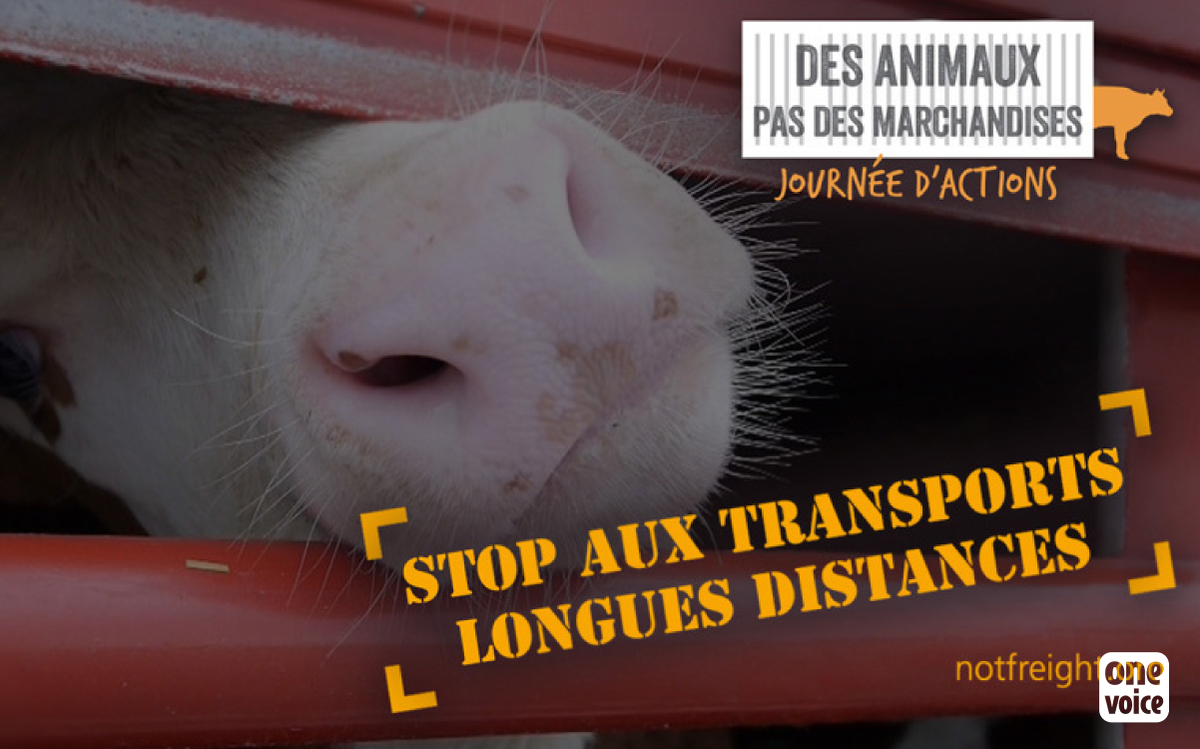
"Animals, are not products", a global mobilization
Twenty years ago, on August 29, 1996, 67,488 sheep perished at sea when the cargo ship carrying them caught fire. To mark this tragic anniversary, One Voice is partnering with CIWF for its global day of action: “Animals, Not Commodities.”
The little ewe stares wide-eyed into the dim light
She is afraid; the ship’s slow rocking is making her seasick. It has been a long time since her flock left the lush pastures of Australia. After two days of an exhausting truck ride, the men forced her aboard the gigantic cargo ship with electric prods.
Now, her fleece is covered in feces and urine dripping from the ceiling.
Up above, thousands of other sheep are crammed together in the open air beneath the gusts of sea foam. The ewe stands in one of the lower holds, where the ammonia-laden air is suffocating her and the ceiling is so low that she must keep her head down. It’s impossible to lie down: there are too many sheep around her. The rolling of the ship sweeps them against one another on the damp floor, where the trampled corpses of the weakest and the sea-water-soaked feed pellets that no one wants to eat lie scattered. She is thirsty, for they are rarely given water, despite the increasingly oppressive heat.
One morning, as the overloaded ship slowly approaches the Seychelles under a blazing sun, an explosion rings out in the engine room. Human screams and millions of terrified bleats rise up from all sides. The acrid smell of diesel and burnt flesh reaches the ewe’s nostrils along with the black smoke and flames. Panic breaks out. Under the pressure, a door slams shut. The sheep rush onto the burning deck. A huge crowd is already thronging there, turning in all directions. Some end up throwing themselves overboard. The fire devours the ship’s eight decks; fuel tanks explode, sending burning debris flying. The ewe’s fleece is on fire. She, too, plunges into the ocean, where the sharks await.
In the distance, the Mineral Century carries fifty-five crew members safe and sound. No one, however, has bothered to save a single one of those sheep swimming around the burning wreck.
This happened twenty years ago
On August 29, 1996, the MV UNICEB, a 20,884-ton cargo ship, caught fire on the sixth day of its voyage from Australia to Jordan. Abandoned in the middle of the Indian Ocean, the 67,488 sheep met a horrific death, either by fire or by drowning.
Twenty years later, nothing has changed. Pigs, cows, calves, and sheep are still being shipped by the millions from their places of birth to distant destinations. When a shipwreck or fire doesn’t kill them all, epidemics, hunger, cold, and exhaustion claim their share of casualties among the herds of animals on board. Finally, once they arrive at their destination, these sheep—most of which are destined for countries in the Middle East—are slaughtered without stunning, sometimes even on the unloading dock.
To mark the 20th anniversary of this disaster, CIWF is organizing the first Global Day of Action against Long-Distance Transport on Monday, August 29, 2016. One Voice and 38 other organizations from around the world are partners in this event. It is urgent that the transport of animals be rethought. Animals are not commodities, but sentient and sensitive living beings! We must reconsider how we treat them.
To support our cause, you can participate in one of the organized actions and write to Mr. Phil Hogan, European Commissioner for Agriculture and Rural Development, to ask him to end animal exports outside the European Union:
Commission Européenne
M. Phil Hogan
Rue de la Loi / Wetstraat 200
1049 Bruxelles
Belgique