2,041,157 animals used in experiments in 2024: France seems frozen in inertia
For more than ten years, the figure of 2 million animals used in experiments in French laboratories has not fallen: it has become the norm. Whilst since 2021 – five years ago now – the European Union has been urging its member states to phase out animal experimentation, France is not slowing down. It is stagnating. And becoming bogged down in a statu quo which increasingly looks like a deliberate choice.
The raw figures seem abstract. They say nothing of the bodies subjected to constraint, the repeated procedures, the sample takings, the confinement, the constant stress. They say nothing of the lives cut short, yet they sum up a reality: every day in France, 3,785 animals are used in laboratories. More than 150 per hour. More than two per minute.
The industrialisation of suffering
One of the most striking developments of 2024 is the explosion of the number of genetically modified animals: over a million, 1,022,805 to be precise. These living beings are thus engineered to develop diseases or exhibit specific characteristics to meet experimental protocols. Put simply: manufactured to be used and then disposed of. If they appear in the statistics today, it is because of a European framework that finally requires the reporting of tail, finger or limb amputations, despite these being classified as ‘minor’ procedures.
The most exploited species
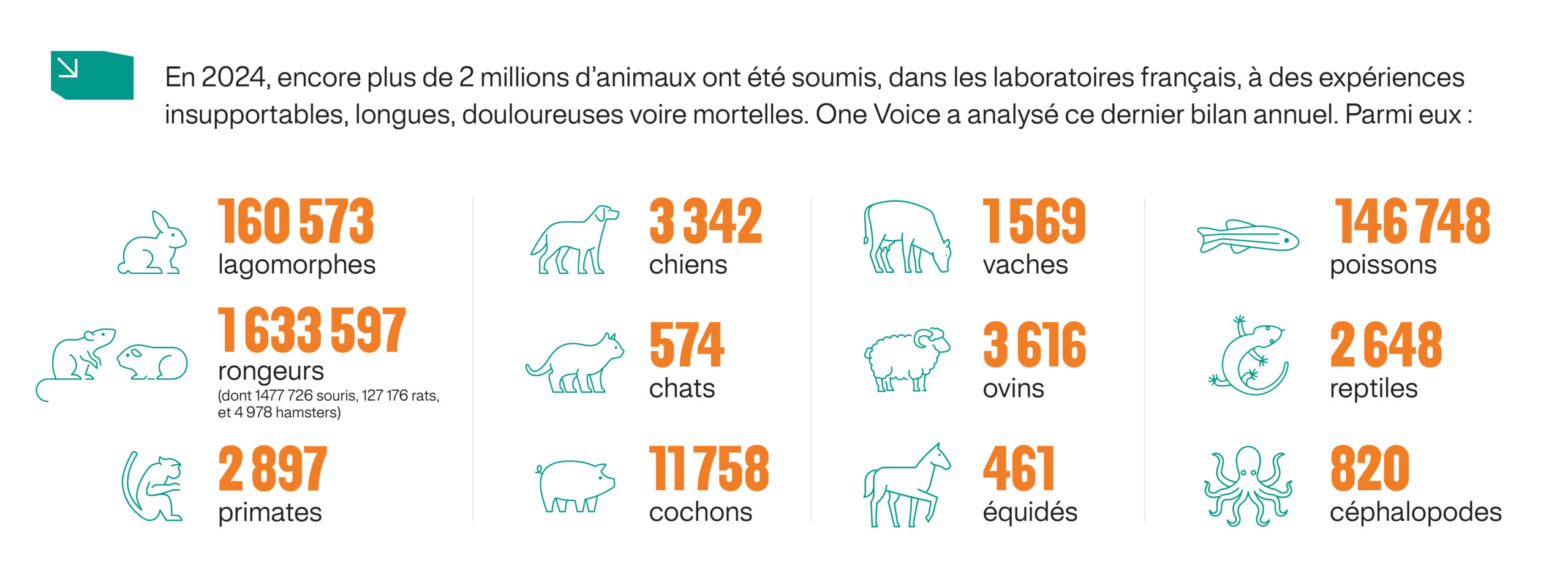
- With 1,477,726 individuals, mice remain by far the most commonly used animals. They are also the most affected by severe procedures and genetic modifications (962,602). If they do not die from induced tumours, they are killed at the end of the experiments.
- Of the 160,573 rabbits used in experiments in 2024, the overwhelming majority (154,663) were ‘used’ in so-called ‘routine production’ tests, a phrase that trivialises the reality endured, as it refers to animals bred to provide their blood, antibodies or bodily fluids. At the end of these procedures, 99.2% of them were killed. The remaining 1,284 fared no better: reduced to the status of resources, they were reused, shuttled through protocols like products, reused until exhaustion. After 2024, they will no longer be undergoing pyrogenic tests: Europe has banned these after long campaigns by our European coalitions. We will now ensure that this ban is actively enforced in the future.
- But these animals are not the only victims of experimentation: our most familiar companions are not spared either. There were 574 cats and 3,342 dogs in the statistics. The vast majority of the latter come from breeding facilities such as those in Gannat and Mézilles, run by the American group Marshall BioResources, because France welcomes these companies with open arms.
- In August 2024, 160 cats and 140 dogs were used to ‘train staff’ and teach them how to kill… Meanwhile, there is no ‘waste’: sample taking and injections are on the agenda. The aim? To dehumanise the experimenters as early as possible whilst daring to speak of ‘animal welfare’.
Fewer severe procedures: a smokescreen
At first glance, one indicator might seem encouraging. So-called ‘severe’ procedures are falling (from 191,046 in 2023 to 159,744 in 2024) and the total for ‘severe + moderate’ has dropped below the one-million mark.
But on closer inspection, the picture darkens: so-called “minor” experiments are skyrocketing and exceeded one million in 2024 (1,079,955). Their number has doubled in just a few years, and mice are paying the highest price (821,876).
The explanations put forward to justify these results – a ‘stricter’ framework and ‘increased pressure’ to reduce the number of animals – do not stand up to scrutiny. Reducing the number of animals is not a matter of pressure: it is an obligation enshrined in European policy. It is also a strong expectation among the French public.
Furthermore, One Voice has scrutinised the projects of laboratories conducting animal experiments that same year: around sixty reveal blatant cases of downplaying the suffering. For some laboratories, the stakes are clear: avoiding the ‘severe’ category allows them to reuse the animals and avoids retrospective assessments that could demonstrate the futility of this suffering. It is a logic of budgetary optimisation where pain and death are merely adjustment variables.
France clings to practices that a growing number of countries are abandoning. Today it remains the last country in the European Union to use the method of ascites to produce antibodies, in spite of it being widely criticised for its cruelty, and despite the existence of alternatives. In 2024, 24,090 instances were recorded, of which 24,043 were classified as severe procedures.
Faced with these figures, the authorities can no longer look the other way.
One Voice calls for an end to this absurd logic. Moving away from animal experimentation is not an utopian dream; it is a matter of political will, already underway among our European neighbours. On behalf of the animals victimised by laboratories, sign our petition.
2,041,157 animals used in experiments in 2024: France seems frozen in inertia
In 2024, 2,041,157 animals were used in laboratories in France, a figure almost identical to that of 2023 (2,046,754)
Les espèces les plus exploitées
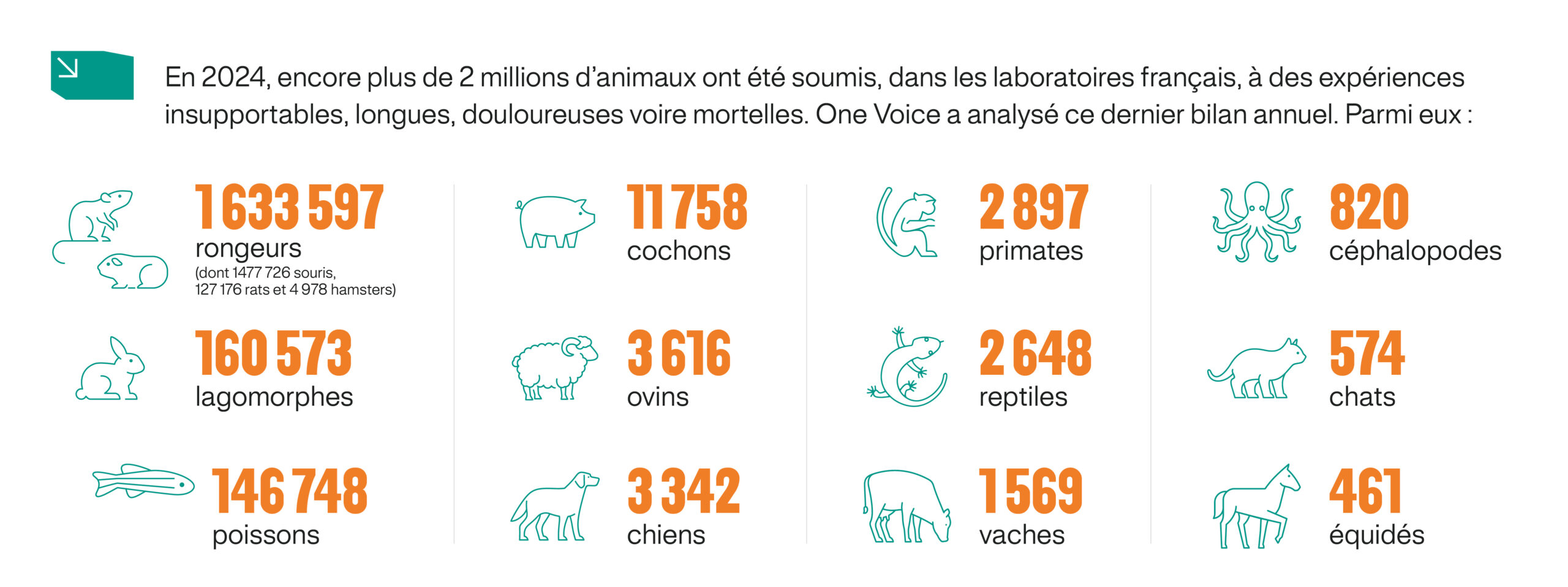
- Avec 1 477 726 individus, les souris restent de loin les animaux les plus utilisés. Elles sont aussi les plus touchées par les procédures sévères et les modifications génétiques (962 602). Si elles ne meurent pas des suites de tumeurs induites, elles sont mises à mort à l’issue des expériences.
- Sur les 160 573 lapins expérimentés en 2024, l’écrasante majorité (154 663) a
« servi » à des tests dits de « production de routine » : une formule qui banalise la réalité endurée puisque l’on parle d’animaux élevés pour fournir leur sang, leurs anticorps ou leurs fluides. À l’issue de ces procédures, 99,2% d’entre eux ont été tués. Les 1 284 restants ne furent pas mieux lotis: réduits à l’état de ressources, ils ont été réutilisés, enchaînant les protocoles comme des produits, réutilisés, jusqu’à épuisement. Après 2024, ils ne subiront plus de tests pyrogènes : l’Europe les a interdits après de longs combats de nos coalitions européennes. À présent, nous veillerons à ce que cette interdiction soit activement appliquée à l’avenir. - Mais ces animaux ne sont pas les seules victimes de l’expérimentation: nos compagnons parmi les plus familiers ne sont pas épargnés. Les chats ont été 574 et les chiens, 3 342. Une grande majorité de ces derniers proviennent d’élevages comme ceux de Gannat et Mézilles, gérés par le groupe américain Marshall BioResources, car la France accueille ces entreprises les bras ouverts.
En août 2024, 160 chats et 140 chiens ont servi à « former le personnel » et à l’entraîner à donner la mort… Entre-temps, pas de « gaspillage »: prélèvements et injections sont au programme. L’objectif ? Déshumaniser au plus tôt les expérimentateurs tout en osant parler de « bien-être animal ».
Les procédures sévères en baisse : un écran de fumée
À première vue, un indicateur pourrait sembler encourageant. Les procédures dites « sévères » reculent (de 191 046 en 2023 à 159 744 en 2024) et le total « sévère + modéré » passe sous le seuil du million.
Mais à y regarder de plus près, le constat s’assombrit : les expériences dites « légères » explosent et dépassent le million en 2024 (1 079 955). Leur nombre a doublé en quelques années et les souris en paient le prix fort (821 876).
Les explications avancées pour justifier ces résultats, un cadre « plus exigeant », une « pression accrue » pour réduire le nombre d’animaux, ne résistent pas à l’analyse. Réduire le nombre d’animaux n’a rien d’une pression : il s’agit d’une obligation inscrite dans la stratégie européenne. C’est aussi une attente forte des Français et Françaises.
Par ailleurs, One Voice a passé au crible les projets de laboratoires expérimentant sur les animaux cette même année : une soixantaine révèlent des cas flagrants de minimisation des souffrances. Pour certains laboratoires, l’enjeu est clair : éviter la catégorie « sévère » permet de réutiliser les animaux et évite des bilans rétrospectifs qui pourraient démontrer l’inutilité de ces souffrances.. Une logique d’optimisation budgétaire où la douleur et la mort ne sont que des variables d’ajustement.
La France s’accroche à des pratiques qu’un nombre croissant de pays abandonne. Elle reste aujourd’hui le dernier pays de l’Union européenne à recourir à la méthode de l’ascite pour produire des anticorps, pourtant largement décriée pour sa cruauté malgré l’existence d’alternatives. En 2024, 24 090 utilisations ont été recensées, dont 24 043 classées en procédure sévère.
Face à ces chiffres, les autorités ne peuvent plus détourner le regard.
One Voice appelle à rompre cette logique aberrante. Sortir de l’expérimentation animale n’est pas une utopie, c’est une volonté politique, déjà engagée chez nos voisins européens. Au nom des animaux victimes des laboratoires, signez notre pétition.