Galeo: a very happy dolphin (according to French law)
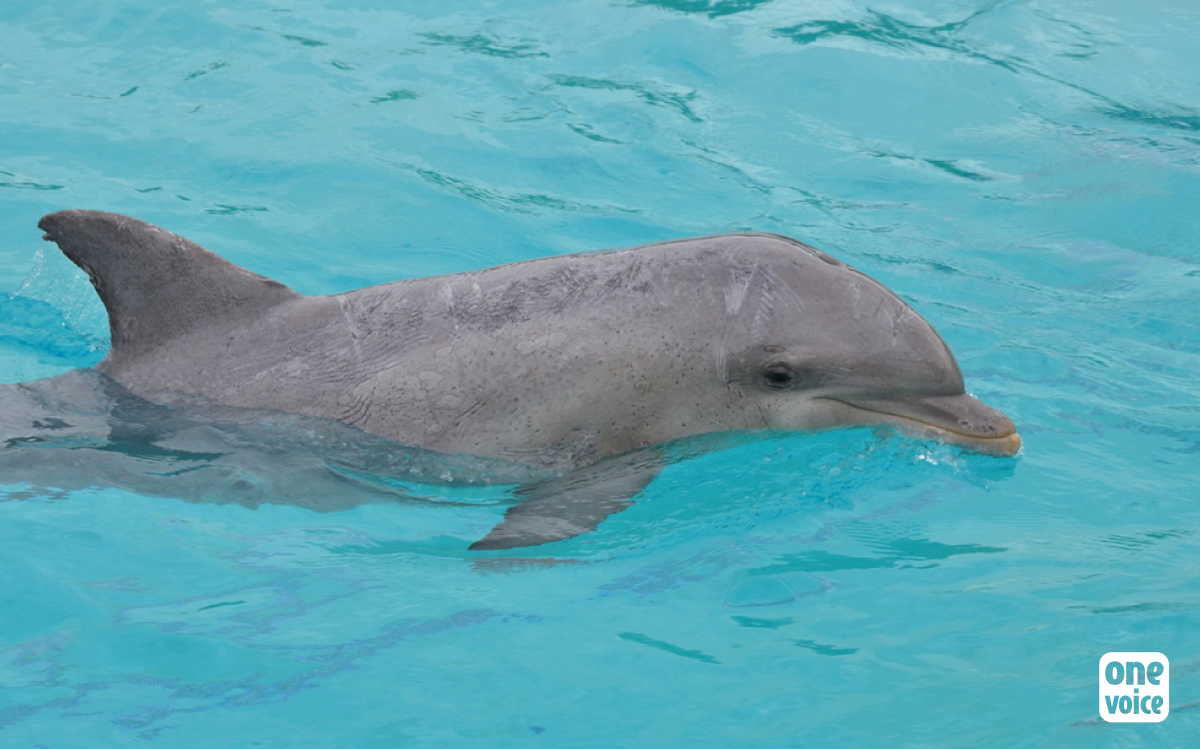
Galéo was born in captivity. According to a forthcoming ministerial decree governing the management of dolphinariums in France, he would therefore be considered a happy dolphin. One Voice is calling for his immediate release and for the draft decree to be withdrawn.
How is Galéo doing?
Following the complaint filed by One Voice, Galéo’s condition has improved. But, having been exiled with Aïcko to the pools at Planète Sauvage, he remains vulnerable to attacks from other dolphins. No investigation has been conducted by the relevant veterinary authorities, as requested. It is true that, according to the draft ministerial decree establishing “the general characteristics and operating rules for establishments holding or displaying live cetacean specimens to the public,” all dolphins born in captivity are perfectly adapted to their restricted lives. Galéo would therefore be a happy dolphin, capable of enduring all the hardships of captivity with his eternal smile. Soon, if the decree passes, hundreds of Galéos will be produced in France, both for the domestic market and for export to Dubai or China. And this for the sole purpose of realizing the economic fantasies of a wolf-killing minister who would so much like to see the dolphin-slavery industry regain its former glory in France, just as in the heyday.
Why is this draft decree dangerous?
Yet its opening lines seem quite reassuring: “The keeping of cetaceans is prohibited in France.” Prohibited? Of course not—let’s not get carried away! Any cetaceans already in captivity six months after the decree takes effect, as well as any dolphins born in captivity, may be “retained.” The law therefore considers these “specimens” to be perfectly suited to the conditions of care that the law has provided for them. These standards generally reflect the minimum basic quality criteria set by the EAZA (European Association of Zoos and Aquaria). They also strangely correspond to the facilities that the Beauval Zoo planned to build for its future dolphinarium. As we know, this zoo had to backtrack under pressure from its own visitors but no doubt still dreams of its project, and it is not the only one…
The draft ordinance seems to have been written in the last century
Unreasonable work schedules are permitted for the dolphins, with five shows scheduled and twelve hours of nighttime isolation! While the importance of social groups is finally recognized, three orcas are considered a perfectly adequate community—a far cry from normal “pods” that often number over a hundred cetaceans—but this will undoubtedly allow Marineland Antibes to keep going for a few more years. As in the 1960s, the transfer of “specimens” is encouraged to form other artificial families in other pools around the world, avoid inbreeding, and increase the overall stock of available circus animals. This project therefore paves the way for an outdated and shameless exploitation of captive cetaceans, running counter to the shift in public opinion that has swept across the U.S. and Europe since the release of the documentary Blackfish.
Should we remind the Minister that the commercial giant SeaWorld is sinking deeper into financial ruin every day?
That the Baltimore Aquarium is planning to create a vast marine sanctuary in the Caribbean for its remaining captive dolphins? That the Barcelona Zoo is considering the same option? That Finland’s last dolphinarium had to close its doors due to a lack of visitors? That several marine sanctuary projects for captive cetaceans are in the works around the world, under the supervision of scientific experts?… And now the minister wants to revive this industry with a useless, obsolete, and devastating decree?!
Let’s be serious! We demand that the minister abandon this proposed decree and instead launch a broad initiative to explore the economic future of amusement parks without captive animals. As for the young dolphins Galéo and Aïcko, we demand that they be separated from the rest of the group until a satisfactory solution is found for them.
HOW TO TAKE ACTION
Write to the Minister of the Environment, Energy, and the Sea, asking her to permanently ban the keeping of cetaceans in France:
Ministry of the Environment, Energy, and the Sea
Ms. Ségolène ROYAL
Pascal Towers A and B
Sequoia Tower
92055 La Défense CEDEX
Send a polite email to Planète Sauvage: contact@planetesauvage.com
Ask them to take all necessary measures to protect Galéo from the attacks he is suffering at the hands of the other dolphins and to place him in a secure pool with his companion Aïcko.
Urge zoos and dolphinariums to stop breeding and inter-park exchange programs and instead transform themselves into animal sanctuaries.