Wolf poaching: Press release
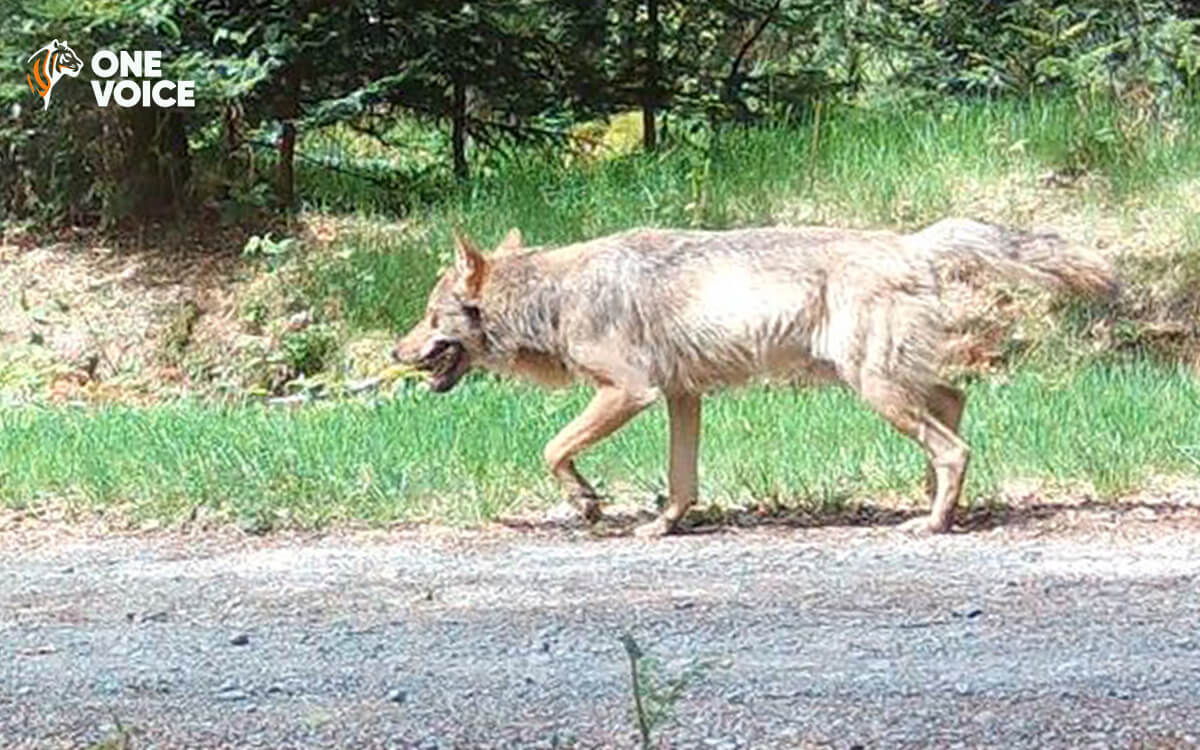
A mass grave as a lure, firearms, photographs of dead animals: on 28 July, the French Biodiversity Agency announced the dismantling of a poaching ring in the Hautes-Alpes. Nine wolves were killed there. Three people are due to stand trial in January 2027, and One Voice is a party to the proceedings. Ten days after Pomme’s death, and one week after the adoption of the Emergency Agricultural Law, our organisation states this unequivocally: this massacre is the result of a climate of hatred fostered by the State.
It all began with a report in April 2025 in the north of the Hautes-Alpes. After nearly a year of surveillance, the searches carried out by the OFB and the local police uncovered a mass grave of animals – presumably intended to lure wolves – numerous firearms and the carcass of a wolf. The seized mobile phones contained photographs of dead animals. On 28 July, simultaneous searches resulted in three people being taken into police custody and six voluntary interviews: nine wolves killed illegally, three people placed under judicial supervision by the Public Prosecutor’s Office in Gap, and a criminal hearing set for January 2027 for the destruction of and complicity in the destruction of a protected species.
One Voice is a party to the proceedings, alongside its solicitor, Maître Caroline Lanty. Nine wolves in a single French department. And meanwhile, 85 others have been legally killed in France since January, out of a national quota of 227 — for a population estimated at 1,082 individuals, a long way from the viability threshold that scientists place at a minimum between 2,500 and 5,000. There are not poachers on the one hand, and public policy on the other: there is the same slaughter, part of which is punished and the other part funded.
First they kill. Then they provide evidence. Or not
On 16 July, Pomme was shot dead in La Bréole, in the Alpes-de-Haute-Provence. Data from her GPS collar shows that she was not responsible for the damage cited to justify the shooting: she was hunting wild animals and had not attacked any flocks. Yet the president of the department’s Young Farmers’ Association claimed to the press that she had been killed in the act. She had done nothing. She was killed all the same, and lies were told afterwards.
Everywhere, it is the same distortion of facts. In the Morbihan, the OFB merely states, regarding the sheep killed around Ploërmel, that the possibility of a wolf ‘cannot be ruled out’: on the basis of that single phrase alone, calls are already being made for a wolf to be killed, even though predation attributed to wolves in Brittany has fallen significantly this year. In Alsace, only two males have been identified in Kiffis; the Hunters’ Federation of Haut-Rhin suggests there are more of them and blames them for the collapse of the amount of game, based on its own estimates. Two wolves accused of having emptied the forests: that is the level of the debate.
On the Millevaches plateau, two wolf cubs have just been born: Girole and Truffe. There, too, attacks are on the decline – five, involving eleven animals, in six months. Yet this has changed nothing: a documentary by the Carduelis association was withdrawn from screening twice in fifteen months – first at a secondary school in Corrèze and then in a municipal hall in Creuse – until the Administrative Court of Limoges ruled against the mayor. It is not just about killing wolves. They want to silence those who defend them.
Article 14 sets the tone
On 21 July, Parliament gave final approval to the Emergency Agricultural Law. Article 14 classifies herds of cattle, horses and donkeys as ‘unprotectable’, replaces prior authorisation for defensive shooting with a simple declaration, and authorises shooting even within nature reserves. Not a single line on the protection of herds. When the State itself organises the killing and removes all oversight, how can it be surprised that others take matters into their own hands at night?
Coexistence is necessary, but is it desired?
Because the system is working backwards. A farmer is compensated as soon as the wolf’s responsibility ‘cannot be ruled out’ — and it is these very same findings that are then used to justify the shootings. In Corrèze, out of 87 reports drawn up in 2025, 50 concluded that the wolf’s responsibility had ‘not been ruled out’ — never that it had been established — and yet 7 cases of undetermined cause were nevertheless put forward for compensation ‘in view of the local context of predation’. Dogs, on the other hand, have always killed sheep: yet a sheep killed by a dog entitles the owner to no compensation. So the wolf is singled out, and it is the wolf that pays with its life.
One Voice calls for this logic to be reversed. Public money should go towards measures that genuinely protect flocks – fencing, guard dogs, shepherds, night-time grouping – and compensation should be conditional upon the effective implementation of these measures, without any derogations or exceptions. Killing must cease to be the simplest and most financially rewarding solution. Wolves ask for nothing more than to be left to live: coexistence is possible wherever there is a will to make it happen, and it is a political choice, not an inevitability.
“They want us to believe that wolves are monsters, and nine of them have been killed in secret by those who shout the loudest against them. Enough lies: we do not believe them. What we want is a country that finally accepts living alongside them. Politicians must stop being in the pocket of organisations that have made biodiversity their enemy, and wolves must finally be left in peace,” says Muriel Arnal, President of One Voice.
Our organisation is renewing its call for witnesses: anyone with information about wolves killed in France can pass it on to us. Complete and absolute anonymity is guaranteed.
Wolf poaching: Press release
Nine wolves poached in the Hautes-Alpes: One Voice will be at the trial in January 2027