Beauval Dolphinarium: Press release
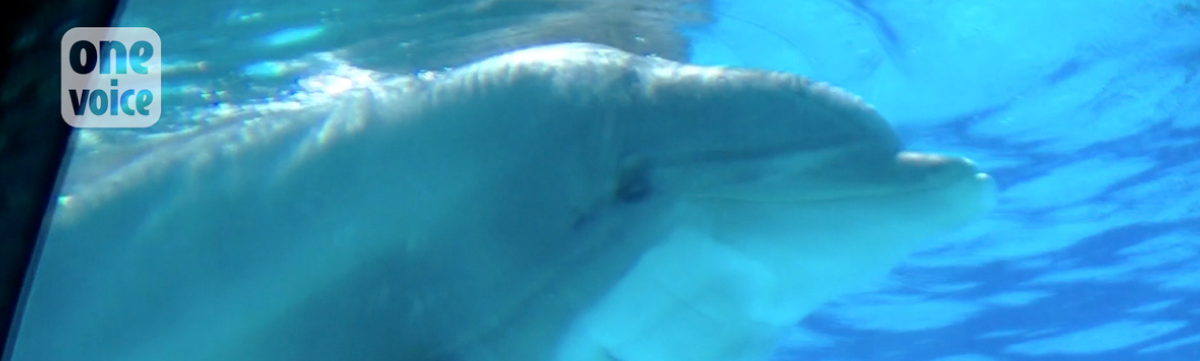
By authorising Beauval Zoo (Loir-et-Cher) to establish a ‘centre for the study, scientific research and conservation of dolphins’, the prefecture has just taken a further step towards the opening of a new dolphinarium in France. One Voice, which has long denounced this captivity project disguised as a scientific centre, rejects this new direction: planned breeding, concrete pools, eventual transfers to other parks and an approach which is primarily economic, to the detriment of the dolphins’ welfare.
The project is not new, and One Voice has been campaigning against it for months. But with this authorisation, it has reached a decisive milestone: administrative approval, which the organisation fully intends to challenge. Its lawyers have immediately begun reviewing the case file.
Beauval would take in, on the one hand, the 11 dolphins from Planète Sauvage (Port-Saint-Père), whose dolphinarium is due to close, and, on the other hand, 8 of the 12 dolphins from Marineland, which is already closed to the public. According to the latest announcement by Mathieu Lefèvre, Minister for Ecological Transition, the dolphins from Marineland would first be sent to Spain; eight of them would then return to France, to Beauval, once the facility is ready. A round trip between France and Spain – traumatic for these animals – only to end up… in yet another dolphinarium.
A ‘research and conservation’ label that doesn’t hold water
One does not study wild animals in captivity, except to measure the effects of that captivity on them. As for ‘conservation’, the bottlenose dolphin (Tursiops truncatus) is not an endangered species. The IUCN classifies it as of ‘least concern’. This classification serves only one purpose: to fulfil the requirement for a research programme in order to be authorised to keep dolphins.
The zoo will join the European Endangered Species Programme (EEP): in other words, it will carry out breeding programmes. However, breeding is in no way necessary for the dolphins’ welfare, and no reputable scientific literature supports this, as Dr Pierre Gallego, a veterinary surgeon and marine biologist specialising in cetaceans, points out in his analysis of the project.
The announced dimensions – around 10,000 m² of water surface area and 30,000 m³ of reconstituted seawater – remain derisory for animals that, in the wild, readily travel 50 to 90 km a day. Self-aware and possessing a vocal signature unique to each individual, dolphins are constantly making choices: choosing their partners, avoiding conflict, diving, hunting. No tank allows for this, and the resulting chronic stress seriously undermines their health.
Finally, during the consultation process, the facility clearly considered transferring dolphins to other dolphinariums, including those in China. This is the exact opposite of sanctuaries.
The water in the pools will need to be treated continuously. Yet the licence was granted without an environmental impact assessment: it is surprising that such a decision was taken without evaluating the impact of such a facility on the environment.
The only solution: genuine marine sanctuaries
The calculation is primarily financial. In captivity, dolphins are a money-spinner: sought-after shows, educational presentations, births, and transfers from one zoo to another. A sanctuary, on the other hand, brings in no revenue – no performances, no breeding, no resale: just a cost, with no commercial return.
By approving Beauval, the State is embracing this profit-driven logic and prioritising the profitability of an industry over the welfare of animals for which it is responsible. Reduced to mere assets to be monetised, the dolphins are paying the price. One Voice refuses to go along with this.
“There is no such thing as a magical sanctuary,” declared the minister. That is untrue. In Taranto, the San Paolo Dolphin Refuge, which One Voice helped to fund, is set to welcome its first dolphins as early as this summer: proof that, with political will, creating this type of sanctuary in Europe is a realistic prospect. Building a sanctuary is, in fact, simpler than erecting a dolphinarium, however attractive it may be to visitors… But it requires the courage to embark on this ecological transition, which the ministry of the same name is methodically working to scupper.
“First, we were sold the idea of a sanctuary. Then came breeding, then exports, even to China: the mask has slipped. Studying and ‘conserving’ dolphins in captivity – when they aren’t even an endangered species – is utterly cynical. We stopped a dolphinarium from being built in Beauval in 2016; together with scientists and our partners across Europe, we will see this through to the end once again.” Muriel Arnal, President of One Voice
One Voice will fight the creation of this dolphinarium by every means possible. If the dolphins were to be shunted off to Spain, abandoned in Valencia or locked up in a new dolphinarium in Beauval, the French people who have campaigned to close dolphinariums would see their wishes flouted. A new dolphinarium in France in 2026 would be outrageous. The organisation is launching a campaign and calls on all those who love dolphins to stand ready: marine sanctuaries are the only acceptable solution – a credible solution, provided there is political courage.
Beauval Dolphinarium: Press release
One Voice condemns the prefecture’s approval of the Beauval dolphinarium