Animals in circuses: an overview of European legislation
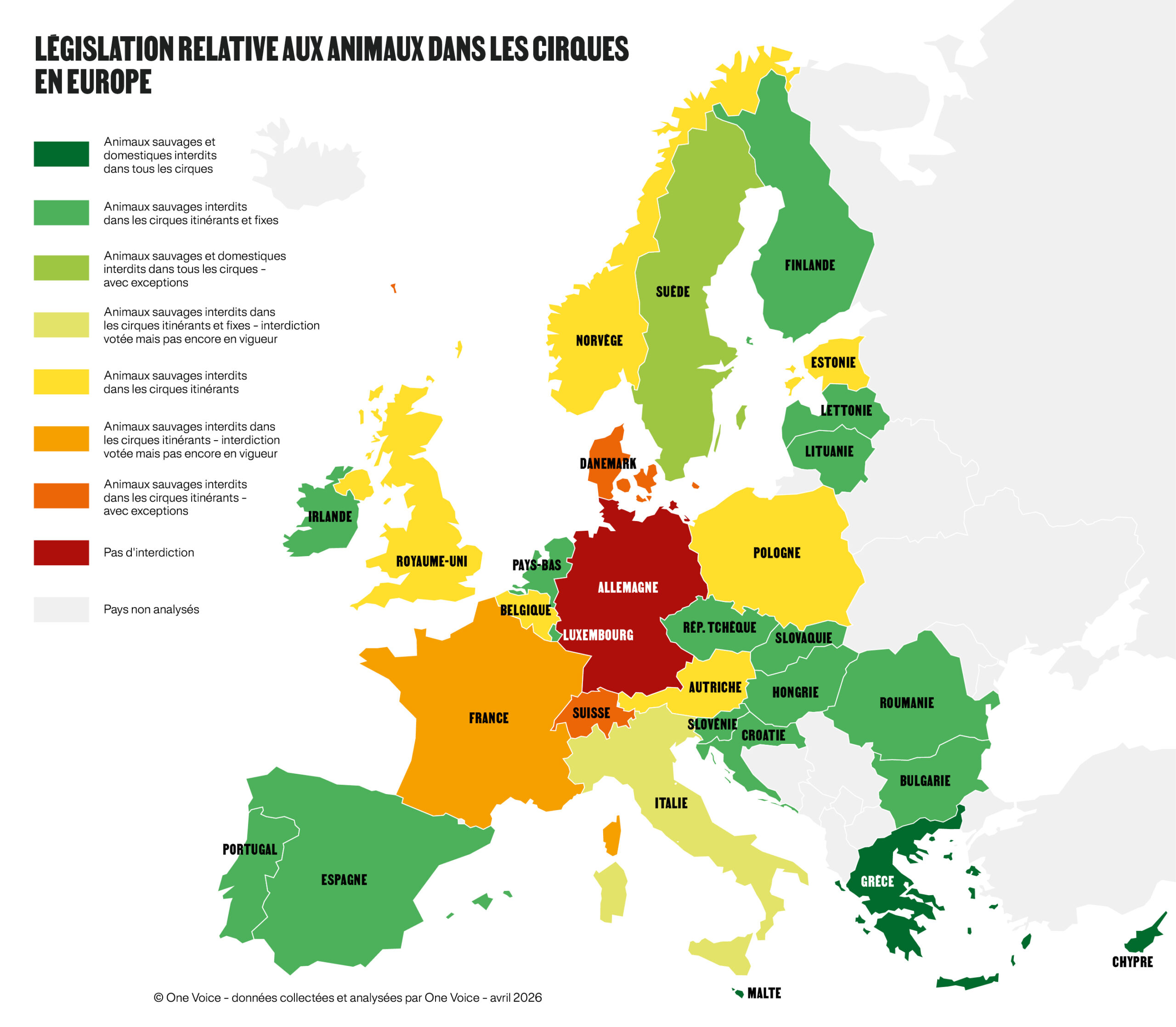
The map we are publishing shows it quite clearly: across Europe, progress for circus animals – both ‘wild’ and ‘domestic’ – is on the rise. France, however, is lagging behind. It still condones the captivity and exhibition of animals. Worse still, with substantial public funding, the State supports the continued operation of circuses featuring animals, going so far as to fund their settlement in permanent locations, all the while turning a blind eye to the abuse and illegal breeding that we continually report.
When Europe bans…
Portugal, Spain, Hungary, Greece, Bulgaria, … In these countries and many others, the keeping of wild animals in circuses is already a thing of the past: total or near-total bans, an end to exemptions, and recognition that travelling captivity is incompatible with respect for the animals’ vital needs. Some go the whole way and also include so-called domestic animals.
Our analysis of European legislation, illustrated by the map we are publishing, bears this out: today, Europe is moving forward, driven by advances in scientific knowledge and by a growing societal awareness of these outdated spectacles.
Thus:
- Twenty countries have legislation that is more ambitious than France’s, including three with a total ban on all types of circuses and on all animals, both wild and domestic,
- Six countries have legislation similar to France’s, but their laws are already being enforced,
- Two have legislation that is slightly less ambitious but is already being enforced, and
- Just one has no legislation at all.
In recent weeks, Julie, the last elephant, and Sona, the last tiger in circuses in Portugal, have been taken to sanctuaries and refuges, following a law passed in 2017 and rigorously enforced.
… France circumvents, condones and even subsidises
While a great many neighbouring countries are working to end the use of animals in circuses, the French government, for its part, has chosen the path of hypocrisy. Having passed in 2021 a law that is only nominally protective, it now plans to compensate circuses, the perpetrators of this violence and these illegal practices, with millions of euros of public money, while we are sounding the alarm about the lack of sanctuaries and refuges to rehome these deeply suffering animals. In its theoretical implementation, this law actually supports the interests and practices of the circus industry. In reality, the animals continue to be exhibited, trained, bred and confined, despite their widely documented and recognised suffering, and with complete impunity.
Neither wild nor domestic!
While the consequences of captivity, training and life on the road are terrible for wild animals, so-called ‘domestic’ animals also suffer and are the great forgotten of the 2021 Act. They, too, suffer trauma linked to such conditions of confinement: they are under constant stress, malnourished, isolated, crammed into lorries or tethered too tightly when they are not being forced to perform in shows. They, too, suffer from severe stereotypies. This arbitrary classification is, moreover, contested by many scientists, particularly regarding camels and dromedaries, which remain very similar to their wild ancestors and have the same social and physiological needs.
Our analysis of the European legislative landscape regarding circuses reveals one clear fact: protecting all captive animals is neither an exception nor a utopian ideal; it is a societal choice already embraced by many countries.
One Voice calls for the immediate and effective preparation for the ban on wild animals in circuses scheduled for 2028, without delay or circumvention. The development and registration of adequate shelter solutions for all these living beings are urgent and must become a priority, not to mention penalties commensurate with the reported cases of abuse. And subsequently, the law must be amended to include domestic animals, following the example of countries that are pioneers in this field.
Animals in circuses: an overview of European legislation
One Voice has analysed the laws currently in force across Europe: while our neighbours are freeing animals, France continues to exploit them
… la France contourne, cautionne et même subventionne
Quand de très nombreux pays voisins œuvrent à la fin des animaux dans les cirques, l’État français, lui, fait le choix de l’hypocrisie. Votant une loi faussement protectrice en 2021, il prévoit à présent d’indemniser les cirques, auteurs de ces violences et de pratiques illégales, avec des millions d’euros d’argent public, tandis que nous sonnons l’alerte à propos du manque de sanctuaires et de refuges pour placer ces animaux en proie à une grande souffrance. Dans sa mise en œuvre théorique, cette loi soutient en réalité les intérêts et pratiques des circassiens. Dans les faits, les animaux, eux, continuent d’être exhibés, dressés, reproduits et enfermés, malgré leurs souffrances largement documentées et reconnues, et ce en toute impunité.
Ni sauvages ni domestiques !
Si les conséquences de la captivité, du dressage et de l’itinérance sont terribles pour les animaux sauvages, les animaux dits « domestiques » subissent aussi et sont les grands oubliés de la loi de 2021. Ils présentent également des traumatismes liés à de telles conditions de détention: le stress y est permanent, ils sont malnourris, isolés, enfermés dans des camions ou attachés trop court quand ils ne sont pas contraints de se produire en spectacles. Eux aussi souffrent de graves stéréotypies. Cette classification arbitraire est contestée d’ailleurs par de nombreux scientifiques pour ce qui est des chameaux et dromadaires notamment, qui restent très semblables à leurs ancêtres sauvages et ont les mêmes besoins sociaux et physiologiques.
Notre analyse de la situation européenne des législations relatives aux cirques révèle une évidence : protéger tous les animaux captifs n’est ni une exception ni une utopie ; c’est un choix de société déjà assumé par de nombreux pays.
One Voice appelle à la préparation effective immédiate de l’interdiction des animaux sauvages dans les cirques prévue pour 2028, sans report ni contournement. Le développement de solutions d’accueil adaptées à tous ces êtres vivants et leur recensement sont urgents et doivent devenir prioritaires. Sans oublier des sanctions à la hauteur des maltraitances signalées. Et de faire ensuite évoluer la loi pour y inclure aussi les animaux domestiques aussi, à l’exemple des pays pionniers en la matière.