Layish’s arrival in South Africa: Press release
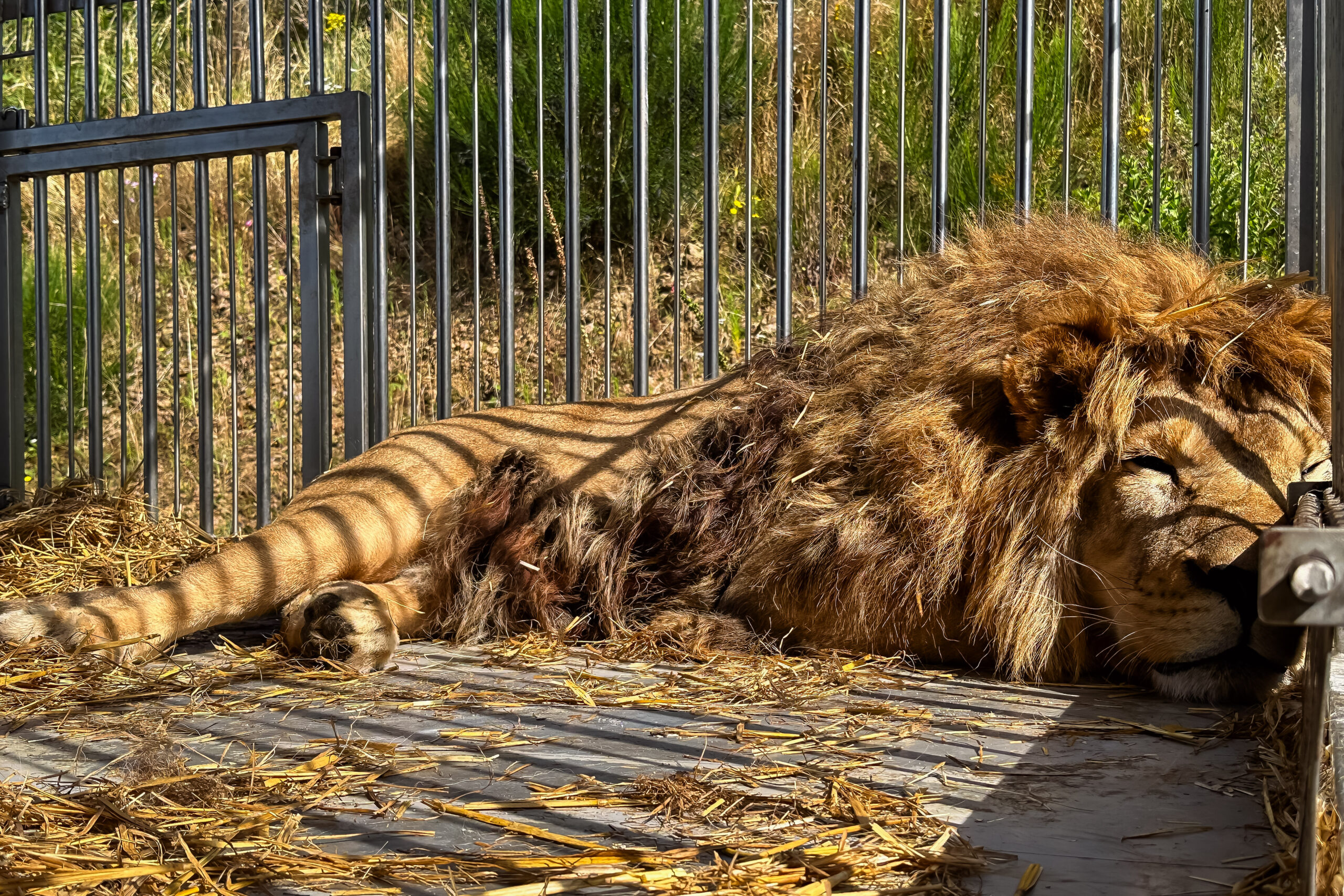
On Thursday 30 April, Layish, a five-year-old lion, set foot on South African soil for the first time. Having arrived at the SanWild Sanctuary after four years behind the bars of a lorry trailer, the lion, rescued from the circus world, is finally discovering the real life of a big cat. For One Voice, who has been following him since he was abandoned and who organised his transfer, this new life marks a crucial milestone – but above all it serves as a reminder of the urgent need to act for the hundreds of animals still held in circuses in France.
Taken in by the sanctuary Le Repère in 2024, and looked after by One Voice, who entrusted him to the Tonga Terre d’Accueil sanctuary in late 2025, Layish had until then known only the extreme conditions of captivity typical of travelling circuses.
After several months of care and preparation, Tonga Terre d’Accueil was able to organise his transfer to SanWild Sanctuary, along with that of four servals. Layish’s transfer was fully funded by One Voice.
After a long journey, the young lion was released into a temporary enclosure before moving to a much larger space, which he is expected to share with a lioness, Mel. Having known only confined spaces, upon arrival he took refuge in a small shed whilst he acclimatised to his new life. From now on, Layish will live in semi-freedom within a vast South African reserve, an ideal setting for a lion scarred by four years of confinement in just 3 square metres of living space and unable to survive alone in the wild.
>> Report on his transfer and arrival at SanWild Sanctuary (+ hyperlink to photo/video gallery)
This move is part of a wider initiative to help exploited wild animals, notably through the Roar Project led by Tonga Terre d’Accueil, as well as by welcoming big cats to our sanctuary in Tuscany.
Layish, a symbol of a system on its last legs
While Layish’s story has a happy ending, it remains the exception. In France, more than 600 wild animals are still held in travelling circuses: big cats, monkeys, hippos, birds and even reptiles…
For years, One Voice has been documenting cases of abuse, illegal detention and trafficking. Several establishments have been convicted by the courts for these offences, revealing a system where violations are frequent and often go unpunished.
Despite the forthcoming ban on performances involving wild animals by 2028, problematic practices persist: illegal births, appalling conditions of captivity, and a lack of planning for the animals’ retirement.
A transition still poorly prepared
Whilst solutions do exist, particularly in specialized sanctuaries, their development remains insufficiently supported. These facilities lack the resources, visibility and public support to address the urgent needs. And animals held illegally all too often remain in the hands of lawless trainers.
At the same time, the government has allocated a plan worth tens of millions of euros to support circus operators, which raises serious concerns. One Voice warns of the risk that public funds may benefit establishments that have broken the law.
“Layish must be the beginning, not the exception”
For One Voice, Layish’s arrival in South Africa illustrates what the future should be for all captive wild animals: appropriate care that respects their needs and prioritises their welfare.
“Layish is now discovering the savannah after four years of confinement in a trailer with eight other lions, all of whom have been taken into care. His story shows that another way is possible. But above all, it highlights the urgent need to end the exploitation of big cats in circuses, to put a stop to the areas of lawlessness and to organise, starting now, their transfer to sanctuaries », says Muriel Arnal, President of One Voice.
Layish’s arrival in South Africa: Press Release
One lion saved, but hundreds more animals still trapped in circuses: for One Voice, the fight continues!