Dolphin Production?
While monitoring Galéo, One Voice was able to see Amtan’s newborn baby in a pool at Planète Sauvage. Since then, Parel has also given birth to a baby dolphin. Beyond immediate concerns about their future, is it reasonable to mass-produce dolphins in this way?
On August 31, One Voice visited Planète Sauvage to observe little Galéo and the other dolphins. On this occasion, they saw Amtan’s newborn baby for the first time. In mid-September, it was Parel’s turn to give birth to a baby dolphin.
This is, of course, cause for concern, given that a year ago, Parel’s newborn was killed during a fight with Lucille. But there is worse to fear: this hasty production of dolphins, on the eve of a forthcoming ministerial decree regulating captivity in France.
Industrial farming appeared in France in the 1970s as a way to produce meat, milk, and eggs at a lower cost. To this end, animals are treated as commodities and most often raised in enclosed buildings.
The same is true for dolphins, whose industrial production only began in the early 1990s. CITES regulations had put an end to the influx of dolphins from Florida and Cuba. Breeding programs modeled on those in zoos had to be set up, which was fairly easy. Dolphins are naturally very sexually active, and boredom from confinement exacerbates this behavior. They were therefore provided with “maternity pools,” while dolphinarium research focused on artificial insemination and pregnancy monitoring. As Taiji’s customers know, capturing a wild dolphin is much less expensive than breeding one in a tank. But the Western captivity industry had no other choice. And so it “produced” dolphins in abundance.
For what purpose? Not for meat or milk, and certainly not to repopulate the oceans. From birth, these dolphins learn to live not as real dolphins, but as “performing” animals intended exclusively for shows. Some become very skilled in this limited field of knowledge, and amusement parks marvel at them. For example, about Bahia at Parc Astérix: “Very playful, she often imitates the adults during shows. She is always ready to have fun, alone, with other dolphins, or with her trainers.”
Trained in this way, these dolphins would obviously be incapable of catching live fish. Their instincts, culture, consciousness, and dignity have been skillfully erased in just two generations. It would take a thousand generations to begin a process of true domestication, but two generations are enough to create beings that are dependent on humans and physically and intellectually diminished. According to the director of Amnéville Zoo, French dolphinariums produce so many dolphins that they no longer know where to put them. Hence their export to Greece, Spain, and Belgium, like ordinary parcels in the mail.
In strictly commercial terms, is all this really reasonable? In the US, SeaWorld’s descent into hell continues, and the Baltimore Aquarium promises a sanctuary for its former inmates. In Finland, the last dolphinarium has closed its doors due to lack of visitors. Most dolphinariums in northern Europe are now struggling to fill their stands.
One Voice believes it is time for dolphinariums to close and for marine sanctuaries to be created to offer a well-deserved retirement to all captive cetaceans. Sign and share our petition!
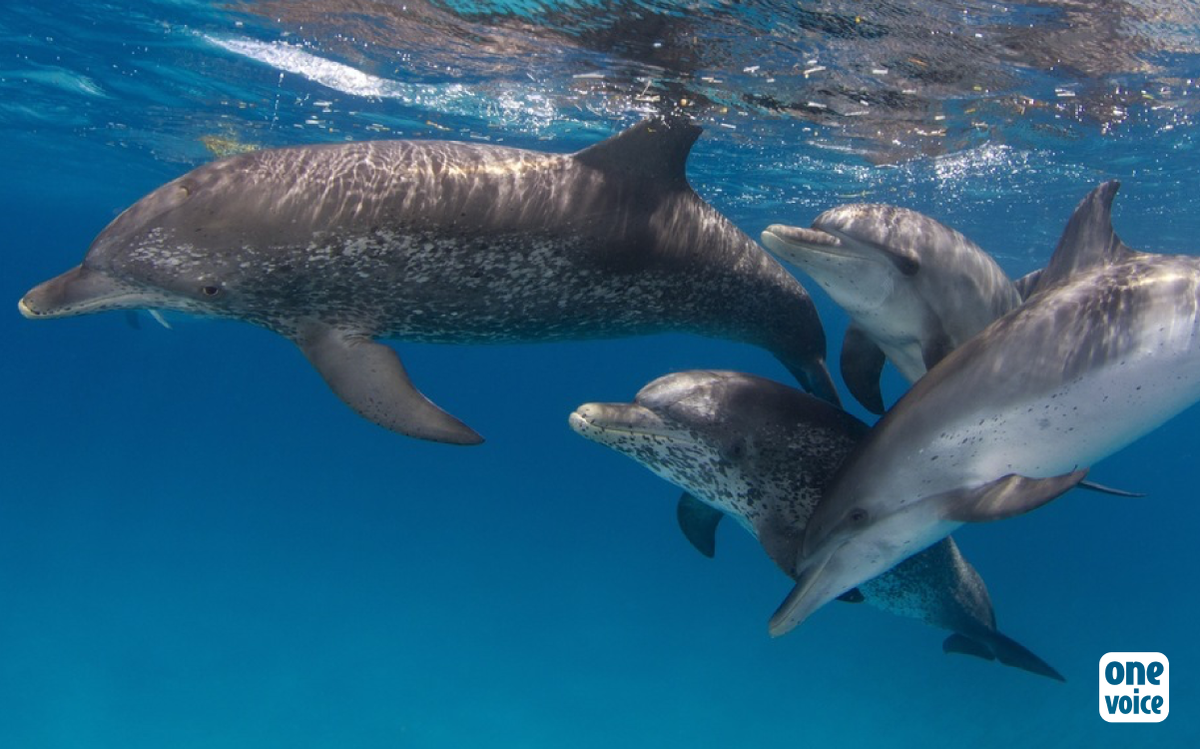
Photo caption: In the wild, baby dolphins grow up with their families.