Worryingly overweight and permanently stressed: a new complaint for the last circus elephant in France, Samba

Worryingly overweight and permanently stressed: a new complaint for the last circus elephant in France, Samba

Worryingly overweight and permanently stressed: a new complaint for the last circus elephant in France, Samba
27.07.2023
France
Worryingly overweight and permanently stressed: a new complaint for the last circus elephant in France, Samba
Exploitation for shows

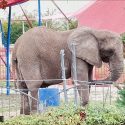
Nothing has changed for Samba since our first ‘meeting’ in 2002. Twenty years later, she is alone, moving between the lorry and the big top, always coerced into performing shows that are humiliating and dangerous for her body that has been bruised by decades of exploitation. Based on our latest investigation footage and four experts specialising in African elephants, we are filing a complaint against the Cirque d’Europe. The last French ‘circus elephant’ must be placed in a sanctuary before it is too late.

At 35 years old, Samba is still roaming around in Seine-et-Marne. Last April, we found her in Dammarie-les-Lys, then in June in Longperrier. The footage that we sent to courts is not deceptive; despite her declining health, she continues to be exploited relentlessly with the complicit inaction of the Ministry for the Ecological Transition.

Under the big top, fear and pain are the only reality

Parading around, turning herself around on a stool that is just about big enough for her four feet, walking on her wrists and collapsing to the ground… all with a circus performer permanently on her back. This is what Max Aucante forces her to eternally repeat on the Cirque d’Europe stage. An aberration when we know that such pressure on an elephant’s backbone can deform it, deteriorate their bones, and exacerbate arthritis. The effort that is asked of her is so significant that she urinates on herself during the performance.

How many times has Samba had to have been hit with an ankus to make her submit, for fear of being beaten like she was in 2003?

“There is no doubt when it comes to the current mistreatment of this elephant and the need to move her… I recommend that Samba be taken away from this standard of treatment that has led directly to physical and mental injuries, both in the past and present. Samba needs high-quality care which can be offered by an elephant sanctuary.” Philip Ensley, veterinarian

Being enclosed and left alone for life

It does not matter, in the eyes of those who exploit her, that she is an extremely social, intelligent animal that is full of empathy… Outside of the shows, Samba is enclosed in a trailer where she barely has enough room to lay down, or even on the tarmac in an enclosure which would be incapable of preventing an escape if she tried to break out of her ordeal again. Desperately alone, she does not even have any enrichment to distract her.

The inaction of authorities has condemned French elephants

For Samba to have a dignified life far away from her trainer, we have rallied investigators, referred to the legal system, published reports, gained the support of specialists, organised protests, written to elected representatives… All this so that the Bouches-du-Rhône Prefecture, on which the circus relies, and the Ministry for the Ecological Transition can turn a deaf ear.

The old elephant in her thirties is currently overweight, the main cause of death among captive elephants. A place in a sanctuary is waiting for her in the United States. But we have to believe that the State would prefer her life to come to an end as miserable as it has always been in our country. If nothing is done quickly, she will be abandoned outside our borders to die there, like Dumba before her, or transferred with the agreement of the Ministry to a zoo abroad where her exploitation will continue indefinitely like Baby.

We will not let the State abandon Samba. We are once again referring to the legal system for her. Sign our petition to ask that the “last French circus elephant” be placed immediately in a sanctuary.

Translated from the French by Joely Justice
The ‘progressive’ suppression of using animals in chemical testing, not in cosmetics

The ‘progressive’ suppression of using animals in chemical testing, not in cosmetics

The ‘progressive’ suppression of using animals in chemical testing, not in cosmetics
26.07.2023
European Union
The ‘progressive’ suppression of using animals in chemical testing, not in cosmetics
Animal testing

On 25 July 2023, the European Commission launched a plan aiming to progressively suppress animal testing for chemical products in the whole of Europe, but they will not protect a ban on testing on animals for cosmetic products as requested by the ‘ Save Cruelty Free Cosmetics’ European Citizens’ Initiative (ECI), signed by 1.2 million European citizens. A response that leaves a mixed impression to say the least.

While we were glad about the plan aiming to eventually eliminate animal testing for chemical products and more long-term propositions aiming to reduce and progressively remove animal testing from research and education, the Commission has scandalously ignored calls from citizens to keep a ban on animal testing for cosmetic products, a ban established by legislators more than a decade ago.

Despite the European Union having banned tests on animals for cosmetic ingredients in 2009, tests on animals for chemical products used by workers in the industrial sector or likely to be released into the environment still exist pursuant to the REACH regulation (registration, evaluation, authorisation and restriction of chemicals). For the European Commission, since certain tests have not yet been replaced, banning the use of animals would mean forcing certain products to be withdrawn from the market. As always, the economy comes before animals. Rather than waiting for the EU tribunals to resolve this issue as an ongoing matter as proposed by the Commission, citizens’ requests must be taken into account immediately in order to avoid animals suffering even more.

In the EU and in Norway, 8 million animals suffered in laboratories in 2020. Substances are forcefully administered into their throat, they become infected by diseases rendering them disabled, they are genetically manipulated, subjected to brain damage during surgical operations, exposed to intense pain, and used in breeding programmes that perpetuate the cycle of suffering. However, the Commission is pleased about this “reduction” in 2020 in relation to previous years, without mentioning that it is mainly due to the Covid-19 pandemic, as we saw with the rise in French figures in 2021.

A European participatory democracy tool used for the end of animal use in laboratories

This Initiative was launched in August 2021, in particular by One Voice within the coalitions Cruelty Free Europe, European Coalition to End Animal Experiments, and alongside Eurogroup for Animals, Humane Society International/Europe, and People for the Ethical Treatment of Animals, with support from The Body Shop and Dove brands. It called for the reinforcement and protection of a ban on animal testing for cosmetics, for a transformation of the regulations on chemical products to put an end to tests on animals, and for a commitment to progressively eliminate all tests on animals in Europe. It is the second ECI on this subject that has gained more than one million signatures, after ‘Stop Vivisection’ in 2015, and only the ninth to have been crowned with success among more than one hundred that have been submitted to European institutions.

A positive response that leaves an unfinished taste

Among the positive commitments made by the Commission in response to the ECI, we found:

  • the development of a road map to put an end to all obligatory tests on animals for industrial chemical products, pesticides, biocides, and human and veterinary medications. But no precision was given on the means that will be invested in this road map, except that it will be defined during two workshops, in the second halves of 2023 and 2024. It does not have to be done in a hurry… the Commission is fully aware of the need to modernise the law to make the adoption of testing methods without animals easier, which is essential;
  • the response to the ECI also mentions creating a committee of experts, preparing workshops, and coordinating national policies to develop research methods without animals, without giving any details as to the more concrete content of these proposals however;
  • as for alternative methods, the Commission is pleased to have subsidised their development for up to a billion euros in twenty years – which corresponds to the financing of a few hundred full-time people. Knowing that the Horizon Europe programme has a budget of almost one hundred billion euros over eight years, and that France alone has more than 600 animal testing laboratories, the European desire to simply “continue” financing alternatives frankly seems insufficient.

Citizens now expect all parties concerned to ensure that the measures proposed by the Commission have maximum and significant impact. We will continue to work for yet more ambitious commitments!

Translated from the French by Joely Justice
Underground badger hunting with hounds: when prefectures stumble blindly

Underground badger hunting with hounds: when prefectures stumble blindly

Underground badger hunting with hounds: when prefectures stumble blindly
26.07.2023
Ille-et-Vilaine
Underground badger hunting with hounds: when prefectures stumble blindly
Wildlife

The State never runs out of imagination when it comes to preventing us from condemning illegal acts. In Ille-et-Vilaine, the Prefect has thus passed not one, not two, but three decrees authorising badger digging in the spring and summer. Each one repeals the previous. Without a doubt they hoped we would not be able to keep up. It was a wasted effort: not only have we obtained a suspension on this type of hunting, but the Prefect has found himself lost in this strategy.

While the legal system has massively proven us right and suspended badger digging in numerous departments, a wind of panic is blowing among prefectures, who are getting lost in their own strategies to put obstacles in our way and stop us from saving badgers. This year, Ille-et-Vilaine stood out in particular…

Not one, not two, but three decrees!

The first act: on 1 June 2022, the Prefect authorised an additional period for underground hunting with hounds from 1 to 30 June 2023. The second act: on 5 January 2023, he signed a new decree, revoking the one of 1 June and authorising digging… from 1 to 30 June 2023. We are already having trouble keeping up! The third act: on 16 May 2023, the same again! A new decree revoked the one of 5 January 2023, and authorised underground hunting with hounds from 1 June 2023 to 14 September 2023.

In this labyrinth is hidden a clear strategy in reality: increasing attempts to unsettle us, by hoping that we would lose ourselves in these publications and repeated repeals. It could happen on a misunderstanding!

The joke is on them and the badgers are saved

But these strategies did not work: we attacked these decisions and on 6 June 2023, with AVES, we were victorious. No badger will be dug out in the department this summer.

We were surprised when we received, a few weeks later, a defence brief of several pages long, in which the Prefect defended an act tooth and nail… that he himself had revoked!

We immediately informed the Tribunal of this ludicrous situation. On 18 July, the judge could only note that we had already obtained complete satisfaction, and that the Prefecture was defending a decree that no longer existed…

A lesson that State representatives should learn: these strategies allowing hunters to kill badgers at any cost do not work and do nothing but reinforce our determination to give these animals – including their young – that are massacred in their thousands for the pleasure of a select few a voice.

To save yet more badgers from hunters’ pliers, spades, and guns, sign our petition for the abolition of underground hunting with hounds, and support us!

Translated from the French by Joely Justice
Brown bears in Ariège: faced with a disloyal opponent, the Prefecture, One Voice has obtained a hard-fought suspension of the decrees

Brown bears in Ariège: faced with a disloyal opponent, the Prefecture, One Voice has obtained a hard-fought suspension of the decrees

Brown bears in Ariège: faced with a disloyal opponent, the Prefecture, One Voice has obtained a hard-fought suspension of the decrees
25.07.2023
Ariège
Brown bears in Ariège: faced with a disloyal opponent, the Prefecture, One Voice has obtained a hard-fought suspension of the decrees
Wildlife

Do you think you could win a bare-handed duel against Goliath with your strongest arm tied behind your back? This is essentially what we managed to do with the advice of the Thouy Avocats office to defend bears in Ariège last week. The Prefecture had authorised reinforced scaring shots two nights in a row the day after the decrees were published. With a rarely used legal proceeding and uncertain results, we obtained a quick and major victory! We are potentially taking on an endurance obstacle course. But for the bears and with your support, nothing will stop us!

To flatter the farming lobby at all costs by making sound scaring possible (a source of stress for pregnant brown bears, and potentially dangerous for the cubs who can be injured or separated from their mother), the Prefecture is playing with legality. This year, to avoid an identical repetition of the scenario in summer 2022 where no scaring shots were possible thanks to our legal action, the Prefect has implemented clear and targeted attacks. These decrees are very time-limited (two nights) and are applied by the day after their publication, making any plea extremely difficult to file in sufficient time for a hearing to be set and a decision returned before the measures are executed.

Great ills require great remedies

As well as the cancellation plea that could make a decree illegal a posteriori and the suspension emergency interim proceeding that allows it to be interrupted within a few days (and thus often spares animals’ lives), a freedom emergency interim proceeding exists, which allows an even quicker suspension of the contested decree: in a few hours. But with the latter, the legal motives that we present to the tribunal to achieve our objective must be very specific, and it is rare that they are perfectly moulded to the situation. The extreme responsiveness and pointed argumentation that it requires explains why we have never tried this type of proceeding before.

Nothing decided in advance; obtaining fair decisions is even more delightful

As they did on 3 and 10 July, and 17 July at the end of the day, the Prefect published their three decrees relating to the Arreau shepherding group, the Trapech one, and the Massat-Le-Port pasture land association. But this time, we were ready. We filed our plea and freedom emergency interim proceedings on 18 July at the beginning of the afternoon, and the hearing was set that evening for the following morning at the Toulouse Administrative Tribunal.

We went to the dispute both determined and angry, but without foreseeing the final decision. And the shots during the night on 19 and 20 July did not take place: the three decrees were suspended urgently before they had been executed! A magnificent victory, which puts a clear stop to this abuse by the Prefecture.

For the judge, the conditions allowing these authorisations that are harmful to the protection of bears were not fulfilled regarding the number of attacks on herds, or their attributability with certainty to bears. This element was enough to suspend the decrees. Thus, the Prefectures strategy of making new similar decrees each week without proof of new developments will not be possible. The judge also made it clear that it was not necessary to examine the other arguments, in particular the lack of measures for the protection of herds that hit struck a chord with his colleague last year.

A freedom emergency interim proceeding on the right to a healthy environment: a victory that will set a precedent

These decisions are extremely significant on several levels. Firstly, they recognise the urgency of ruling on scaring measures, which is essential for bears and their cubs in the Pyrenees mountain range to live peacefully.

But also, and above all, on the fundamental freedom for the right to a balanced environment regarding animal protection, in particular those that are listed on the IUCN red list. Since its recognition by the State Council in 2022, this is only the second decision that has intervened on this fundamental freedom in aid of an association and been done successfully.

This is also in relation to the future case law to come that will allow us to now consider freedom emergency interim proceedings – extremely strict, and which we had always missed due to the lack of precedent on the subject – for other animals in particularly urgent situations.

A perpetual endurance test

Our 4th emergency suspension proceeding, which asked that the Prefecture be obliged to publish its decrees within an acceptable time frame, was rejected the next day due to the suspensions that occurred the day before. We were gasping for breath after our success in moving mountains. And the Tribunal, both kind and mocking, seemed to tell us: “You can see that when we want to, we can go beyond the impossible”!

We know that animal defence is a long-term fight and not a sprint. After this fourth decision, we believe that this perverse game will repeat itself tirelessly. But the Toulouse Administrative Tribunal judges have heard and sufficiently accepted our arguments. We will not hold the flag at half mast and will not hesitate to present to them again if necessary!

Seeming not to care at all about being sentenced, today on 25 July, the Ariège Prefecture published a decree authorising scaring shots on bears in another pasture on the nights of Wednesday to Thursday and Thursday to Friday (from 26 to 28 July). We are preparing a counterattack.

Faced with such irresponsible behaviour from State representatives, with you by our side, the bears have indispensable allies!

Support our action for the bears

Translated from the French by Joely Justice
One Voice is urgently referring to the legal system against the Ariège Prefecture

One Voice is urgently referring to the legal system against the Ariège Prefecture

One Voice is urgently referring to the legal system against the Ariège Prefecture
18.07.2023
Ariège
One Voice is urgently referring to the legal system against the Ariège Prefecture
Wildlife

For more than two weeks, the Ariège Prefecture has been publishing decrees authorising the implementation of scaring measures using sound effect shots on brown bears with a view to “preventing damage to herds”. These decrees are systematically published to be applied within 48 hours. We protest against this procedure which, as well as posing a problem for bears, also prevents any appeal within an acceptable time frame. The administration are thus knowingly circumventing regulations. They are looking to avoid the situation that happened in summer 2022, where we had its nine decrees allowing bear scaring suspended and then cancelled. We have therefore filed four freedom emergency interim applications. The hearing will take place on Wednesday 19 July at 11:30am at the Toulouse Administrative Tribunal.

Photo: Collectif Hope ferestecspirineus wildlife photos

Since last year, we have been successful in urgently suspending 9 decrees by the Ariège Prefecture, who have clearly decided to change their strategy, on bear scaring shots. From now on, it is publishing its decrees in such a way that they are applied from the following day and for a maximum duration of two days. They repeat this as often as necessary.

Short-circuiting the regulations

The decrees of Monday 3 July 2023 have authorised bear scaring in the Arreau and Trapech groups’ pastures, which contain 1800 and 2000 sheep respectively, while no night park is set up in these two pastures. These measures were authorised and carried out over two subsequent nights, from 4 to 5 and 5 to 6 July, between 8pm and 7:30am.

On 10 July, the same thing happened on these same pastures. Once again, the prefectural measures were carried out the day following their publication, from Tuesday 11 July at 8pm to Wednesday 12 July at 7:30am and on the following night at the same times.

The Prefect’s ideal is clearly to short-circuit any legal plea and to thus deprive any person or organisation interested in their rights of an effective solution. In fact, even if we were to refer the matter to the courts immediately after the decrees are published, no legal decision would be made before the authorised measures are carried out completely, because, in the context of a suspension interim proceeding, the judges’ decision generally does not take place for between a few days and a few weeks.

After two previous prefectural attempts, we are immediately opposing a third

But we will not leave the bears prey to this vicious bypassing by State services, for pastures that are not even properly protected! This is why we are fighting today with new weapons to put an end to this intolerable prefectural strategy that is becoming more and more widespread.

When, yesterday at the end of the day, the Ariège Department published 3 new decrees authorising these sound shots that are terrorising brown bears in the Arreau and Trapech shepherding groups, as well as in the Massat le Port pasture, from the evening into the following night, we were ready.

The freedom emergency interim hearing is the only plea that would make it possible to obtain a decision before the prefectural decree is completely executed. In fact, the judge must rule within a maximum of 48 hours. We have therefore filed three from today, to try to assert the violation of the right to a balanced environment as well as another so that the Prefect will be compelled to publish their actions with a sufficient time frame before the implementation of scaring measures. The hearing will take place tomorrow, 19 July at 11:30am at the Toulouse Administrative Tribunal.

Translated from the French by Joely Justice

When empathy disappears in the face of laboratories’ objectives: interview with Kevin Vezirian

When empathy disappears in the face of laboratories’ objectives: interview with Kevin Vezirian

When empathy disappears in the face of laboratories’ objectives: interview with Kevin Vezirian
18.07.2023
France
When empathy disappears in the face of laboratories’ objectives: interview with Kevin Vezirian
Animal testing

On 29 November 2022, Kevin Vezirian obtained the title of Doctor in Social Psychology with a research thesis on the study of animal testing from a social psychological perspective. Is the violence inflicted on animals linked to violence between humans? Are those who practise animal testing void of empathy? All of the answers are given by this specialist in the field.

You have just obtained your PhD in Social Psychology. What does this mean in concrete terms?

A doctorate (or PhD) is a university diploma issued at the end of working on scientific research. In concrete terms, in my case, this means that I have led research work in social psychology, a scientific discipline aiming to understand and explain how individuals’ thoughts and behaviours are influenced by the presence of others. More specifically, my research work consisted of studying individual factors and contextual frameworks that facilitate and justify prejudices towards laboratory animals, through social psychology theories.

Throughout the thesis, you make a link between discrimination between groups of humans and the mistreatment that other animals are victims of. Is this link scientifically well established?

The link between the way in which individuals behave towards each other and the way in which they behave towards animals is already well established. For example, extensive literature shows that there is a strong relation between cruelty towards animals and interpersonal violence. However, growing evidence suggests that there is in fact an interrelation between discrimination with regard to individuals and attitudes and behaviours towards animals. Thus, research shows that individuals having strong negative prejudice towards another due to their ethnicity are also more likely to agree strongly with speciesism, an ideology that defends the idea that all animal species do not deserve the same moral considerations and that the exploitation of certain animals is justified. Recent research led by a team of researchers from the University of Oxford incidentally shows that adhering to speciesist ideologies has a positive correlation with other types of discrimination such as racism, sexism, or even homophobia.

Despite these intriguing results, in reality it is not surprising to note that the manner in which individuals perceive members from discriminated groups is closely linked to the way in which they perceive animals, because after all, animals themselves have all the characteristics of discriminated individuals and are exploited because of who they are.

Where does animal testing fit in in this field?

Animal testing involves relying on animal models to lead experiments, the majority of the time for scientific purposes, which we prefer not to carry out on humans for ethical or moral reasons. Animal testing thus strongly involves considerations that we have for a specific social group, humans, compared to those we have for another social group, laboratory animals. While numerous surveys show that the majority of the population is opposed to the use of laboratory animals, there is some variability when it comes to the perceived legitimacy of this practice, and it appears necessary to understand where these interindividual and contextual differences come from. Furthermore, animal testing is carried out to the detriment of the animals that we should be motivated to protect from suffering, and it is vital to understand what the behavioural strategies that allow individuals to rationalise and legitimise their use for scientific purposes are, while it is almost always synonymous with dire purposes. It is a safe bet that the answers to our questions are found in the way we perceive and interact with others, and the social psychology is very pertinent in this respect.

Are those who practise animal testing therefore devoid of empathy? If not, how do they manage to inflict this suffering on animals?

Devoid of empathy, probably not. Incidentally, in our research, in reality we have no data regarding the empathetical disposition of laboratory technicians, therefore we cannot give any clear answers in this respect. On the other hand, our research indicates that in the general population, the least empathetic dispositions are actually associated with a greater perceived legitimacy of animal testing, but also of more harmful behaviours towards a laboratory animal within pharmaceutical research.

As for knowing how people come to inflict suffering on animals for scientific purposes, our research provides some answers. By taking inspiration from Stanley Milgram’s protocol, we invited people to conduct (fake) pharmaceutical research on a (fake) laboratory animal, and our results showed that the preliminary focus on the benefits of science would also significantly increase individuals’ motivation to participate in research to the detriment of the animal, but also that strong pro-scientific dispositions were strongly linked to the perceived legitimacy of the experiment and the instrumental vision of a laboratory animal. In summary, this research showed that pursuing scientific aims allowed temporary alleviation of empathetic considerations that individuals had with regard to laboratory animals in order to facilitate their use for research purposes and in the pursuit of research. In other research currently being done, we have also shown that disparagement strategies for laboratory animals’ mental and cognitive capacities can be used in order to justify the use of laboratory animals. While making another suffer goes against our most fundamental moral principles, we have shown that individuals can be motivated to reduce the mental capacities and the sentience of a laboratory animal in order to make its use more morally acceptable in some way.

Armed with the knowledge gained from your research, what course of action would you recommend in order for the situation to improve for these animals?

Our research shows that the scientific objectives behind animal testing allow moral considerations that individuals have towards laboratory animals to reduce. However, we must reiterate that animal testing is not only criticised by animal advocates, but also by a part of the scientific community who question its validity, its lack of replicability, or very weak pharmaceutical applications in humans. We imagine that communication and information campaigns questioning the legitimacy and usefulness of animal testing could thus ensure that individuals do not blindly justify the suffering of laboratory animals under the pretext that significant benefits for human health would be key, because it is not always so clear.

Furthermore, our research also shows that animals’ cognitive and mental capacities are central in moral considerations towards them, and the more we perceive their capacity for sentience and intelligence, the more they endure in laboratories what seems to us to be morally unjustified and unacceptable. Therefore, awareness campaigns around the originality of laboratory animals, showing their cognitive abilities and personality, could somehow impart greater moral considerations on them and perhaps further motivate individuals to oppose this practice.

Translated from the French by Joely Justice

The State has decided: permanent circuses and cheap zoos are coming

The State has decided: permanent circuses and cheap zoos are coming

The State has decided: permanent circuses and cheap zoos are coming
13.07.2023
France
The State has decided: permanent circuses and cheap zoos are coming
Exploitation for shows

We have been warning of this danger for four years. It is here: the ministerial decree has just appeared and confirms the fact that competency certificates (a way into allowing the keeping of wild animals) for circuses and other travelling trainers are equal to those for settled establishments; in other words, zoos. A critical analysis… of the law and the consequences for animals.

One Voice: a whistle blower on circuses

As a precursor in France on this subject, the Association has been defending elephants, bears, hippopotamuses, lions, and tigers in circuses in particular for almost twenty-five years. Our expertise has been developed over the experience we have gained by fighting for them.

Some are born free and captured, others are born behind bars; all are forcefully subdued from their first weeks of life, shut into lorries day and night, transported from town to town whether it be in stifling heat or wintry cold… What undignified and humiliating treatment must they suffer, once they are an adult, for them to be left like this? When you are a tiger, a family of lions, or an elephant, it takes terror to be submissive to primates in this way…

The business of lies

This is what the circus trainers have been hiding from the public, journalists, and public decision-makers since the dawn of time, and what we as advocates for animals and the planet strive to prove with forceful videos of this abuse, which we have referred to the legal system to ensure, not only that the law be respected, but also improved.

Preserving the natural habitat of these vulnerable species

These demeaning shows sell a misleading reality, in which those being held captive and exploited are happy in such a situation, and in which it is normal to show this to our children. In reality, it is the survival of an archaic tradition that we should be ashamed of. That of the uninhibited and absolute domination of humans over non-humans. Incidentally, it takes these creatures away from their natural habitat despite them being in serious decline.

A flimsy law

In 2019, already, during discussions at the Ministry for the Ecological Transition to prepare for measures being announced for wildlife being kept captive in lorries and circuses, and the law that followed in November 2021, we explained the risk of zoos being obtained at a discounted rate whilst travelling circuses are settling. And this is, no more or less, what is happening before our eyes with the publication, on 13 July 2023, of the ministerial decree establishing an equivalence between competency certificates for circus trainers and those from zoos, thus now allowing trainers to obtain competency certificates for animals that they could not keep previously in travelling circuses, such as giraffes for example. It will not take much more to trample all over the zoo decree of 2004.

The most obvious negative effect of this law is that is has given the impression to the whole of France (or even Europe) that it would represent a major step forward for animals, even though it was only a façade did nothing but discourage goodwill and made little difference to people’s actions. Just like in 2015 with the inclusion of animal sentience in the law, without changing their status as movable property.

Sordid winter living spaces soon to be considered as zoos

With this new law, it is a further step towards minuscule living spaces over winter in places considered as zoos, as the Médrano Circus in Aimargues attempted (unsuccessfully thanks to our vigilance).

But what we prevented then may soon be unpreventable in future… Because after an equivalent competency certificate, we foresee harmful changes to come on regulatory standards being dragged down with the trampling of the 2004 decree regulating zoos.

The State is an accomplice in exploitation

We condemn the deafening silence and inaction of the Ministry regarding sanctuaries for large land or sea mammals, as well as their delay in publishing implementing decrees of the law, particularly regarding the reproduction of big cats. Only the one on the CNCFSC was published. In the meantime, circus trainers are getting rid of elephants and making big cats reproduce with all their might to feed trafficking.

We will keep rallying for all captive animals in circuses and are asking for accountability from the Ministry who is supposed to be in charge of protecting them.

Translated from the French by Joely Justice
Law on restoring nature: the European Parliament has passed an encouraging but weak law

Law on restoring nature: the European Parliament has passed an encouraging but weak law

Law on restoring nature: the European Parliament has passed an encouraging but weak law
13.07.2023
Europe
Law on restoring nature: the European Parliament has passed an encouraging but weak law
Natural habitat

On 12 July, the European Parliament voted in plenary session in favour of the law on restoring nature. Despite amendments being passed which partly voided the law of its substance, this victory remains a great step forward for animals, nature, and our life on earth

We joyfully followed the well-attended vote on the Law on the Restoration of Nature on Wednesday 12 July. 336 MEPs finally voted in favour of the law in opposition to the 300 against. Even if it did not gain the votes we had hoped for, this result nonetheless represents a great victory given the ferocious opposition’s campaign led by the conservatives behind PPE, a right-centre group.

Amendments that cause harm to the ecological emergency voted in by citizens

The law passed is nevertheless weakened greatly by the lack of cohesion at EU level on this subject, which is in fact crucial for a liveable future on earth. Numerous amendments voted in have reduced the initial aims of the European Commission. The European Parliament has notably removed the proposed article on the restoration of agricultural land, which includes the restoration of peat lands, thus renouncing a crucial lever for increasing member States’ capacities to stock carbon. MEPs have also given in to Conservatives’ warnings by passing an amendment that will delay the implementation of the law until an evaluation of the one on European food safety has been carried out.

We remain committed to defending this European Green Deal with the support of more than one million citizens who have supported the law on the restoration of nature rallying in response to the call from more than 200 associations including us. And with our partners within the European Bureau, we are now calling on EU institutions (Parliament, Commission, and Council) to come forward in favour of a definitive law that meets environmental challenges during their tripartite negotiations.

Translated from the French by Joely Justice

Underground hunting with hounds in summer: five new victories for badgers!

Underground hunting with hounds in summer: five new victories for badgers!

Underground hunting with hounds in summer: five new victories for badgers!
12.07.2023
France
Underground hunting with hounds in summer: five new victories for badgers!
Wildlife

This summer, diggers in Aisne, Ille-et-Vilaine, Savoie, Haute-Loire, and Loir-et-Cher (as well as all the other departments) have to find something to do instead of torturing animals. These victories pave the way more than ever for an end to digging out in the spring and summer, in addition to those authorised during the remainder of the year. And the fight is far from being over: hearings are already set in the days to come in the Corrèze, Cantal, Allier and Seine-et-Marne, Maine-et-Loire, and Creuse Departments.

This year, we have decided to position ourselves as a force to be reckoned with in the fight against underground hunting with hounds, filing emergency interim suspension hearings either alone and anywhere where decrees start additional periods between 15 May and 1 July, or by joining forces with our partners*.

An unprecedented success for badger cubs and their parents

3500: that is the number of badgers that our legal action has currently allowed to be spared, in 19 out of 24 departments. Each victory is more satisfying than the last when we know the cruelty of this hobby that our infiltration investigation has shown fully and the difficulty in convincing jurisdictions despite this practice being rejected by more than 4 in 5 French people (Ipsos/One Voice survey, October 2022).

In the five departments where we have just won, hundreds of badger families would have been wiped out following long hours of being hunted. Female badgers and their young killed at point-blank range, after having tried in vain to flee to the depths of their setts, their refuge that they took months to build and which hunters would destroy in a few hours.

In Loir-et-Cher, the Orléans Administrative Tribunal has once again swept away the arguments conjured up by the Prefecture. A relief largely shared by local elected representatives invested with us and in this fight such as the Town Mayor, Catherine Le Troquier. 150 to 200 individuals spared! To which we can add the 250 to 300 in Ille-et-Vilaine, 150 in Aisne, and several dozen in Haute-Loire….

Victories that do not spell the end of the fight

Faced with our determination, several departments have chosen to abandon their draft decrees. In Savoie, after a dismal failure (it only took a few hours for the urgent applications judge to render their decision!), the State Representative simply decided not to authorise underground hunting with hounds from 1 July, as he had been about to do! In Vienne, our victory also forced the Prefecture to back down.

In the weeks to come, the following hearings are scheduled: 17 July at the Limoges Administrative Tribunal (for Corrèze), 18 July in Clermont-Ferrand (for Allier and Cantal), on 25 July in Melun (for Seine-et-Marne), on 27 July in Nantes (for Maine-et-Loire), and on 1 August in Dijon (for Creuse).

The prefects will always find us in their way to defend badgers. More than ever, we need your help to give them a voice. Sign our petitions for a radical reform of hunting, for a ban on underground badger hunting with hounds, and to change their image!

Support our fight for badgers

*One Voice’s partner associations for the hearings mentioned: Allier: Animal Cross, AVES, FNE 03, FNE AURA, LPO AURA; Aisne, Creuse, Ille-et-Vilaine, Maine-et-Loire, and Seine-et-Marne: AVES; Cantal: Animal Cross, AVES, FNE 15, FNE AURA, LPO AURA; Haute-Loire: AVES, FNE 43, FNE AURA, LPO AURA; Savoie: Animal Cross, FNE 73, LPO AURA.

Translated from the French by Joely Justice

Animal testing: some are clinging onto forced swimming for rats and mice

Animal testing: some are clinging onto forced swimming for rats and mice

Animal testing: some are clinging onto forced swimming for rats and mice
12.07.2023
France
Animal testing: some are clinging onto forced swimming for rats and mice
Animal testing

Australia and England have recently missed the opportunity to ban forced swimming tests inflicted upon rodents in their laboratories. Incomprehensible decisions with regard to the suffering caused by these experiments, the efficacy of which has not even been proven. In France, we continue to fight against these methods that are defended tooth and nail by the animal testing industry, which, clearly, has no boundaries.

In January, the New South Wales Government disappointed Australia. When it was questioned on the possibility of ‘quickly’ banning forced swimming tests, they turned a blind eye to animal welfare advocates and accepted that these experiments would continue as long as they are “duly justified”. A very vague condition for allowing rodents in clear distress to be immersed for minutes on end in a bowl of water with no possibility of escaping…

Procedures maintained against all logic

A response from England on the same subject has been expected for months. On 5 July, the Animal Science Committee (ASC) published its “advice” on the solution of forced swimming, reaffirming the testing industry’s use of it when all of the warning lights are flashing.

The British equivalent of the French Comité national de réflexion éthique sur l’expérimentation animale (CNREEA) [National Consultative Ethics Committee] also recognised that the projects using these tests do not explain why they are necessary and consciously forget to define their methodology, but also that nothing has confirmed that these procedures can help in finding novel antidepressants. Worse, they could make us miss out on interesting new medications according to a publication by a scientific journal on alternatives to forced swimming tests. Added to the immense stress felt by the animals during these experiments, these arguments should hit the target, but they do not. Against all logic, the ASC states that the use of forced swimming is, in principle, valid in studying the neurobiology of stress and accepts that it is used for testing antidepressants. And this even despite the fact that alternative methods exist and deserve to be developed, whatever the committee might say.

Nothing, not even the fact that members of staff at the laboratories have reported the deaths of rodents from inhaling water following tests in Australia, has convinced the ASC to rule in favour of the animals being subjected to these experiments.

The fight for animals being tested on continues

In France, we are continuing to fight so that rats, who are intelligent, empathetic, and playful beings, can be saved from these drowning simulations. To come to their aid, we are doing everything we can to obtain information and recent footage of the use of forced swimming in our country. This is a sizeable task, given that projects continue to be approved by the Ministry of Research and the animal testing industry is doing everything they can to be as impenetrable as possible.

By 25 July, we hope that the European Commission will give a favourable response to the Save Cruelty Free Cosmetics European Citizens’ Initiative as well as for the 10 million animals who pass through the walls of European laboratories every year.

Translated from the French by Joely Justice