Harderwijk: the shock and the suffering

Harderwijk: the shock and the suffering

Harderwijk: the shock and the suffering
14.03.2016
Pays-Bas
Harderwijk: the shock and the suffering
Exploitation for shows

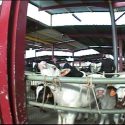
Dutch TV has gone backstage with hidden cameras to capture footage of the Harderwijk dolphinarium. The terrible information revealed in this footage questions how the existence of dolphinariums can even be justified.

The programme « Rambam » wanted to prove in this documentary that the dolphinarium is « an environment where people sit in a half circle on benches watching wild animals turning circles in return for food« , otherwise said, a circus and not a zoo. In Holland exhibiting wild animals is banned in circuses.

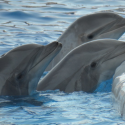
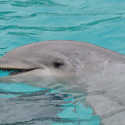
The film shows us the circus shows and the absence of the ‘educational value’ of the dolphinarium. It shows us fourteen male dolphins shut in tiny pools at the back of the main building. Far from benefiting from the prestigious seawater lagoon of the dolphinarium, they are languishing in boredom and fighting between themselves whilst waiting for the next show.

One of the scenes shown was extremely shocking, when a trainer masturbates one of the captive males who lacks female companions. « It’s to relieve him, » explains the man, « and to keep him ready for sperm extractions« . This type of procedure is practised in all the marine parks that practice artificial insemination. « The masturbation is repeated every day, from a very young age, in the form of a reward game« , explains Professor Thierry Jauniaux, veterinarian of the University of Liege in charge of dolphinarium autopsies.

We could therefore understand the importance of this training method for a ‘dolphin farm’ like the Harderwijk dolphinarium. Since the 1960’s, this establishment has effectively provided European dolphinariums with cetaceans born in captivity. The dolphinarium positions itself as the European reference for all that concerns breeding and training of show dolphins. In the past, it has also collaborated with SeaWorld to capture wild cetaceans in the USA, Iceland and Japan. More recently, it ‘saved’ the orca Morgan in the Wadden Sea before transporting her to a zoo in Tenerife controlled by SeaWorld.

The marine parks are without doubt circuses and not zoos. All of them inflict a life of confinement and frustration on their detainees. And the Harderwijk dolphinarium is not an exception.

One Voice commends the work of the Dutch journalists. This young team did not hesitate to take risks and to push the enquiry quite far. This vocation must be credited for revealing sometimes difficult truths and for allowing the public to have full access.

Unfortunately, most media channels have only relayed the shock video posted on YouTube, accompanied by denial from the Netherlands park. But behind these terrible images, what suffering!

It is urgent that other serious enquiries are led by the leisure industry and on the economic levers underlying it, from the Taiji Bay to the heart of Europe. It is not a funny or hype generating subject, but it causes much suffering and deaths amongst thousands of cetaceans in the world.

A fashion show without the need for cruelty!

A fashion show without the need for cruelty!

A fashion show without the need for cruelty!
11.03.2016
Shanghai
A fashion show without the need for cruelty!
Fashion

It is in the megalopolis of China that will parade on March 12, the latest models from 18 fashion designers, representing 8 countries from around the world!

Among the events of the evening, a meal… vegan of course… Shanghai, the largest city in China is preparing to host a parade all the more beautiful, it will be without fur! It marks the growing awareness, even in the world of luxury, of the suffering of animals in this industry whose skin is torn off. And the venue is not trivial. China is both the largest producer, processor and consumer of fur, while having no law protecting animals!

Glam and Vegan, it’s possible! Because there is not only the grunge style in life…

ACTAsia is our partner in China since 2008, One Voice had to be with them for this great opportunity!

Chic and ethical, the trend is to have colour and geometric shapes. Without cruelty and well established!

Great success for the parade without cruelty in Shanghai!

On March 12, 2016, 18 creators introduced us to a trend against fur: trendy, colourful and elegant… This humane style is on display! A pleasure for the eyes, One Voice invites you to come back to these images from this beautiful event.

Lucille, exiled dolphin at Port-Saint-Père

Lucille, exiled dolphin at Port-Saint-Père

Lucille, exiled dolphin at Port-Saint-Père
07.03.2016
Port Saint Père
Lucille, exiled dolphin at Port-Saint-Père
Exploitation for shows

In August 2015, Lucille killed the first baby dolphin born at Planet Sauvage in a fight. This dreadful act, which she immediately regretted, was not random or « natural behaviour ». Sadly, it was predictable given Lucilles state of despair.

From SeaWorld to Harderwijk

Lucille was born at SeaWorld, Orlando the 16th of April 1989 to Louise and Ralph, who were caught in the ocean. She was on exhibition in the Dolphin nursery of the park as a baby, before being brought to Dolphin Cove, where she could be stroked by a continual flow of visitors, for 45 dollars a time.

On the 7th of June 1997, the decision was made to send her to Europe. A heartbreaking departure for Lucille, who would never see her mother again. The Hardenwijk dolphin aquarium needed reproductive females, and despite being so young, Lucille would go on to have two sons.

The 7th April 2015, Lucille was uprooted once again: sent to Planet Sauvage and its mostly male population. This was a huge upheaval having spent the last eighteen years in the lagoon at Harderwijk. Despite having a difficult time, the SeaWorld exile eventually managed to find her place in the tough world of captive dolphins. She even managed to bring up her babies there. However, once again she was taken away, this time from her sons who were now adults, but allies in the violent world of overcrowded pools.

So Lucille arrives at Port-Saint-Père to a pool full of strangers. Since the much contested opening of the dolphinarium in 2008 (see OneVoice’s fight for cetaceans), relationships have been formed. Living there are previous tenants from Parc Astérix, Péos, Aicko and Galéo, as well as a hot headed youngster that has just arrived from Océan, Bruges. The two females, Parel and Amtan, come from Harderwijk, where they have crossed Lucille before. All of these young dolphins have been born in captivity, separated much too early from their mother, and are lacking in social maturity. The cohesion of this small artificial ‘family’ of four males and three females confined into the same space is maintained only under the tight control of their trainers.

Upon arrival, Lucille slips into a depression, refusing to leave the quarantine basin. This greatly worries One Voice, but the Dolphinarium refuses to admit to a problem. Then Parel gives birth to her first baby, and needs a Godmother to help look after her. This is an essential societal dolphin role which relies on tight links between two adult females. It is a relationship of trust which forms over time, and not from an imposed human choice. But in June 2015, Lucille is given this task of taking care of Parel, just three months after her transfer, when she has chosen to isolate herself from everybody! It doesn’t go well…

Just a fight between females

The 8th of August 2015, the spectators are waiting for the show to begin. Lucille, Parel and her baby are enclosed in adjoining Basin no.4 when suddenly an agitation erupts in the tiny enclosure. In front of the stunned public, the two females try to resuscitate the dead baby dolphin by holding him to the surface. There is total confusion but the music is put on anyway and the show begins. The baby’s body is discretely removed from the pool with a net whilst the five dolphins appear on scene, too upset to concentrate on their routine…

Dolphin’s Society

When questioned about Lucille’s depression in May 2015, the dolphinarium responded that « The natural social organisation of dolphins consists of movement between groups with new individuals arriving and others leaving, to avoid inbreeding. We do exactly the same thing. Management between parks is organised at a European level by species coordinators (the EEP) »

But in reality, the young don’t ever really leave their family, they are weaned at the age of three and become distanced from the family clan but they remain connected their whole life by the dialect and culture. Female dolphins in particular stay in their clan a long time to bring up their children in collective nurseries. When the clans become too big, they split and multiply in the same territory. Dolphins have countries like us. Lucille’s parents were almost certainly from Florida Keys.

It is therefore wrong to claim that dolphins leave without returning from the age of three. In the wild, a matriarch doesn’t abandon her tribe. These situations are never seen in nature, any more than the fatal brawls between a young mother and her baby’s ‘Godmother’.

Lucille’s story dramatically reminds us that moving a dolphin from one dolphinarium to another always ends with serious consequences, as recognised since the 60’s. A dolphinarium can never replicate the natural migration or the complexity of dolphin’s society. These transfers are necessary for the survival of the doplhinariums and not of the dolphins themselves.

Lucilles suffering is just one case in many. This suffering will not end until the day that the dolphinariums discontinue these cruel EEP programmes and stop exploiting these beings who have feelings and emotions just like you and I.

Sign and share our petition for the closure of these dolphinariums!


181 dogs and cats rescued: one year later

181 dogs and cats rescued: one year later

181 dogs and cats rescued: one year later
03.03.2016
France
181 dogs and cats rescued: one year later
Domestic animals

For the past year, One Voice has been working tirelessly with the authorities to seize two different properties belonging to animal traffickers. One Voice has already rescued 181 dogs and cats from a nightmarish existence, and the case is still ongoing.

A nightmare for cats and dogs

The situations are dire at the two different clandestine breeding facilities in the South West of France discovered by One Voice. A newly born kitten was found crawling into a litter after falling from a windowsill. A young puppy, just days old, stumbled on the dirty cold ground searching for his mother and a place to warm himself—he was barely alive. Young cats and puppies were locked up in a rabbit’s cage. The stench was unavoidable and the air burned our lungs. In these small rooms, animals of all breeds, genders, and ages were packed together like sardines. Almost all of them suffered from scabies, ringworm, keratitis, coryza, and tumors. Some were dying due to a lack of water and sufficient amounts of food. Vaccines, expired medications, ether, and an illegal concoction of homemade euthanasia were found scattered about the facilities.

A long investigation

Thanks to the network of informants and investigators who comprise the Zoe Unit, One Voice was able to track down these horrific facilities. Not only has One Voice coordinated all of these operations, but the organization has also taken care of veterinary fees and the costs of transporting survivors to our partner shelters. Mrs. A, who was already under surveillance, ran the first seized facility—her license to work was taken away by the authorities. However, 40 cats were still reported missing and the ongoing investigation revealed a connection to a second breeding facility, that which belongs to Mrs. G. In order to release the 181 animal victims at the mercy of these two women, Frédérique Dubost, a counselor in the concerned region, needs to approve three seizures (two of which must occur simultaneously).

Judicial proceedings

As a result of One Voice’s work, Mrs. G. was charged for animal abuse, neglect, and withholding food and water, although she has appealed this indictment. Investigations are still ongoing due to the elaborate nature of these animal trafficking schemes, which took place across several departments and involved drugs and microchips.

Support the Zoe Unit’s fight to end cruelty!

Kennel dog clubs in distress

Kennel dog clubs in distress

Kennel dog clubs in distress
01.03.2016
France
Kennel dog clubs in distress
Domestic animals

While there may be exceptions, footage filmed during a One Voice investigation reflects a sadly all too prevalent reality. Kennel clubs employ violent practices that might not be obvious to an untrained eye, but are glaring to veterinary specialists.

Why investigate?

According to One Voices’ partner veterinarians, the amount of behavioral disorders, bite marks, euthanasia, and abandonment cases recently recorded has been on the rise among expensive purebred dogs. These are dogs that have attended training schools and kennel clubs aimed at transforming them into perfect creatures. But perfect according to what criteria? The human constructed ideal for pets entails turning them into robots or remote controls that can obey their commands. These animal-machines preferably lack any self-determination or distinctive qualities, despite the fact that each breed possesses their own specific skillset, and even more so, each dog his or her own individual characteristics. Many people use training and kennel clubs as an attempt to create the « dream dog. » But would they still do it if they knew the severity of the trauma inflicted? In order to alert the public to this issue, One Voice investigators used a hidden camera to film training sessions in several clubs. Afterwards veterinary behaviorist, Dr. Nathalie Simon analyzed the evidence.

What we denounce

Nothing is more difficult than questioning these practices. Scientists have recently rejected the prevailing school of thought that places dogs in the same category as wolves, animals that function within a hierarchical social order. However, dog trainers still employ methods that necessitate exerting dominance over the animals, in order to suppress their supposed instinct to dominate. It is clear that after a millennium of co-evolution alongside humans, canine behavioral patterns are far more complex and subtle than this. Yet in training clubs, techniques that teach submission cause much undue harm. Practices that entail loud scary noises such as ringing bells or shaking boxes of nails are widespread, as are others like shaking a puppy by the scruff of the neck. These methods often lead to quick results, because out of fear, even the most rebellious dogs submit. But in doing so, they are traumatized, resulting in tragic consequences that range from anxiety to aggression. When animal-human relationships are not based in trust, there are real costs.

What we do

One Voice both denounces these practices and calls for action to change them. Not only do we need to close down some kennel clubs, but we also must seriously revaluate our relationship with the canine species. Alternating extreme negligence with harsh methods is not a solution. Living together involves learning how to treat each dog as an individual, as well as understand their needs. Living with a dog requires respect, consistency, and trust. Violence simply cannot exist in healthy, lasting, and fulfilling relationships between humans and animals, according to the veterinarians trained by Caring for Dogs- Code of Conduct. Information and assistance regarding healthy relationships with companion animals will be available in One Voice’s Dog Partner Spaces, which will be set up in partner shelters.

Testimonials: The farm of 1000 cows visited by farmers!

Testimonials: The farm of 1000 cows visited by farmers!

Testimonials: The farm of 1000 cows visited by farmers!
26.02.2016
France
Testimonials: The farm of 1000 cows visited by farmers!
Other campaign or multi-campaigns of One Voice

Since 2014, the « farm of 1000 cows » is scandalous and rightly so. One Voice shares with you the testimony of two farmers who were disturbed by the fate of the cows locked up in this cruel and polluting factory.

It is in the Somme area, near Abbeville, that the « farm of a thousand cows » sprang up, from the idea of a rich French
entrepreneur. « Inspired » by the huge US and German farms, he decided to develop the concept in France. The premises are intended for the exploitation of 1000 « dairy » cows and 750 calves and heifers, although today it has received authorization « only » for 500 cows. Here, the animals will not know the meadow and will go into boxes in the rotating milking parlour three times a day. For the two farmers who visited this factory farm, the infrastructure is unsuitable and causes multiple injuries to the cattle. An operation of this size can in no way guarantee them at the very minimum a life of well-being. For One Voice, who is already denouncing their suffering in traditional farms, this objectification of animals is intolerable!

« In some small farms where there are milking robots, the cows are going to be hooked up alone, when they want to. While there, at the « farm of 1000 cows », no it is not possible. It’s slavery for cows. » (From a retired breeder-read the full story here)

In connection with the farm, there is a methanizer that will convert the excrement of cows into energy, resold with a large profit to EDF. A profit such as, for some, it largely exceeds the dairy production objective of the farm. But this process is not environmentally friendly despite the announcement of the effects. Slurry will be supplemented by other green waste. The residues (digests) will be so rich in nitrogen that they will be spread onto the soil like a fertilizer, this will pollute the water and the air. It is they who are responsible for the proliferation of green algae in Brittany where methanisation is largely associated with pig farming … One Voice supports the Novissen association which brings together residents opposed to this « cow factory » and who will be the first collateral victims.

« The plough that picks up the dung passes near their hooves; it’s made of rubber apparently. But there is one cow who had lost her balance. This cow, was left lying between the concrete and the back of the plough. And now she is useless… After this she was limping… You should have seen her hooves, they were all shattered. There was blood. There were many who had it on their feet. And that one, I saw her lose her balance with the plough. » (From a retired breeder-read the full story here)

Producing milk on an industrial scale also means producing calves at the same rate. Do not forget that if cows produce milk, it is to feed their little ones! In this Kafkaesque environment, they will be torn from their mothers whose heart-breaking appeals will be ignored. Males will be slaughtered after being transported and sold in terrible conditions (see our survey of « cattle markets« ). The females will be fattened to become producers-if they survive. All this to satisfy humans who want to continue to consume milk even into adulthood, despite the risks to their health and the controversy of this type of consumption… Is this production still possible if all are agreed to finally open their eyes on the mental and emotional life of cows?

« How do you want them to be, these animals? Cows, we called them and they came back immediately, they were caressed. An animal… that it is… Have you seen a dog? Well, it’s like a dog. An animal, who comes to lick you. They followed me in the pasture. They followed me as a person following another person. » (From a retired breeder-read the full story here)

When France kills dogs…

When France kills dogs…

When France kills dogs…
25.02.2016
Europe
When France kills dogs…
Animal testing

When France kills dogs, Italy chooses to condemn those who torture them. The Brescia Court of Appeal has just confirmed the severe condemnation of the managers of Green Hill, a dog breeding facility for laboratories all over Europe. 3000 beagles are saved!

France is one of 27 countries in the European Union, one that experiments the most on dogs and cats. Recently with the Biotrial scandal, a person died. Yet, dogs had died during the preclinical testing phases … tortured and killed, and for what?

Since 1999 One Voice has campaigned for the end of dog and cat experimentation and illustrates its concerns. One Voice successfully managed to stop the installation of a breeding facility by Marshall in Montbeugny, exposed through several investigations the practices of breeding dogs for laboratories and managed to save several beagles.

We have already written to the Minister of Health about the chimpanzees that would have been used by Biotrial and have yet not received a response. A new letter has also been sent to him this week as well as to the Minister of Research asking for reports concerning those dogs whose death did not stop that of a human. The historic victory of the LAV in Italy should be inspiring!

Because of LAV our Italian partner in the European Coalition, has been running a long legal battle. After years of fighting to close the Green Hill dog farm and a startling investigation, they filed a complaint and obtained in 2012 the seizure of 3000 Beagles destined for laboratories all over Europe. Then, the case took a decisive turn in 2014, when Italy announced that it was prohibiting this type of breeding. And in January 2015, the judgment at first instance convicted the veterinarian, the director and the executive manager of Green Hill.

By confirming this conviction yesterday for acts of cruelty, ill-treatment and illegal euthanasia, the Court of Appeal sends a strong signal to all scientists: dogs do not belong in laboratories!

The penalties are exemplary: imprisonment and disqualification for 2 years. It must be said that in Green Hill dogs were not cared for but killed, even for simple dermatological pathologies: the question of profitability… With this decision, Italy clearly expresses its refusal to prioritize the economic interests even of a big multinational like Marshall (who owns Green Hill) when the well-being of sentient individuals is at stake.

And, France? Will it continue to turn a blind eye to ethics and progress when economic interests are at stake? Yet how many more deaths still to investigate concerning the practices of the French laboratories?

Help us better protect our companions: Sign and circulate our petition!

Tilikum: The Blackfish effect

Tilikum: The Blackfish effect

Tilikum: The Blackfish effect
24.02.2016
World
Tilikum: The Blackfish effect
Exploitation for shows

Tilly, dear Tilly. Six years already. We fight for you and yours. We do not give up. Resist a little longer, we are moving towards your freedom, towards your freedom. Your desperate gesture has been heard. Continue to resist!

Today, after thirty-three years of detention, Tilikum, aka Tilly, is subdued
by tranquilizers, floating motionless and facing a wall. His dorsal fin is so flaccid that it hangs on his side. Sadly, echoing The One Flew Over the Cuckoo’s Nest, Tilikum was punished for wanting to break his chains. Seaworld, who wants him alive, has put him in a chemical straightjacket. He is a « breeding bull ». His seed is highly prized.

However, his suicidal revolt will not have been in vain: thanks to him, all
captive orcas can now benefit from a new public gaze. The Blackfish
effect continues to eat away at SeaWorld and soon, all companies that
exhibit orcas in glass jars will have to deal with this change of opinion. Tilikum is a whistle-blower, a Spartacus amongst orcas!

At sea, no orca has attacked a human. In captivity, there have been
hundreds of incidents. Why this violence? Orcas are not happy; SeaWorld explains that they are receiving the best veterinary care and the best gourmet food? No, they are not. Orcas have extremely developed brains. Maybe even more developed than that of the human brain…

When it was revealed in Death at SeaWorld and then in Blackfish in
2013, Tilikum’s story moved the world. Clearly the victim of an
industrial lobby, his violent attack has paradoxically revealed all the « humanity » of captive orcas, all the suffering that these giant slaves feel, locked up in an overcrowded pit, and that sometimes makes them swing from the « dark side » of the force, to use John Hargrove’s words.

Born in the icy waters of Iceland, Tilly was kidnapped from his mother and
tribe in 1983, at the age of two. He later became a gigantic male, but he was still a shy male. At Sealand of the Pacific where he was brought, he was locked up every night in a shed with two aggressive females. Every morning he came out covered in wounds. And one day, at the end of his nerves, he dragged his trainer by the foot and drowned her. A little later, he killed a drifter who had probably plunged into his pool. But for SeaWorld, the moods of killer whales must not be known. Tilly’s past has been concealed. Until the death of Dawn Brancheau, February 24, 2010.

Tilikum’s mad despair did not go unnoticed. His miserable life, his anger, this dignity that he desperately tries to win back, inspires our struggle. We do not want killer whales to be enslaved any longer. We do not want to see them suffer anymore. We must save Tilikum and the fifty-five other orcas that are still held in the world!

Please sign and diffuse our petition for closing dolphinariums!

Tilikum died in January 2017.

Jeeth: a historical liberation

Jeeth: a historical liberation

Jeeth: a historical liberation
20.02.2016
India
Jeeth: a historical liberation
Wildlife

Jeeth, one of the last dancing bears identified in India, was released back into the wild from a sanctuary in Agra by his Qualandar trainer on December 9th, 2009. This liberation was the successful culmination of seven years’ worth of One Voice’s intensive work alongside Wildlife SOS.

A victory for bears

The name Jeeth, which translates to « victory » in Hindi, could not be more appropriate for this particular bear. For all four years of his life, Jeeth has been forced to dance. However, on December 9th, 2009, Jeeth became a symbol for all of the bears that have been liberated in India. Today he represents a victory for all of those who have spent years both working on the ground with and supporting Wildlife SOS, One Voice and the NGOs IAR and Free the Bears to put an end to a tradition which has been contributing to the extinction of the sloth bear on the Indian subcontinent for 400 years.

No longer slaves

In spite of a very strict law passed in 1972 in India, the bear keeping tradition managed to endure for centuries due to the fact that it is the primary source of income for the nomadic Qualandar community. This barbarous custom consisted of forcing bears, captured at a very young age, to mimic a jumping dance. Being hit with sticks and having ropes strung through their snouts was just part of the daily torture. For the price of a few rupees, the Qualandars exhibited the bears in the most touristic places they were able access. By gradually liberating all of the bears from the yokes of their captors, our anti-poaching unit has put an end to this life of slavery, in which bears were mutilated and deprived of care, adequate food, or any semblance of freedom.

A long-term undertaking

Since 2002, the anti-poaching unit Forestwatch, created by One Voice and Wildlife SOS, has been carrying out this long-term project. Not only did they locate all of the dancing bears throughout the country, form teams, conduct informational campaigns, stop traffickers and poachers for questioning, but they also collaborated with local authorities to develop a reintegration program for Qualandar community. This program assists in providing for medical needs, schooling for children, and educational programs that facilitate former trainers in receiving financial assistance and starting new professions. There is no doubt that the key to the success of this seven-year struggle was the promise of a « better future, » Jeeth’s trainer emphasized following their separation.

Relearning how to live

Jeeth has been entrusted to a sanctuary in Agra where he currently resides. Freed from his rope and placed in a park that takes into account both mental and physical health, he gradually relearned how to live like a bear. As soon as he was ready, he went on to join his fellow bears, also liberated from their formers lives of slavery. Unlike a zoo, where everything is done with regards to the human visitor, the sanctuary is designed according to the needs of residents. From now on, Jeeth’s daily life consists of climbing trees, hiding, looking for food, eating honey and fruit, playing, and even spending time with other wild animal survivors such as long-tailed macaques, antelopes, mongoose, birds, etc.

A historic turning point

December 9th, 2009 marks a historic turning point for all of the bears in the world. The end of the Indian bear’s bondage inspires hope for all other wild animals trained to perform. In France, bears and many other animals are still constrained to lives that disrespect both their nature and their needs.

Watch the videos 

Forestwatch: in action in the field

Forestwatch: in action in the field

Forestwatch: in action in the field
20.02.2016
India
Forestwatch: in action in the field
Wildlife

Based in India, the mission of the anti-poaching team Forestwatch is to save bears and take out poaching and smuggling networks. In a few years its work has put an end to the ancient tradition of dancing bears. But they still have plenty more to do about widespread trafficking in endangered species.

A strict law

In 2002 One Voice and Wildlife SOS set up an anti-poaching team to combat poaching of sloth bears for dancing, an ancient Kalandar gypsy tradition. A very tough Indian law dating from 1972 punishes poaching with heavy fines and prison sentences. Despite this, it quickly became clear that large numbers of bears are also captured to be used for bile or killed for meat for the south-east Asian market. All wild animal smuggling is closely linked and utilises the same networks. The remit of the team was thus quickly enlarged.

Infiltrating the networks

Working in close cooperation with government and local authorities, the anti-poaching team Forestwatch relies on research, often long-term, and a network of informants which they have recruited and trained. These are usually former poachers or reformed smugglers who know the territory well. To infiltrate networks, the team regularly pose as smugglers or potential buyers. When a network is taken down, it is the local authorities who make arrests and determine the fate of rescued cubs. Forestwatch requests whenever possible that cubs be entrusted to them. Several sanctuaries operated by Wildlife SOS, with the support of One Voice, allow them to ensure they have a happy and safe future.

Advising and training

Thanks to One Voice, the Forestwatch team has the use of all the high tech kit essential for their work (computers, mobile phones, PDA etc). As well as intelligence-based fieldwork, the anti-poaching team trains police, forestry workers and other technicians. Its biologists, investigators and informants analyse trafficking data and predict trends…

Taking down traffickers

The partnership between Indian government agencies and Forestwatch has resulted in effective combating of bear poaching and illegal trading in India. Tackling severe poverty, and setting up a retraining programme for Kalandar gypsies who agree to hand over their bears, have contributed to completely wiping out the tradition of dancing bears. Today the anti-poaching team, whose strength comes from its experienced network, carries on the fight against trafficking in endangered species, such as leopards poached for their pelts.