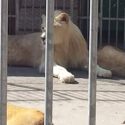
Help us get a lion called Sultan out of his prison!

Help us get a lion called Sultan out of his prison!

Help us get a lion called Sultan out of his prison!
21.06.2018
France
Help us get a lion called Sultan out of his prison!
Exploitation for shows

Sultan is being held by a circus in the worst conditions of his life. One Voice is fighting to save him before captivity takes his life.

How long has he been suffering this ordeal? How long has he experienced each second of each day in this living hell? Sultan, an eight-year-old lion in full strength, is imprisoned by William Zavatta in unbearable conditions.

Deprived of a lion’s life

Out of sight, locked away in a small truck which is sometimes covered over and with no contact to the lionesses, this handsome male lives his life alone, often in the dark. Deeply alone. Motionless or trapped in stereotypical movements. His trainer represents his only contact with the outside world. Completely at his mercy, his entire existence is reduced to nothing but emptiness.

How can such suffering be imposed on an animal that, in the wild, would spend its days roaming a vast territory of up to 100 square kilometres? How can one cut this lion off from the contact of his own kind, a feline by nature who is extremely sociable? Lions need to live together for their stability. The size of their groups can reach forty individuals in the wild! Sultan, he has nothing and no one to occupy him in his life. He therefore sinks further into despair.

From isolation to the commotion of the parades

Absolute cynicism: His only « outings » take place in the summer, during the time of the circus parades, to announce the shows. Very roughly, his jailers suddenly shoo him from his loneliness and darkness to brutally expose him to the hubbub of the horns, yells and booming music, while the sound of the trucks carrying animals is prohibited … Nearly falling to the floor with each press of the brake pedal, Sultan appears in the vehicle, completely haggard. What a gloomy « spectacle » of this noble beast, broken by humans, used to gain the public, what a stressful and frightening experience for him.

Sultan calls for help

Crushed in this way, Sultan could give up and die. But despite the horror of his meaningless daily life, Sultan is still resisting. One Voice has witnessed it. In the evening, sometimes, from his tarpaulin truck, from the depths of the darkness, a heart-rending cry escapes. He calls out! He calls us to his rescue! Since 2016, our association has already filed a complaint twice for ill-treatment in order to save him. But nothing has changed, justice is too slow! We do not abandon it. Today, we make Sultan’s voice sound even louder by launching a massive campaign on his behalf. Join us in this action to obtain his release from the circus William Zavatta and to have him moved to a sanctuary. His only hope of a dignified life, of a free life, of a full life, is in our hands and yours.

Please sign and share the petition!

Little Boy, young Cane Corso stabbed and impaled on a branch: trial on June 20th

Little Boy, young Cane Corso stabbed and impaled on a branch: trial on June 20th

Little Boy, young Cane Corso stabbed and impaled on a branch: trial on June 20th
20.06.2018
Bethune
Little Boy, young Cane Corso stabbed and impaled on a branch: trial on June 20th
Domestic animals

Rejected from all sides, abandoned several times, without anyone to love him, Little Boy, a young dog Cane Corso, had already experienced many disappointments with the human race. He was coldly murdered by people he trusted. Our Cell Zoe will be at the court of Bethune for him on June 20th.

Editorial: 

On Wednesday, June 20th, the court adjourned the hearing to July 9th, 2018.

That day, Little Boy was tied up. Then, the blows began to rain down, he was stabbed several times, gutted and impaled on a tree where he was abandoned, still whining. His identification chip was removed, but fortunately it was not enough … And his terrible journey was traced.

Locked most of the time on the balcony, the daily life of Little Boy was only solitude. In four years of existence, humans have never been faithful to him, he went from one owner to another, given away by ad on the internet, without ever a person of confidence to finally bring him the protection, the security and the love he needed.

On the day of his death, did his torturers act on orders from his owners who had already tried to get rid of them? Did Little Boy happily believe in a welcome stroll, a break from the balcony to which he was assigned, or did he sense the danger and was terrified. He followed his torturers reluctantly? Still, they premeditated their gesture, since they took with them two knives when they took the dog. The two or three men, it remains to be determined, they reject each other’s blame. The record of this massacre still contains many inconsistencies and grey areas.

What happened to Little Boy is torture!

Living with a dog entails responsibility. It is not an accessory that you can get rid of or dispose of at your leisure. Not being able to bring him what he needed, and above all, to have considered then proceeded with his assassination, they must be severely punished. What happened to Little Boy is torture! The people who killed him must be judged with all necessary force!

We will be on June 20th at the trial, our Cell Zoe will defend the memory of Little Boy and claim justice for him in court.

We are fighting to have the “link” recognized by the law

Some of the people involved had already been reported for violent behaviour, this cannot continue, these people are proven to be a danger to the whole of society.

We recently renewed our appeal to the Justice Ministry to highlight the link between violence, whether the victim is human or animal, in order to change the law in this area.

Madame la Garde des Sceaux, @NBelloubet @justice_gouv, nous vous écrivons de nouveau car les #violences perpétrées sur #animaux familiers doivent être punies très sévèrement du fait de leur lien fréquent avec les #ViolencesDomestiques. Il est temps de changer la loi! pic.twitter.com/6A8SDgU0wO

— One Voice (@onevoiceanimal) 7 juin 2018

Please sign our petition to support us in this fight.

Pictures: © DR (France 3 Hauts-de-France)

Silence, lies, and betrayals: Welcome to the world of captivity and ministry.

Silence, lies, and betrayals: Welcome to the world of captivity and ministry.

Silence, lies, and betrayals: Welcome to the world of captivity and ministry.
15.06.2018
Antibes
Silence, lies, and betrayals: Welcome to the world of captivity and ministry.
Exploitation for shows

During discussions prior to the writing of the 2017 decree that led to the prohibition of reproduction of captive cetaceans, they seemed to have accepted the way of History. Beautiful words were spoken. But their attack of the decree, cancelled on technicalities, gave them a new breath. Five months after the cancellation of the so-called « dolphinariums » decree, where are we now? Despite our insistence and yet perfectly informed, the ministry does not seem to take the measure of the problem. But playing for time is making animals pay more and more!

Lies and not keeping to your word

Jon Kershaw, director of Marineland Antibes, June 8th, 2016, before the Minister of Environment represented by the Director of Water and Biodiversity during the discussions prior to the writing of the decree called « dolphinariums » Ending the breeding of captive cetaceans had shown his commitment:

Regarding the holding and displaying to the public of killer whales, it noted that the 4 orcas currently present in the establishment will no longer reproduce and that no new animals will be introduced in this establishment, which means that the activity of public display of killer whales in France will end with the death of the next animal. Because it had been recorded in previous meetings that a group of orcas must consist of ‘at least 3 animals‘. Now Marineland refuses to answer our mail about orcas!

The Beauval zoo had meanwhile undertaken the same day, in the person of Rodolphe Delord, its director, and in front of witnesses, to abandon his dolphinarium project at Beauval. The minutes of the work meeting at the ministry state this in black and white: « The Beauval Zooparc had a project of building a dolphinarium which would have been a new generation one and which had been presented to the President of the Republic during his visit on September 11th, 2015, unfortunately the management of this establishment decided to abandon this project, under the pressure from social networks.  »

The Minister of Ecology, meanwhile, did not hesitate on September 19th, 2017 to respond to one of our deputies: « the captive detention of cetaceans, and in particular the participation of these animals in shows, raise many ethical issues … the prohibition of the detention of cetaceans in captivity by the ministerial decree of May 3rd2017 should not be questioned. […] The economic impact of the ban on cetacean captivity will therefore be moderated, in the light of the progress that this ban will have on animal welfare. In the coming months, new processes of reflexion with regards to animal welfare will be initiated, involving parliamentarians, ethologists and philosophers. “Has this changed? Five months after the cancellation of the so-called « dolphinariums » decree, where are we now?

Silence of the ministry

In order to request a new decree resuming from where the precedent had stopped, the Council of State having cancelled this one on technicalities, we seized several times Nicolas Hulot and his cabinet. We did so ourselves in March 2018 by mail and on several other occasions as well as by other means (emails, tweets …), as representatives of the Dolphinaria-Free Europe coalition, and also together with our partners La Dolphin Connexion, Network-Cétacés and Sea Shepherd. But he has not answered.

This basic work can only be done if you have someone to talk to. Since we find the door closed, we are forced to act on other fronts. The majority of the population agrees with us, we must save these animals from these prison worlds.

Faced with a wall, we are more determined than ever

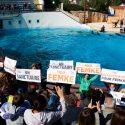
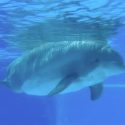
We are pressing charges in order to obtain the release of Femke, whom, when we visited her, deeply worried us. She lets her deformed body float without vitality, and remains facing the wall for hours in the day. She has had little contact with other dolphins since Ekinox, her only son, was taken away from her. Sign our petition for her.

As for Aïcko, he did not have the chance to get out of it, his life was so early interrupted… We will reveal to you very soon what he suffered during his last moments of his life, and the reasons for his death. For all those who remain captive, sign our petition to end dolphinariums!

Captive cetaceans are put into hopeless, desperate, and tragic situations. The previous minister had fully measured the scale of the issue. We therefore appeal to the Council of State against the implicit refusal of the present Minister to issue a new order prohibiting the possession of any new cetacean specimens. Sign our petition, demand a new order! Enough is enough, dolphins and orcas do not have the luxury of being able to wait for months and months on end!

Keijo, a son from incest

Keijo, a son from incest

Keijo, a son from incest
12.06.2018
Antibes
Keijo, a son from incest
Exploitation for shows

Keijo, son from incest between brother and sister, was rejected by his mother. Then he was the helpless spectator of the deaths of many of his companions in misfortune. His future will not be bright if he remains captive.

Keijo is a male killer whale born in Marineland on November 20th, 2013. His mother Wikie and his father Valentin. That makes him a consanguineous child at 12.5%, since Wikie and Valentin were half-sister and half-brother.

Incestuous relationships, observed only in the pool, remain a major problem for most large marine parks. Taku, at SeaWorld Orlando, impregnated her own mother Katina, who gave birth to Nalani in 2006. At Loro Park, Kohana was fertilized twice by her uncle, then she refused to take care of her children. Under these conditions of promiscuity and captivity, how do we educate the little ones? The mothers seem helpless. Is it the same for Keijo?

In any case, we could see Wikie pushing him away from the side of the pool with the help of Moana. It was, as the delphinarium assures, to exercise the orca on the slide-out manoeuvre, that deadly posture where the cetacean runs itself aground on command. Rather, it seems that Wikie had some difficulty accepting her second son, who arrived too early after the birth of the first, which would not have happened in the wild.

Like Moana, Keijo is eager to learn, and he learns quickly. But the intellectual challenges that one asks of him are limited and repetitive. He has already lost the excitement of childhood by banging on the windows, and the flood of October 2015 certainly marked his memory like a hot iron. The first pictures shot just after the disaster showed him very close against the side of Wikie and his half-brother Inouk, in a small black water pool, while the dead body of Valentin had just been washed away. All this, like the agony of Freya, Valentin’s mother, the two little ones saw it. They will not forget it.

However, a site promoting zoos dared to write about the birth of Keijo:

“On 20th November 2013, a new orca infant was born for the second time from the efforts of Wikie at Marineland Antibes. His father is unknown, but there is a strong suspicion that it is his half-brother, Valentin. This brings the number of orcas in captivity to 53, and with the recent addition of 8 wild orcas captured in Russia, as well as the female Morgan, saved by the Dolfinarium of Harderwijk and 2 babies born remotely by the orca Kshamenk this year, the future of these animals in captivity is radiant”.

Oh yes, radiant …

One Voice in action on 9 June in Auxerre against the biggest French breeder of dogs that are destined for the laboratories

One Voice in action on 9 June in Auxerre against the biggest French breeder of dogs that are destined for the laboratories

One Voice in action on 9 June in Auxerre against the biggest French breeder of dogs that are destined for the laboratories
07.06.2018
Auxerre
One Voice in action on 9 June in Auxerre against the biggest French breeder of dogs that are destined for the laboratories
Animal testing

The One Voice association lodged a complaint against the intensive breeding of dogs in Mézilles in the department of Yonne. Saturday June 9, from 2.00pm to 4.00pm, One Voice organizes a rally in front of the prefecture of Auxerre to demand the closure of the CEDS, the largest French dog breeding provider for laboratories. The same day at 2.00pm a delegation will be received by the Chief of Staff of the Prefect of Yonne.

One Voice was authorized to use a bailiff who was able to undertake findings in the ECSR on 24 May. Following his report, he lodged a complaint against this farm for ill-treatment and lack of care. The association also requires that all the dogs must be handed over to the bailiff.

The breeder requires the Prefecture to endorse an increase in its capacity which is already effective

The Breeding Centre of the Domaine des Souches (CEDS) is asking the State for permission to expand its reception capacity, while it has already exceeded the maximum capacity that is allowed.

A complaint for lack of care and ill-treatment

It is apparent from the report of the bailiff that females are used for breeding each time they are on heat until they are seven years old. On that day, the keepers were clearly understaffed as the report mentions only three keepers were on site. Only one keeper is there at night, but does not watch the animals. So, when the females give birth, how can they benefit from assistance or care in case of complications? Once born, the puppies live locked up with their mother in the same concrete box for 12 weeks, the only « comfort » expected: a plastic bin and sawdust on the ground. There is no trace of any games or other means of isolation for the mothers.

After two months, the puppies are weaned, separated from their mothers, and grouped in the « storage area », where there no « no playground » is planned: nature is absent, except behind the fence. Those who survive are sent to laboratories as early as 10 months of age. When females can no longer reproduce, they suffer the same fate. The complaint of One Voice reports many failings.

The Law and the people demand less cruelty and animal testing

The Beagles and Golden Retrievers are dogs chosen to supply the laboratories applying animal experimentation protocols because they
are soft and docile. Since 2016, the quantity of dogs used in the laboratories is increasing. When we know how much they are protected by French law, it makes one imagine what sort of life there is for rabbits, hamsters, mice…

And yet, 83% of French people are in favour of stopping animal testing (IPSOS survey for One Voice December 2016).

The European regulation is clear on the subject, it makes it explicit in the form of the 3R rule: Reduce, Replace, Refine. Member countries of
the European Union must replace animals with alternative research methods (computer simulations, stem cells, etc.), refine tests to make them less painful, and most importantly, reduce the number of animals used. The state must therefore finance the search for alternative methods when they do not exist, and scientists have the duty to implement these methods when they exist.

Consistent with these provisions, One Voice calls for the closure of this French breeding facility, instead of its expansion and is supported in this process by more than 40,000 people. These supporters have all signed the petition over a six-week period after its posting on One Voice’s website. Many associations make up the main European coalition in this area, the ECEAE, European Coalition to End Animal Experimentation, who support One Voice – of which we are the French representative. The local collective « Let’s close the CEDS » who is also in solidarity with this action.

Saturday June 9 at 2.00 pm, the association will be received by the Cabinet Director of the Prefect of Yonne, the assembly will leave after this
appointment.

We are at your disposal for any further information and will be available for any interview at request until 1:30 pm on the day of the meeting, or after 3 pm that same day.

Photograph taken from the complaint filed with the Attorney General of Auxerre

Share on

Four dogs and two cats killed by gunshots!

Four dogs and two cats killed by gunshots!

Four dogs and two cats killed by gunshots!
06.06.2018
France
Four dogs and two cats killed by gunshots!
Domestic animals

Six victims. Six innocent deaths, six violent deaths and a terrified family. This is the result of a fit of anger. Against this man is the threat that he could do it again – and against whom? – One Voice pressed charges. We will be in court in Laon on Thursday, June 7th.

The constant death threats, and the blackmail of suicide, had kept the whole family alive for many years. The unstable and violent sexagenarian, sickly jealous, found it easy to insult. This hunter was an imposing figure, with gun in hand, reproaching his son and grandson for being too present in his life and being « shits ». To put pressure on his relatives, he also threatened the animals, of which he acted on…

On April 4th, 2018, he killed four dogs and two cats by shooting them in the head. He then called his ex-wife to threaten her with death and rushed home, then after firing at the door he fled! Violence is blind, she does not choose her victims. Who will be next to perish by his hand? This is what worries the relatives of the defendant, who testified to being afraid that he will « finish what he started » while leaving custody.

Our campaign, so that the “link” existing between the violence exerted against humans and against animals is recognized in France. It appears again in this example the meaning of this link.

It is urgent that the law take into account the danger that these people represent for the whole of society, and are proactive in preventing them from continuing to harm!

Our Cell Zoé has pressed charges of wilful harm on a pet (six in this case), and demands an exemplary sentence during the hearing that will take place in Laon on June 7th.

You too must act to ensure that this link is criminally recognized and that vulnerable people, whether animal or human, are properly protected. Please sign our petition.

Moana a child from a syringe

Moana a child from a syringe

Moana a child from a syringe
04.06.2018
Antibes
Moana a child from a syringe
Exploitation for shows

Moana, the first orca that was born by artificial insemination in Europe suffered the rejection of his mother. His sister has been sent thousands of miles away, they cannot play together anymore. His life is one of boredom and obedience and with surrogate parents …

Moana is a male killer whale born in Marineland Antibes on March 16th, 2011. His mother is Wikie and his father is Ulises, a wild orca captured in Iceland and held at SeaWorld in San Diego, California.

Moana was the third orca in the world to be born by artificial insemination, and the first ever in Europe. It is unclear whether this mode of reproduction, still experimental, will one day affect the health of this infant. The trainers say he is smart. This means for them that by the age of one year, Moana had already performed a range of forced movements, which most orcas only learn later, after long years of training. He had understood everything just by looking at his mother. And we understand his enthusiasm to do well!

$(document).ready(function(){ $(‘.diaporama’).bxSlider(); });

In the closed, confines of the world where he is forced to live, within this glass jar without any rocks, any seaweed or any fish where he has been turning around and around in circles since his birth, the slightest distraction is worth its weight in gold. One would fight to be able to repeat those human words over and over again, not unlike a scratched record. Such is the life that is imposed on Wikie, so much boredom weighs heavy on the this big pool where under the heat of the midday sun live these big black fish with the sadness in their eyes.

Moana was very independent very early. Too early perhaps, because very quickly his mother left the trainers the burden of his education.

In 2013, the small orca with a hopeless future became the older brother of Keijo, a baby clearly neither desired nor expected. A year later, his half-sister Amaya was born from the same father as him. But he will never have the happiness of playing with her, since she is was taken thousands of miles away, to the pools of San Diego.

KANGAROO, the interview

KANGAROO, the interview

KANGAROO, the interview
03.06.2018
France
KANGAROO, the interview
Wildlife

We are organizing the first two venues of the documentary « Kangaroo, a love-hate story » in France. This is the exclusive interview of its directors, Mick McIntyre and Kate McIntyre Clere and Pr. Peter Singer who shed light on this issue.

How was this project born? What was the trigger?

Kangaroos are one of the most recognizable symbols in the world and have always held a fascination for us. No film had explored this icon before. We set out to make a story that celebrated this magnificent animal but soon discovered that the kangaroo was at the heart of a bitter, complex and divided situation in Australia. We were shocked to learn that millions of kangaroos are shot each year as so-called pests and sold for profit. To find out where it started and why it still happens today, we needed to investigate the origins of an industry and government partnership, which has become the largest wildlife slaughter in the world. Where had the ideology come from that a native animal that has lived in Australia for millions of years could be a national problem? How and when did Australians start believing kangaroos were a pest and therefore must be eliminated?

«One of the worst elements is the treatment of the joeys — when the mother is shot, they often die slowly. Sometimes they are not in the pouch at the time, and hop away into the dark (kangaroo shooting usually takes place at night) and then they often die of thirst or starvation. »Pr Peter Singer

How many kangaroos die every year? You say the number of kangaroos isn’t growing, in opposition with your government’s assessment, why?

One of the biggest issues we faced in making this film was examining the population figures that the Australian government published every year about how many kangaroos there are. So we had to unpack the survey methodology that the government uses to get those numbers. No surprise we discovered how flawed the methodology is and so we got expert testimony in how inflated the govt estimates are.We learnt that the govt has been using these inflated figures as a way of abdicating responsibility for the conservation of the kangaroo. On the subject of how many are killed we discovered that with the growth of the commercial kangaroo industry, so-called pest mitigation, recreational and illegal shooting, as well as road-kill and other accidental / collateral death, there is still very little data collected of the number of kangaroo deaths that occur daily. Some scientists and conservationists are reporting both local and regional extinctions. They don’t know how many are being killed.

What reasons do the Australian government give to consider kangaroos as pests?

When Australia was colonized by white settlers 230 years ago, the kangaroos were killed as meat for eating, but as sheep and cattle herds grew over the next 100 years, many people stopped eating them, though they were still frequently killed for sport. It didn’t take long before the white settlers began to see kangaroos as competing with their stock for feed, and damaging their crops. Later, when ecosystems collapsed from overstocking of introduced livestock, the farmers blamed the kangaroos for the damage, and decided they needed to be removed from the landscape; the Australian government facilitated this, labelling them as noxious species, and paying out millions in bounties. The idea that kangaroos are seen as a pest has continued through to the present day.

«Animals may cause some loss to humans, of course, when they eat the crops we plant, or in the case of kangaroos, when they reduce the amount of grass available for cattle or sheep. But they are never simply a pest. They are also sentient beings with lives of their own to lead, and we should find better means of limiting their numbers and living alongside them.
The Australian government isn’t doing enough to protect its wildlife at all. They are too influenced by the graziers. »Pr Peter Singer

Why most of the killing is taking place at night in secret?

In filming KANGAROO we found that over time that the killing of kangaroos as so called pests had been replaced by killing millions of kangaroos for profit. The killing is government sanctioned and the shooting is done in the dead of night often miles from anywhere. There is no onsite monitoring of the killing. As kangaroos are nocturnal marsupials they are active at night and therefore shooting them in vast numbers is easiest at this time; they are also very vulnerable to the spotlight hunting method, often turning to face the light. Permits are sought to remove kangaroos from the landscape for many reasons from agricultural, land clearing for development and other human events. Although codes of practice have been developed for farmers and shooters to reduce cruelty, in many cases this is impossible to police, and research has found that non-compliance is widespread. We had whistleblowers come forward and give us first hand eyewitness accounts of the brutal treatment of kangaroos and their young joeys.

Which country or continent imports the most kangaroo products? What are they?

The largest importers of kangaroo parts are in Europe. They import kangaroo meat for pet food, meat for human consumption and skins for fashion and sports goods. The key importers for meat products are Belgium, Germany, Netherlands and France.

Are there farms that raise kangaroos for this?

No kangaroos are a wild animal that cannot be farmed. This is a wildlife slaughter.

In which conditions did you film? Was it dangerous?

For so many reasons this was an uncomfortable movie to make. Probably because its an uncomfortable issue. Most pople are shocked when they find out what is going on with the kangaroo – every night ! To find out the mass scale on which kangaroos are hunted was definitely alarming and to witness these mass shootings was traumatic. Witnessing first hand the treatment of joeys and the wounded animals dying slow deaths was disturbing. There was definitely some situations where it was more of a men’s business situation, shooting kangaroos at night, out in the wilderness. It was essential to have some strong guys on our team.

How did you choose the locations to film? How long did you film and where?

To produce « Kangaroo, » we had to travel thousands of kilometers across the magnificent red dusty Australian outback. As kangaroos are spread across the country we filmed in many national parks and farms (some as big as 300,000 acres) capturing images of the landscape and ecosystem of the kangaroo. The kangaroo themselves are shy herbivores so filming them is challenging  so it took many trips to get enough filming done. We were told by famers that we could film the ‘plagues’ of kangaroos that are so often propagated in the Australian media but after 4 years filming we never came across this.In fact we were shocked by how few kangaroos we found. We also filmed in the countries who are involved in the import of kangaroo parts, like the UK and The Netherlands, we also filmed in countries that have banned the import of kangaroo parts like Russia who have banned importing kangaroo meat due to meat hygiene and California where they have a blanket ban of importing any kangaroo parts. We wanted to give the audience a comprehensive picture of what is happening to the kangaroo globally.

Who did you interview for the movie and why? What is their input?

We knew we would have to immerse ourselves in all aspects of the story and we worked to get interviews from the many differing stakeholders. We interviewed indigenous Australians, scientists, commercial shooters, farmers, politicians, artists, wildlife carers, chefs and activists
Key to the telling this story was investigating the details behind the largest wildlife slaughter in the world, to find out where it all started and why it still happens today.. We uncovered many people who have a strong emotional connection to kangaroos juxtaposing many different opinions on their status as wildlife and their « management » as pests.

«As an Australian, I have been involved with animal issues in Australia for more than 40 years, so i am familiar with the enormous scale of the kangaroo slaughter in this country, and also with the fact that many kangaroos do not die instantly. I want to see this brought to an end, so I welcome a film that exposes how kangaroos are treated in Australia. »Pr Peter Singer

What will the audience take away?

With breathtaking footage of kangaroos in the wild, we hope this film will give the audience an up-close experience of this unique species and bring to the table a conversation that Australians seem reluctant to have. It’s time that people in Australia and across the world know what is going on with this internationally celebrated icon and ask the question: Why is no one responding to this barbaric treatment and wholesale slaughter?«We need to foster attitudes of respect for all animals, and give more consideration to their interests.

Please ask your government not to permit the import of products made from kangaroos: meat, fur, or leather. And of course never buy these products yourself. »Pr Peter Singer

Tickets for the venues of Paris (5th June 2018) and of Strasbourg (6th June 2018) can be purchased in advance.


Picture Credits: Cover: Hoping Pictures (Kangaroo Dundee, Mick McIntyre & Kate McIntyre Clere / Peter Singer by Aletta Vaandering